
History · The American Wagon
A brief history of the American wagon.
From the Pennsylvania-Dutch Conestoga to Charles Goodnight's chuck wagon, from the Studebaker empire to the Concord stagecoach — a quick tour through the wagons that built America.
Hero photograph: Newbold Hough Trotter (1827–1898), photographed by Ad Meskens. Public domain
The Conestoga.
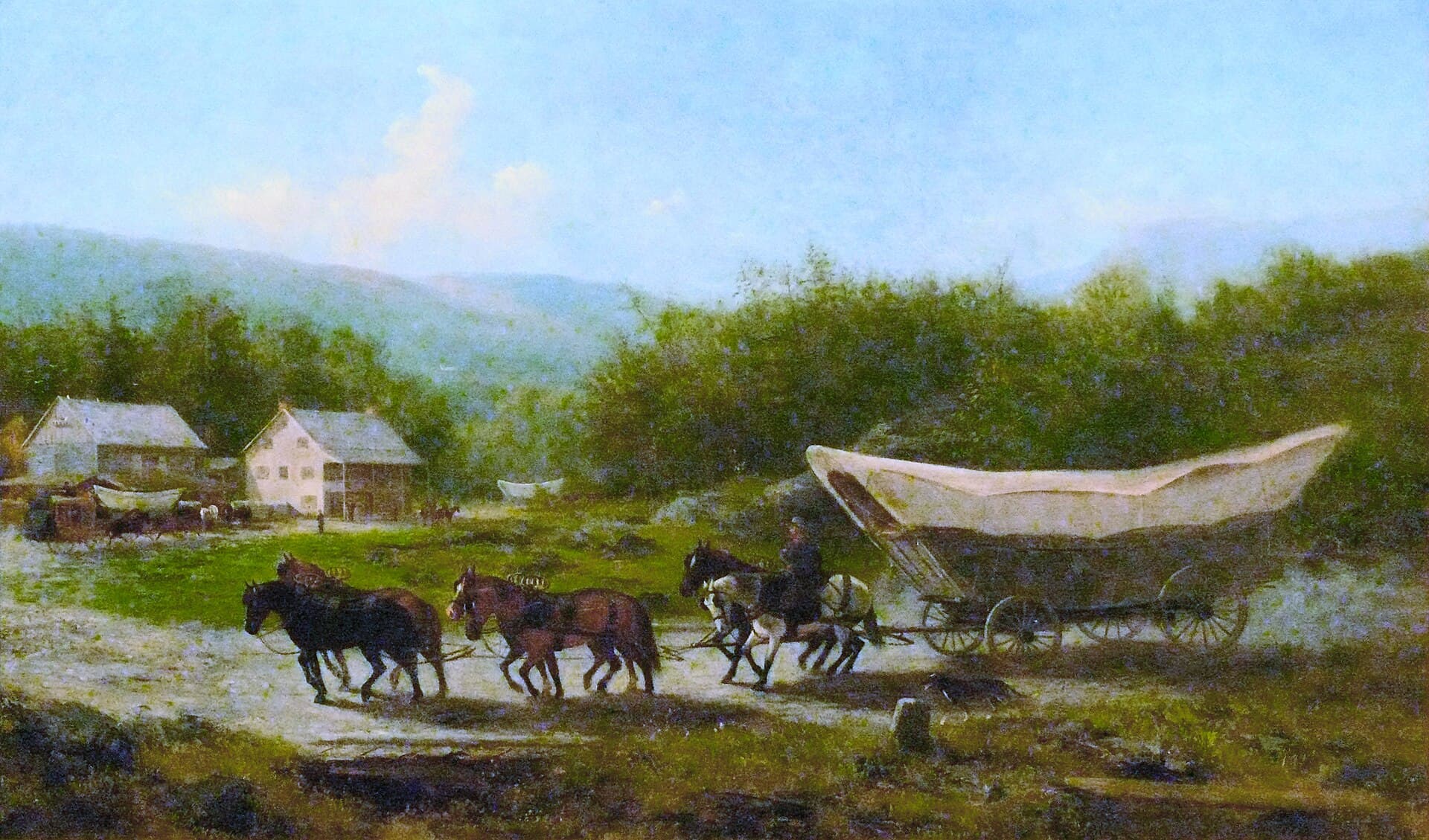
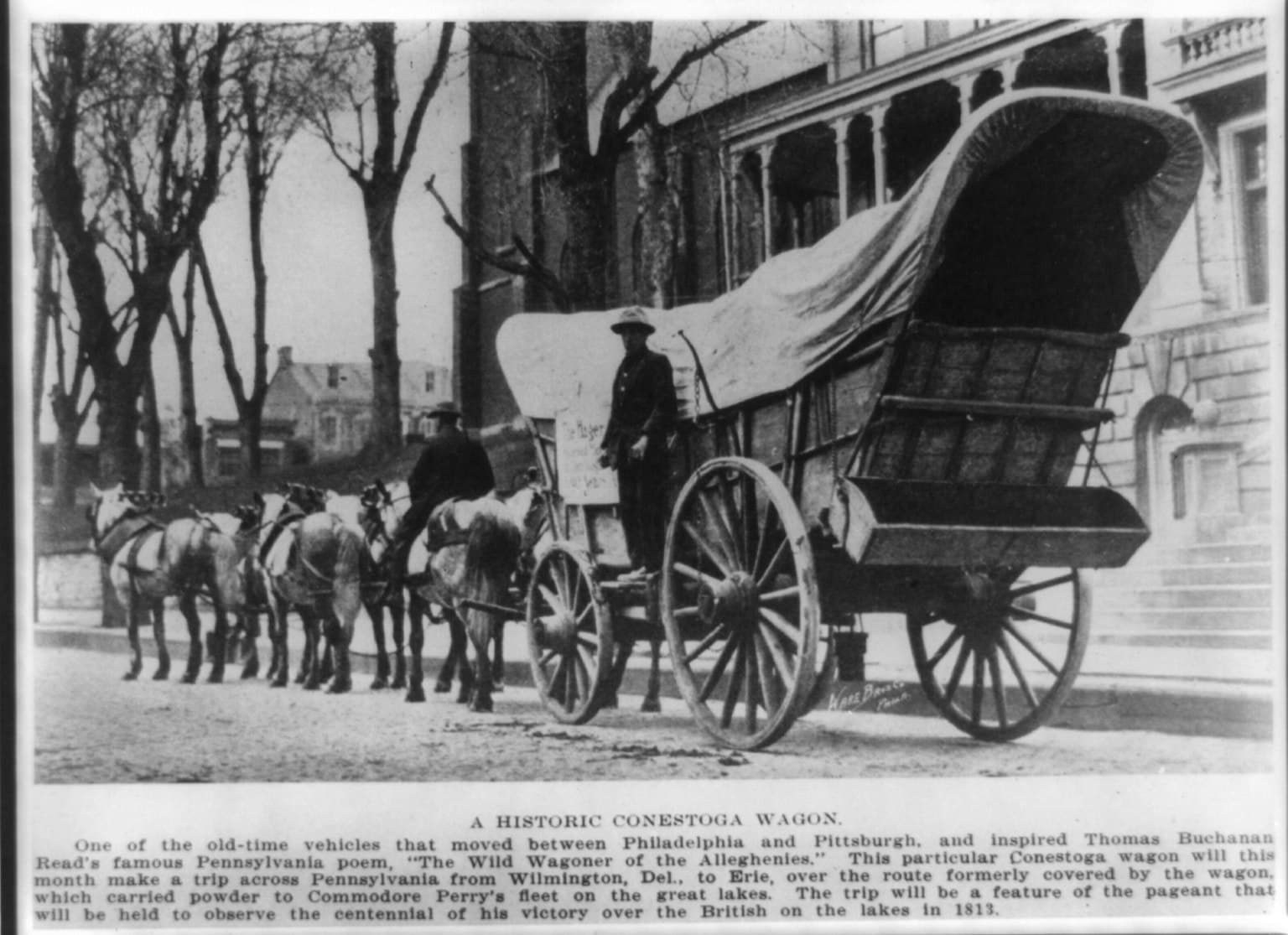
The Conestoga came out of the Conestoga Valley in Lancaster County, Pennsylvania, around 1717 — built by Pennsylvania-Dutch (really German) wheelwrights and blacksmiths who needed something stout enough to haul grain, whiskey, iron, and furs over the rolling country east of the Susquehanna. By the 1750s it had grown into the freight hauler of the colonies. A loaded Conestoga could carry six tons. Six tons. On wooden wheels, pulled by four to six horses bred specifically for the work — the Conestoga horse, a breed since lost to the ledger of extinct American livestock.
The bed was the giveaway. It was shaped like a shallow boat, swept up at both ends, so that as the wagon climbed and dropped along the ridge roads of the Appalachians, the load would slide toward the center instead of out the tailgate. Linseed-oiled canvas stretched over hickory bows kept the weather off. The running gear and ironwork were painted Prussian blue, the box red — the famous "blue Conestoga" tradition that travelers spotted miles off across a hayfield. Some say the blue came from milk paint and indigo; others, from a German pigment habit carried over from the Rhineland. Either way, a Conestoga on the road looked like nothing else.
The Pennsylvania-Dutch detail.
The Conestoga Valley sits east of the Susquehanna, in what is now Lancaster County — rolling limestone country, deep topsoil, cold winters and humid summers, the sort of land that grows hickory straight and oak slow. The Pennsylvania-Dutch — Germans and Swiss, most of them Mennonite or German Lutheran — had been moving into the valley since the 1680s under William Penn's open invitation, and by the 1710s they had cleared farms, built bank barns, and started turning out the wagons that would carry their grain to Philadelphia market. The wagons took the name of the valley. So did the horses, and so did a creek, a town, and eventually a stretch of road.
The blue paint is worth a paragraph of its own. The pigment was Prussian blue — a synthetic compound first made in Berlin around 1706 and cheap enough by mid-century to find its way into a country wheelwright's paint pot. The German shops in Lancaster used it on undercarriages and ironwork because it weathered well, sat dark against the red box, and read across a field. Some wagons carried hex signs on the toolbox lids — six-pointed stars, tulips, distelfinks — in the same vocabulary the Mennonite and Lutheran farmers were painting on their barns. Half decoration, half tradition. The signs weren't magical (that's a tourist-era invention) but they were a maker's pride, and a shop that signed its toolboxes signed its work.
The Conestoga also carried one quiet piece of standardization that most people miss. The wheel track — the distance between the wheel ruts — settled around four feet eight inches across most Lancaster shops. That measurement carried west along the National Road, got picked up by the early American railroads, and became the standard gauge that still runs under most freight in this country today. The wagon shaped the rail. Not the other way around.
The form's high tide was short. The Conestoga was at its peak between roughly 1780 and 1840 — the great age of the National Road and the Philadelphia-to-Pittsburgh wagon trade. By 1850 the railroads had reached out past the Alleghenies and the heavy long-haul freighter was already an obsolete machine east of the Mississippi. The shape survived in pieces — the bowed canvas, the hickory bows, the iron strap-work — but the six-ton ridge-road freighter that the Lancaster shops had spent a century perfecting was, by then, mostly a memory heading west in the lighter prairie schooner.
Why the wheels dished out.
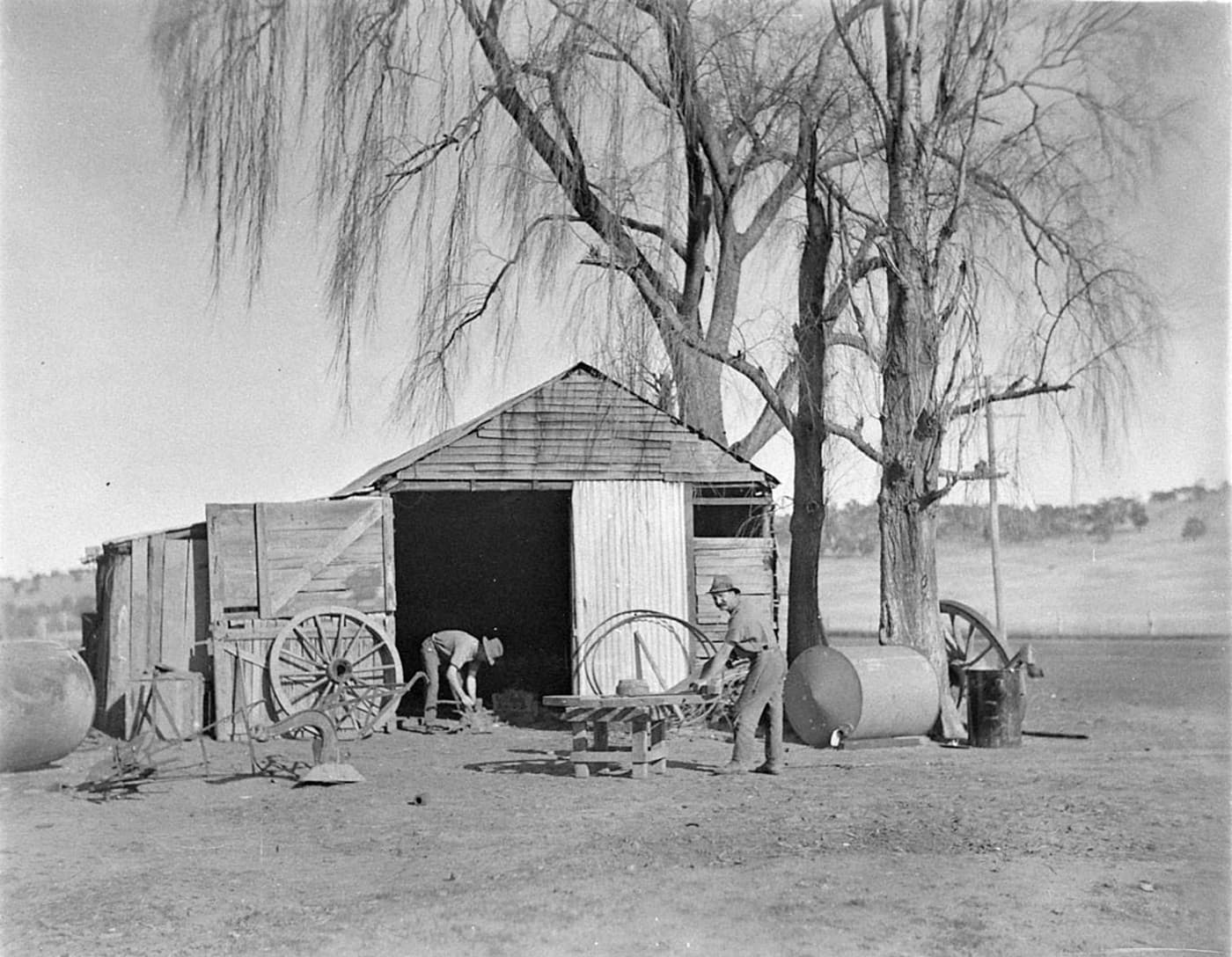
Look at a good wagon wheel from the front and the spokes don't sit flat — they fan outward from hub to felloe like a shallow cone. That outward dish wasn't a style choice. It was engineering. A horse walking in harness sways the wagon side to side with every step, and a flat wheel would try to walk itself off the axle on every roll. A dished wheel, set on a slightly downward-canted axle, plants the lower spokes vertically — straight up and down — at the moment they bear the load. The spoke becomes a column. Wood is strongest in compression along the grain, and the dish turns the wheel into a rolling truss.
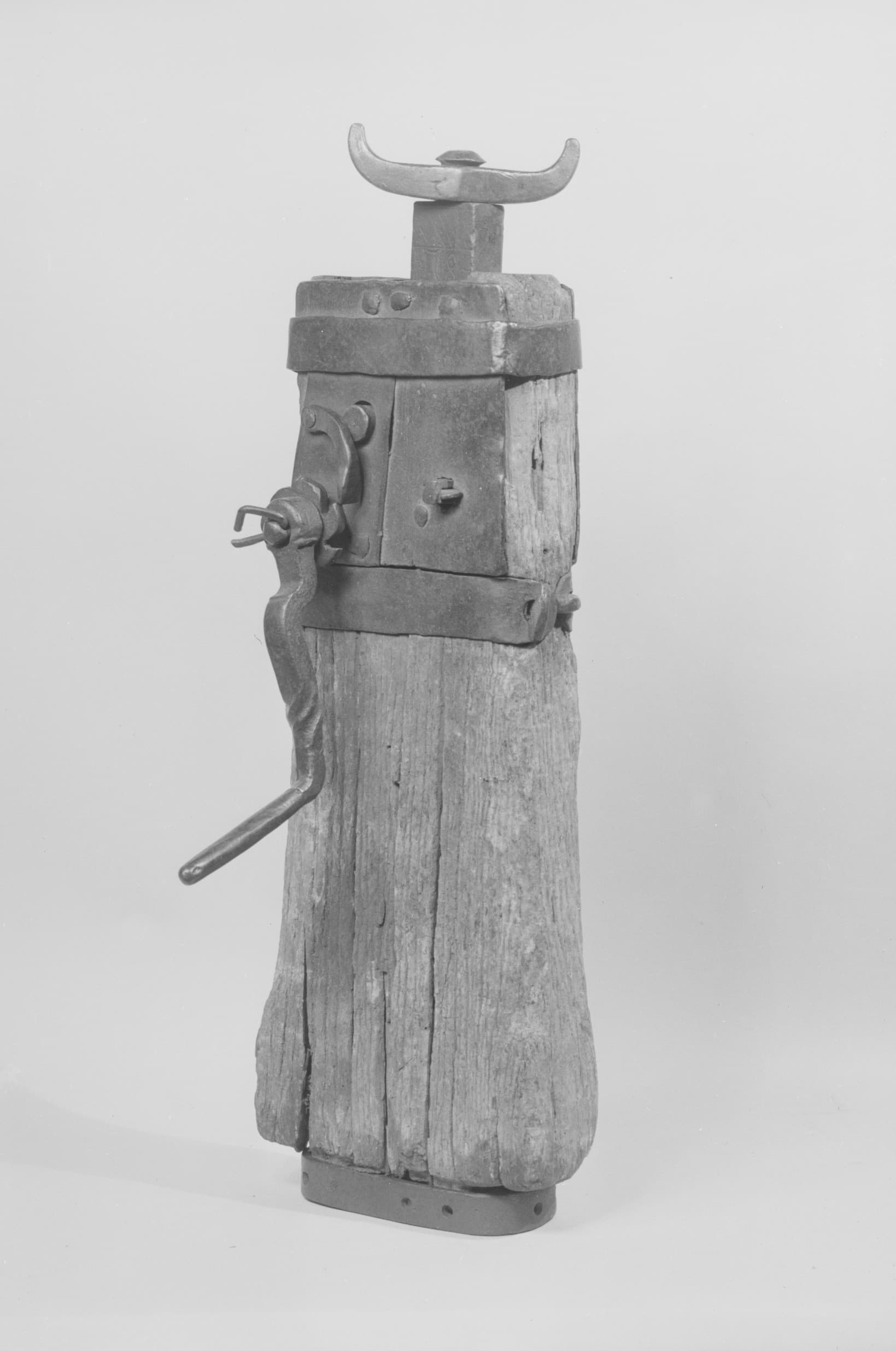
The iron tire was where the wheelwright proved his trade. A blacksmith forged a flat band of wrought iron a hair smaller than the wooden rim, heated it cherry-red in a ring fire until it expanded, then dropped it over the wheel and quenched it. As the iron cooled it shrank — pulling every joint in the wheel tight against itself. Felloes locked to spokes, spokes seated into the hub, the whole thing drawn up into one stressed assembly. "Shrink-fitting," they called it. Done right, a wheel set this way would run a generation. We still do it the same way at the shop — see how wagons are built and the lost art of the trade.
The Prairie Schooner.
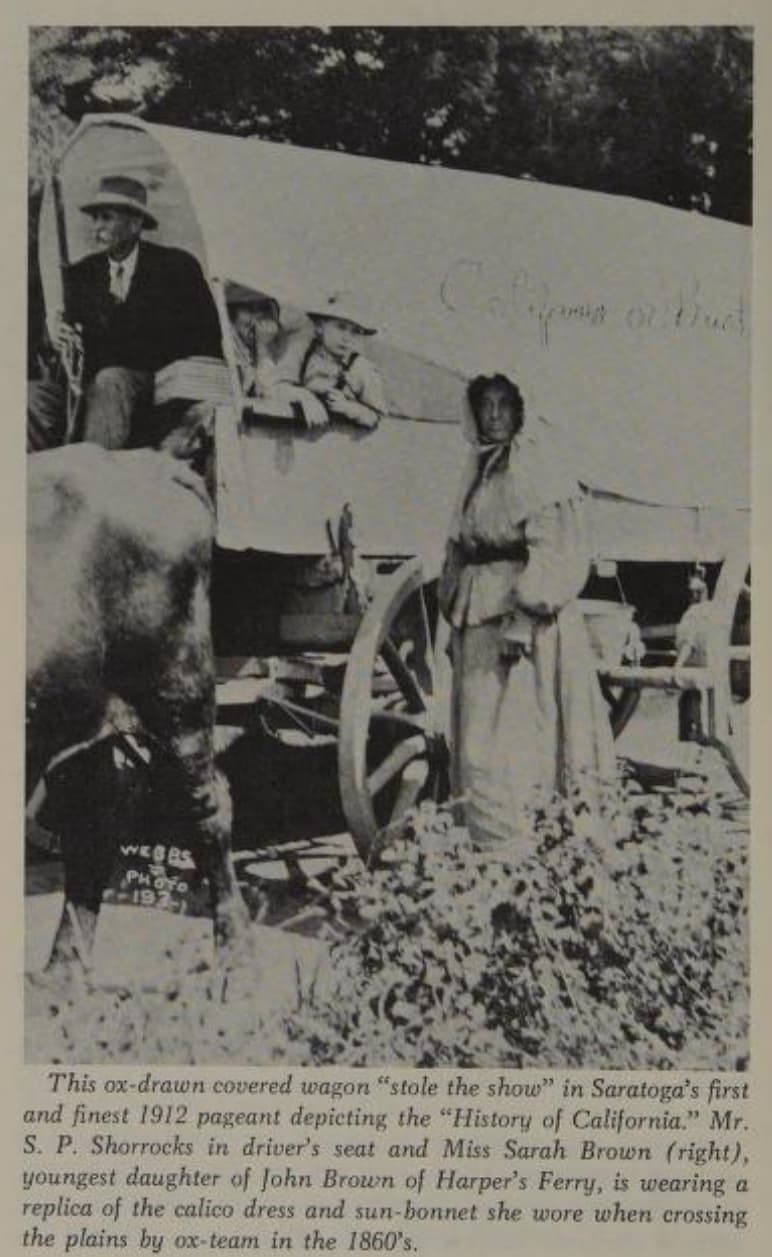
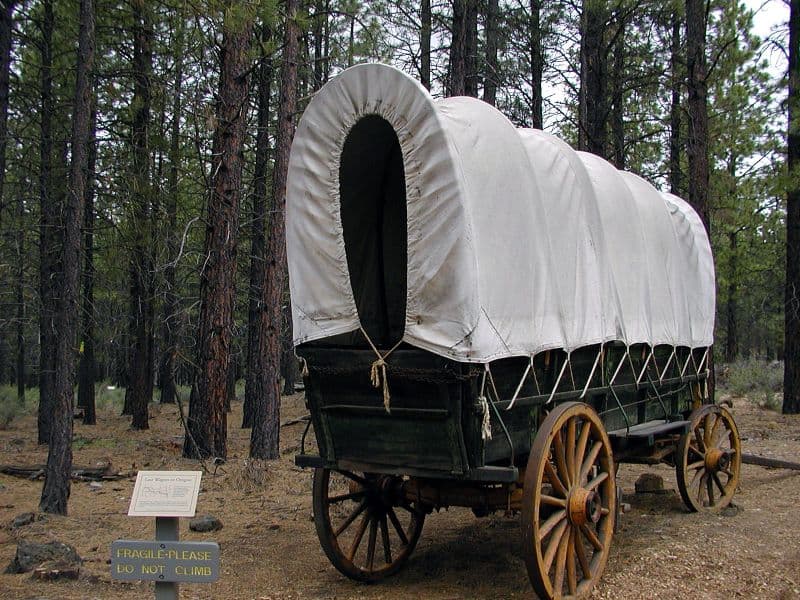
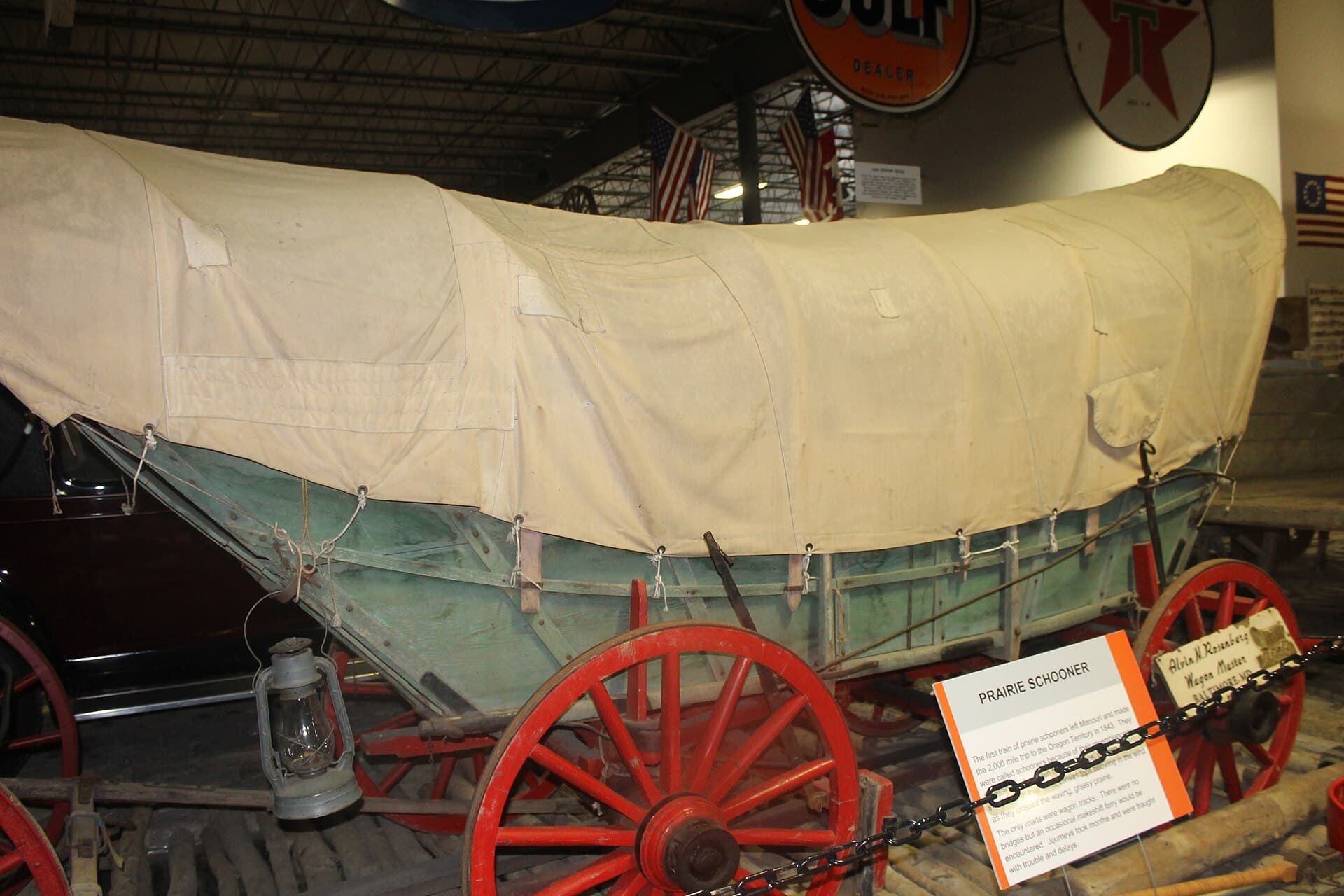
The Conestoga was a freighter. It was too heavy and too tall for a family with everything they owned and a team of oxen that hadn't eaten a square meal since Independence, Missouri. So the emigrants shrunk it. The prairie schooner — sometimes called the emigrant wagon — was lighter, lower, narrower, and built around a flat bed about four feet by ten. The bows stayed. The canvas stayed. The boat shape mostly went away, because the plains weren't the Alleghenies. The name came from settlers cresting a swell of prairie grass and watching a line of white-topped wagons drift across the horizon like sails at sea.
Between 1841 and the late 1860s, somewhere around half a million people walked — not rode, walked — alongside these wagons up the Oregon Trail, the California Trail, the Mormon Trail, and the Santa Fe Trail. Oxen pulled most of them. Slower than mules, but tougher, cheaper, and you could eat one if it came to that. The wagons averaged fifteen miles a day in good country and a tenth of that in bad. They threw axles, broke tongues, burned tires loose in the dry heat, and got patched in camp with whatever was at hand. Every river crossing was a small disaster waiting to happen.
Studebaker — South Bend, Indiana.
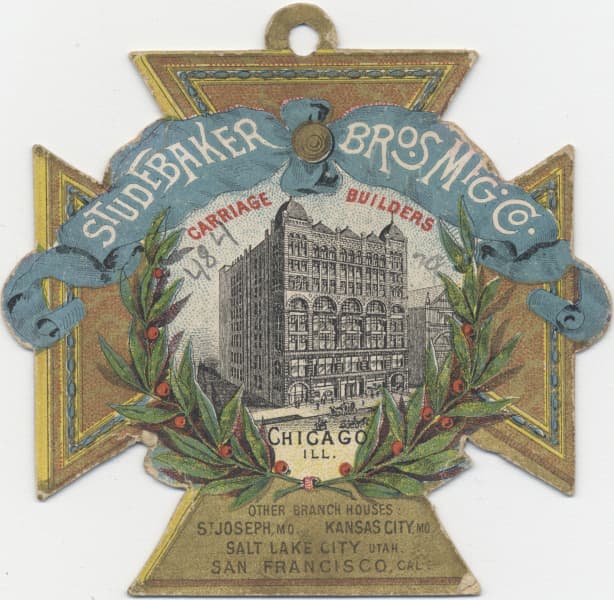
Two brothers, Henry and Clement Studebaker, opened a blacksmith and wagon shop in South Bend in 1852 with sixty-eight dollars between them. They built two wagons their first year. Within a decade they were supplying the Union Army. By the 1880s the Studebaker Brothers Manufacturing Company was the largest wagon and carriage maker in the world — sixteen acres under roof in South Bend, kiln yards full of seasoning hickory and white oak, a forge shop you could hear from a mile out.
Their farm wagon, the freight wagon, the chuck wagon kit, the buggies, the surreys — Studebaker built them all and shipped them on rail cars to every state and a fair number of foreign countries. Ranchers in Texas ordered Studebakers by the trainload. The brothers paid cash for hickory they liked and turned away timber they didn't. Quality was the whole pitch. The slogan — "Always give a little more than you promise" — was John Mohler Studebaker's, and he meant it. When the automobile came, Studebaker pivoted into cars and lasted until 1966. The wagon side closed in 1920. Sixty-eight years from first wagon to last.
The Studebaker dynasty in full.
The number is worth saying again because it sounds like a misprint: sixty-eight dollars. That is what Henry and Clement Studebaker had between them when they hung out their sign in South Bend in 1852 — a blacksmith shop on the corner of Michigan and Jefferson, two forges, an apprentice or two, and the brothers' time. They built two wagons in their first year of operation. They shod horses, fixed plows, and turned out ironwork for whoever asked. It was a country smithy with ambition.
The Civil War scaled them. In 1857 a third brother, John Mohler Studebaker — fresh back from five years building wheelbarrows for gold miners in Placerville, California, where he had saved eight thousand dollars in coin — bought into the firm and put his California money on the books. When the War Department came calling in 1861, the Studebakers were one of the few wagon shops in the country with the cash on hand and the bench depth to take a Union Army contract at scale. They built wagons for the Quartermaster Corps through the whole war. By 1868 the firm had reorganized as the Studebaker Brothers Manufacturing Company and added two more brothers — Peter and Jacob — to the masthead. Five Studebakers, one company.
The growth from there was steady and a little astonishing. By 1875 they were shipping wagons by rail to every state west of the Mississippi. By 1885 they had moved into the sixteen-acre South Bend works that the photographs always show — the kiln yards, the paint shops, the steam-driven trip hammers, the dry-house where hickory and white oak sat seasoning for years before a spoke was turned. By the turn of the century the firm employed roughly four thousand people in South Bend alone and was, by most measures, the largest wagon and carriage maker on earth. The catalog was a small book: farm wagons, freight wagons, log wagons, mountain wagons, mining wagons, dump wagons, buggies, surreys, phaetons, broughams, hearses, ambulances, circus wagons, and a chuck-wagon kit for outfits down in Texas.
The automobile pivot started in 1902, when the firm built an electric runabout. Gas-powered Studebakers followed in 1904. For almost twenty years the company built both — wagons in one set of buildings, automobiles in another, painted in the same shops by the same hands. The wagon line finally closed in 1920. The auto line lasted forty-six more years. Studebaker assembled its last car in South Bend in December 1963, ran the Canadian plant in Hamilton, Ontario until 1966, and then closed for good. From a sixty-eight- dollar smithy in 1852 to a shuttered auto plant in 1966 was one hundred and fourteen years. Five generations of one family, two technologies, and most of the working life of the American wagon.
A note on the family itself. The Studebakers were Pennsylvania-Dutch, originally — the name in the old country was Studebecker, and the family came over from the Solingen region of Germany in 1736, settled in Pennsylvania, and moved west through Ohio before landing in Indiana in the 1830s. Five generations of blacksmiths before Henry and Clement opened the South Bend shop. The trade ran in the bones. John Mohler, the brother with the California money, was a Dunkard — a German Baptist Brethren — and ran the firm on Dunkard principles: no debt, cash for materials, pay your workers on Saturday, and never ship a wagon you would not buy yourself. The firm survived the Panic of 1873 and the Panic of 1893 without laying off its core crew, largely because of the cash discipline John Mohler insisted on. That was unusual for a manufacturer of that size in that era, and it is a fair part of why Studebaker outlasted its competitors when most of them — Owensboro, Bain, Mitchell, Moline — either folded or got rolled up into International Harvester by 1915.
The Chuck Wagon — Charles Goodnight's invention.
In 1866, Charles Goodnight was about to push a herd of longhorns up from Young County, Texas, on what would become the Goodnight-Loving Trail — across the Pecos and on into New Mexico and Colorado. A trail drive meant ten to fifteen men out of camp for three or four months. They needed to eat. Goodnight bought a surplus Army wagon — by most accounts a Studebaker — and had a carpenter rebuild the back end. What he bolted on was a stout cabinet with a hinged tailgate that dropped down on a chain to become the cook's worktable. Inside: drawers and pigeonholes for flour, beans, coffee, sourdough starter, dried fruit, salt pork, tin plates, a Dutch oven or two, a coffee grinder bolted to the side.
Underneath the bed rode a water barrel and a possum belly — a stretched cowhide slung between the axles where the cook stashed firewood and dried cow chips for the next dry camp. That was the chuck wagon. Goodnight didn't patent it. He didn't need to. Within a few seasons every outfit on the Chisholm Trail, the Western Trail, and the Goodnight-Loving had one. The cook — "Cookie," or sometimes less polite — was the second-highest-paid man in the outfit after the trail boss, and the chuck wagon was rolling kitchen, infirmary, paymaster's office, and post office in one. Texas named it the official state vehicle in 2005.
 Covered wagon · High Desert Museum
The Buckboard.
Not every wagon needed to haul six tons. Most of country life — running into town, checking a fence line, taking the kids to church — needed a light, fast, cheap rig. The buckboard was the answer. A flat plank floor lashed directly to the front and rear axles, with no springs — the long flexing plank itself was the suspension. A simple bench seat up front, a singletree, and one horse in harness. That was it.
Buckboards were the pickup trucks of rural America from about 1850 to 1920. Cheap to build, cheap to fix, light enough that a stuck buckboard could be lifted out of a bog by two men leaning on the wheels. The name came from the way the floorboards "bucked" — flexed up and down — when the wheels hit a rut. Every farm had one. Every country doctor had one. The Sears, Roebuck catalog sold them mail order for under thirty dollars.
The Stagecoach — the Concord coach.
The classic American stagecoach — the one in every western ever filmed — was built by the Abbot-Downing Company of Concord, New Hampshire, starting in 1827. The Concord coach was a passenger vehicle, not a freighter, and it sat on something stranger than springs: thoroughbraces, which were thick straps of bullhide leather slung lengthwise under the body. The coach swung fore and aft on those straps like a boat at anchor. Mark Twain rode one across the plains in 1861 and called it "an imposing cradle on wheels." That's exactly what it was.
Wells Fargo bought them by the hundreds. Butterfield Overland Mail ran them from St. Louis to San Francisco — twenty-five days, twenty-four hours a day, swapping six-horse teams every twelve miles or so. The classic Concord seated nine inside and as many as a dozen more on the roof, and weighed about twenty-five hundred pounds empty. Painted, striped, lettered in gold leaf. Abbot-Downing built somewhere north of three thousand of them before the trade died.
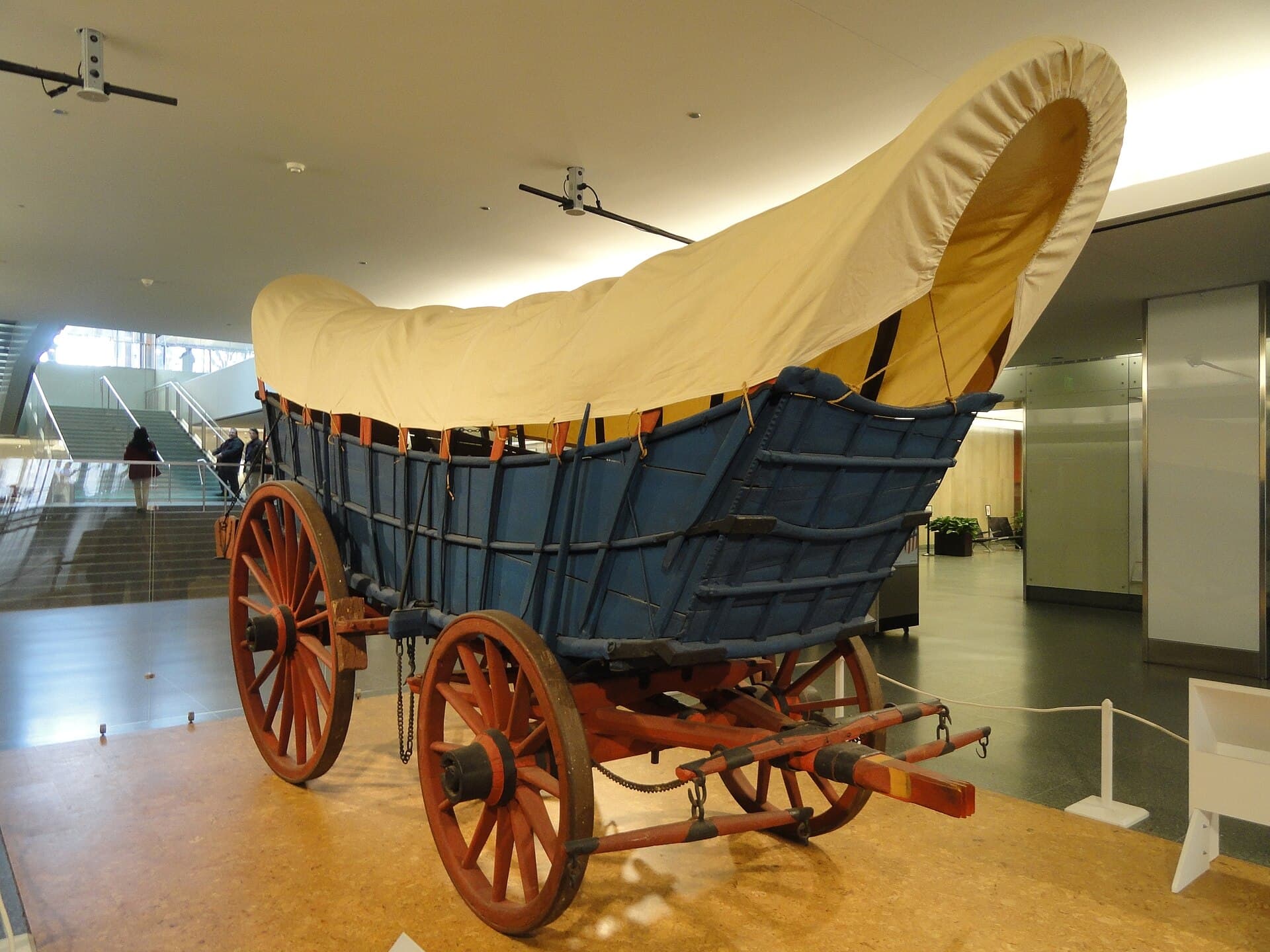 Conestoga, c.1840–1850 · National Museum of American History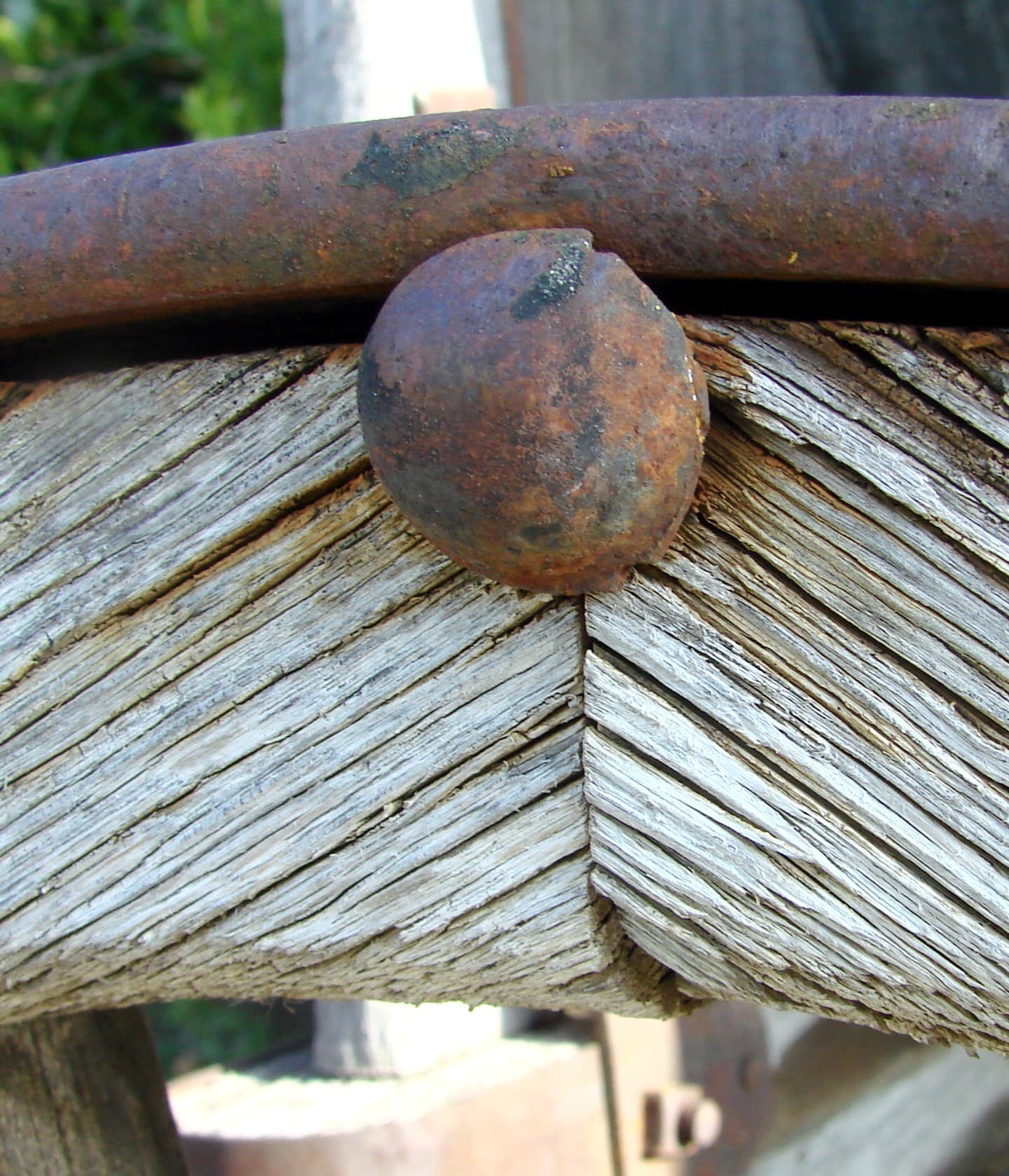
The Concord coach in detail.
Lewis Downing was a wheelwright. He opened his shop on South Main Street in Concord, New Hampshire in 1813 and built wagons and chaises for fourteen years before he hired a body-maker named J. Stephens Abbot away from a Salem coachworks in 1827. The two of them put their first stagecoach together that year. Within a decade Abbot, Downing & Co. — eventually just Abbot-Downing — was the most respected coach builder in the country, and the Concord coach was a form. Not a model. A form. Any nine-passenger leather-sprung coach built to the Concord pattern was a "Concord," regardless of who built it.
The genius of the thing was the thoroughbrace. Instead of steel springs — which were expensive, brittle on rough roads, and tended to snap at the worst moments — Downing slung the body on two long straps of bullhide leather, three and a half inches wide, six to eight plies thick, running fore-and-aft from heavy iron jacks at each corner of the running gear. The body hung in those straps like a cradle. Instead of jolting up and down over a rock, it swung forward and back. Passengers got seasick on bad roads. Horses didn't get their shoulders pounded into the collar on every bump. The straps could be replaced in an afternoon by a country saddler. The whole suspension cost a fraction of steel and lasted longer in the heat and dust of the West.
The price in the 1860s ran about twelve hundred dollars for a standard nine-passenger coach, fully painted and lettered, delivered to the rail depot. Twelve hundred dollars was a lot of money — about what a skilled tradesman made in two years — but a Concord that was cared for would run twenty years on a hard route, and Wells Fargo kept a fleet of them in the hundreds. The standard livery was English vermilion on the body, straw yellow on the running gear, with gold-leaf scrollwork and a landscape panel on the door painted by an in-house artist named John Burgum. No two doors were the same. Burgum signed his work on the inside of the door panel.
The cost to ride one was steep too. The Butterfield Overland Mail — St. Louis to San Francisco, twenty-five days through-passage, no stopping — charged two hundred dollars one way in 1858, meals and rough sleep at swing stations included. The shorter coastal runs were cheaper. San Francisco to Portland on the California Stage Company in the early 1860s ran about sixty-five dollars and took seven days. You sat on a leather seat with eight other people, your knees in someone else's, and you stopped only to swap teams. The roof was the cheap seat, ten or fifteen dollars off, and you held on. Abbot-Downing built somewhere around three thousand of these coaches between 1827 and 1899. The shop closed in 1928, after a last few years building motor-truck bodies on the same benches that had once turned out the Wells Fargo fleet.
The construction was as serious as the suspension. The body framing was ash, mortised and pinned, with poplar panels worked over a steam- bent form and held with iron banding. The wheels were hickory spokes in elm or oak hubs with iron tires, dished and shrink-fit on the same principle the country wheelwrights used on a farm wagon, only heavier — front wheels around three feet ten, rear around four feet eight, the difference letting the front pair tuck under the body on a sharp turn. The brake was a heavy lever working a wooden block against the rear tire. The driver sat up top with the express messenger beside him, a strongbox under their feet, a long whip in one hand and the reins of six horses laced through the fingers of the other. There is a reason the job paid well and the men who held it tended to be remembered by name.
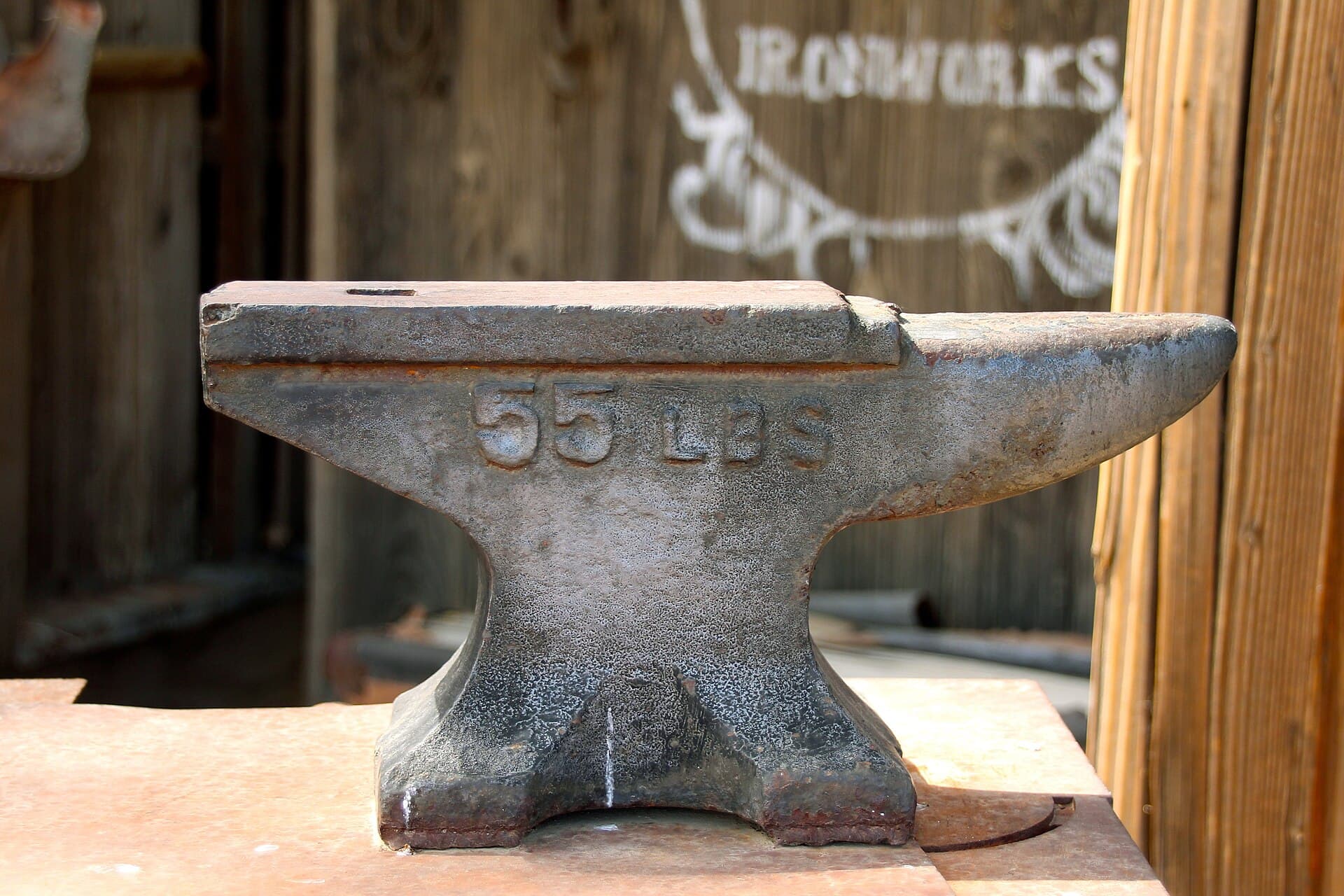 Blacksmith forge · anvil at rest · what our shop looks like
The Texas dimension — trails, teams, and feel.
From roughly 1867 to 1884, Texas pushed somewhere between five and ten million longhorns north — most of them up the Chisholm Trail to Abilene, Wichita, and Dodge City, the rest up the Western Trail to Ogallala or out west on the Goodnight-Loving. Every herd had a chuck wagon. Most had a hoodlum wagon too, hauling bedrolls and spare gear. Behind the herd came a remuda of a hundred saddle horses and a wrangler — usually the youngest hand — to keep them moving. The wagons were the spine of the drive. If the wagon broke, the drive stopped. There are stories of a trail boss riding two days back to the nearest settlement to find a wheelwright with a spoke the right diameter, and stories of cooks rebuilding a hub under a wagon by lantern light because there was no other choice.
The classic Texas freight team was six mules — leaders, swing, wheelers — driven by a single jerk-line by a man walking alongside. Mules over horses because mules drank less, ate worse, and didn't spook at a rattlesnake. The wheelers, the two biggest mules nearest the wagon, did most of the braking and starting; the leaders did most of the thinking. A good teamster could "feel the load" — read the grade and the surface and the mood of the team through the jerk-line and the singletrees, and know without looking when a wheel had started to wobble or a tug had come slack. That feel is the thing nobody can write down. You either get a chance to learn it from someone who has it, or you don't. More on Texas wagon work in our Texas heritage piece.
What killed the trade — the long version.
The death of the American wagon trade happened in two stages, not one, and the gap between the stages mattered. The first stage was the railroad. The transcontinental line met at Promontory Summit in May of 1869, and within a decade the long-haul wagon freighter east of the Mississippi was finished. A single freight car carried what ten loaded Conestogas could carry, moved at twenty miles an hour instead of two, and didn't have to stop for water or to fix an axle. By 1880 the great wagon roads — the National Road, the Santa Fe Trail freight track, the Oregon-California freight branches — had gone quiet. The stagecoach lines collapsed first. Wells Fargo shifted its express business to the rails by 1869 and was effectively out of the coach business inside ten years. Abbot-Downing kept building, but for shorter routes — county seats, mining camps, the last places the rails hadn't reached.
The wagon makers themselves had a longer reprieve, because the railroad didn't kill the local hauling trade. A Kansas farmer still needed a wagon to get his wheat to the rail depot. A Texas ranch still needed a chuck wagon. A country doctor still needed a buggy. That short-haul, last-mile work kept the wagon shops in business for forty more years. Studebaker, Owensboro, Bain, Mitchell, Moline, Springfield — the big shops kept turning out farm wagons by the tens of thousands a year right up to 1910. The decade from 1900 to 1910 was actually the peak production year for American farm wagons. That is one of the strange counter-intuitive facts of the trade: the most wagons ever built in this country were built after the automobile had already been invented.
The second stage was the Model T. Ford put the Model T on the market in 1908, and within ten years it had reached the country roads. A Model T cost about three hundred dollars in 1915, down to two-sixty by 1925 — within reach of a farmer who would have spent eighty on a new wagon. The math wasn't close. By 1920 farm-wagon orders had collapsed. Studebaker built its last wagon in 1920. The smaller shops held on by repair work and by building specialty rigs — fire wagons, ice wagons, milk wagons, things that hadn't yet gone over to gasoline — but the line was sloping down hard. By 1925 most country wagon shops were closed. The shop owners moved into auto repair, or into hardware, or into nothing at all. The trade went quiet inside one working lifetime.
The transitional years are worth a moment of their own. Between roughly 1902 and 1920, Studebaker built wagons and cars in the same buildings, in the same town, with overlapping crews. A wheelwright who had spent twenty years dishing oak spokes could be moved over to fitting wooden wheels onto early Studebaker automobiles, which used wooden artillery wheels until the late nineteen-teens. The same hands that had built a Civil War supply wagon in 1862 — older men by then, sixty and seventy years old — were still on the floor when the first Studebaker gasoline cars rolled out the door. Then those men retired, and the knowledge mostly retired with them. The last generation of country wheelwrights — the ones who had learned their trade as boys in the 1880s and 1890s — was still working in scattered shops through the 1940s, mostly doing repair. When they went, the trade went with them, and almost nobody noticed at the time.
The auction notices from that era are some of the saddest documents in the American agricultural archive. A country newspaper from the 1920s will run a quarter-column on the back page: estate sale, the wheelwright's name, the contents of the shop offered Saturday at ten — bench planes, draw knives, spoke pointers, a wheel pit, a tire-shrinker, three forges, two anvils, the seasoning timber under the eaves. Most of those tools went for scrap iron or firewood prices. A few were bought by neighbors who knew what they were worth, kept in barns, and turned up sixty or seventy years later when the grandchildren cleaned out the estate. That is, weirdly, where some of the best surviving wagon-making tools in this country came from — not museums, but the back of a barn somebody never quite got around to clearing out.
Why the wagons disappeared.
Two things killed the working wagon. The first was the transcontinental railroad, finished at Promontory Summit in 1869. Once track reached a town, the long-haul freighter and the long-haul stagecoach were done — a railcar moved more freight than a hundred Conestogas at a fraction of the cost. The cattle drives themselves died for the same reason, between 1885 and the early 1890s — once Kansas and Texas had rail, you shipped beeves on the cars instead of walking them a thousand miles. The chuck wagon kept rolling for a while because the open range was big and the rails only went so many places, but the trade was shrinking.
The second was the automobile and the gas-powered truck. By 1920 Studebaker had stopped building wagons. By 1925 most farm wagons were sitting in fence corners. By 1940 most of them had rotted into the dirt or been cannibalized for firewood and barn lumber. A few ended up in museums. A few stayed in family barns out in the hill country and the Panhandle, axles rusted, canvas long gone, waiting for somebody to notice. That's mostly where the work comes from now: a great-grandfather's wagon, found in a barn, brought in to see if anything can be saved. Often enough, it can.
Covered wagon · High Desert MuseumWhat's left
The trade isn't dead. It's narrow.
There are working wheelwrights and wagon builders still in this country — not many, and most of them past sixty. The Library of Congress and the Smithsonian have good collections. Living history sites at Conner Prairie, Old Sturbridge, the Landis Valley Museum in Lancaster County, and the National Ranching Heritage Center in Lubbock keep wagons on display and sometimes in motion. Rodeo chuck-wagon races and chuck-wagon cook-offs in Texas, Oklahoma, and Wyoming keep the form working a few weekends a year.
Beyond the museums and the show ring, there's a quieter use case worth naming: wagons built or rebuilt for accessibility, for therapy programs, for kids and veterans who don't ride but want to be out among horses. That's a piece of the future of the trade. You can read more about where the shop comes from, or check the FAQ if you're sizing up a project of your own.
Further reading
Where the real history lives.
Most of what is in this article comes out of a small number of public collections that anyone can read, walk through, or write to. If the trade interests you, these are the places to start.
- The Studebaker National Museum in South Bend, Indiana — the firm's own archive, the carriage and wagon collection, and the production ledgers from 1852 forward. The best single source on the company and the trade it dominated.
- The Library of Congress Prints & Photographs Division — wagon-trail photographs, the Solomon D. Butcher collection of Nebraska homestead images, and the FSA archive that documented the last working wagons in the 1930s. All digitized, all free to use.
- The National Road archive maintained by the National Park Service and the state historical societies of Maryland, Pennsylvania, Ohio, and Indiana — the records of the first federal highway and the Conestoga traffic that ran on it from 1811 forward.
- The Wells Fargo History Museum network — stagecoach records, route maps, and an actual Concord coach on display in several of the company's branch museums in San Francisco, Sacramento, and Charlotte.
- The Landis Valley Village & Farm Museum in Lancaster County, Pennsylvania — surviving Conestogas, the wheelwright shop, and the Pennsylvania-Dutch farming context the wagon came out of.
The Workshop
The craft is nearly gone. We can keep it rolling.
Healin' Wheels is a Texas wagon shop just getting started — built around the old methods, the seasoned hickory, the shrink-fit iron, and the long quiet hours that a good wheel asks for. If any of this matters to you — a wagon to restore, a build to commission, a program to support — there's a phone number below and a person on the other end.