
Texas · Heritage
Texas wagon heritage. From the Chisholm Trail to the Houston Rodeo.
A century and a half of wagons in Texas — the chuck wagon Charles Goodnight invented in 1866, the Chisholm Trail drovers, the modern rodeo trail rides that still roll wagons into Houston every spring.
Hero photograph: Cullen328 (Wikimedia Commons). CC BY-SA 4.0
Charles Goodnight, 1866 — a kitchen that moved.
An army-surplus Studebaker, rebuilt with a drop table.
In the spring of 1866, on his ranch outside what is now Palo Duro, Charles Goodnight took a surplus Studebaker army wagon and rebuilt it into something the cattle business had never seen. He hauled it into the blacksmith's shed, pulled the bows off the back, and bolted a tall pine cabinet to the tailgate. The cabinet had drawers and pigeonholes for coffee, flour, salt pork, sourdough starter, dried beans, beef jerky, and the little tin of bicarbonate that kept biscuits rising.
What changed everything was the hinge. The face of the cabinet dropped down on iron brackets and became a flat work surface — a cook's table at waist height, in the middle of nowhere. The first real moving kitchen on the American plains. Goodnight called it the chuck wagon. Within five years, no Texas outfit moved cattle without one.
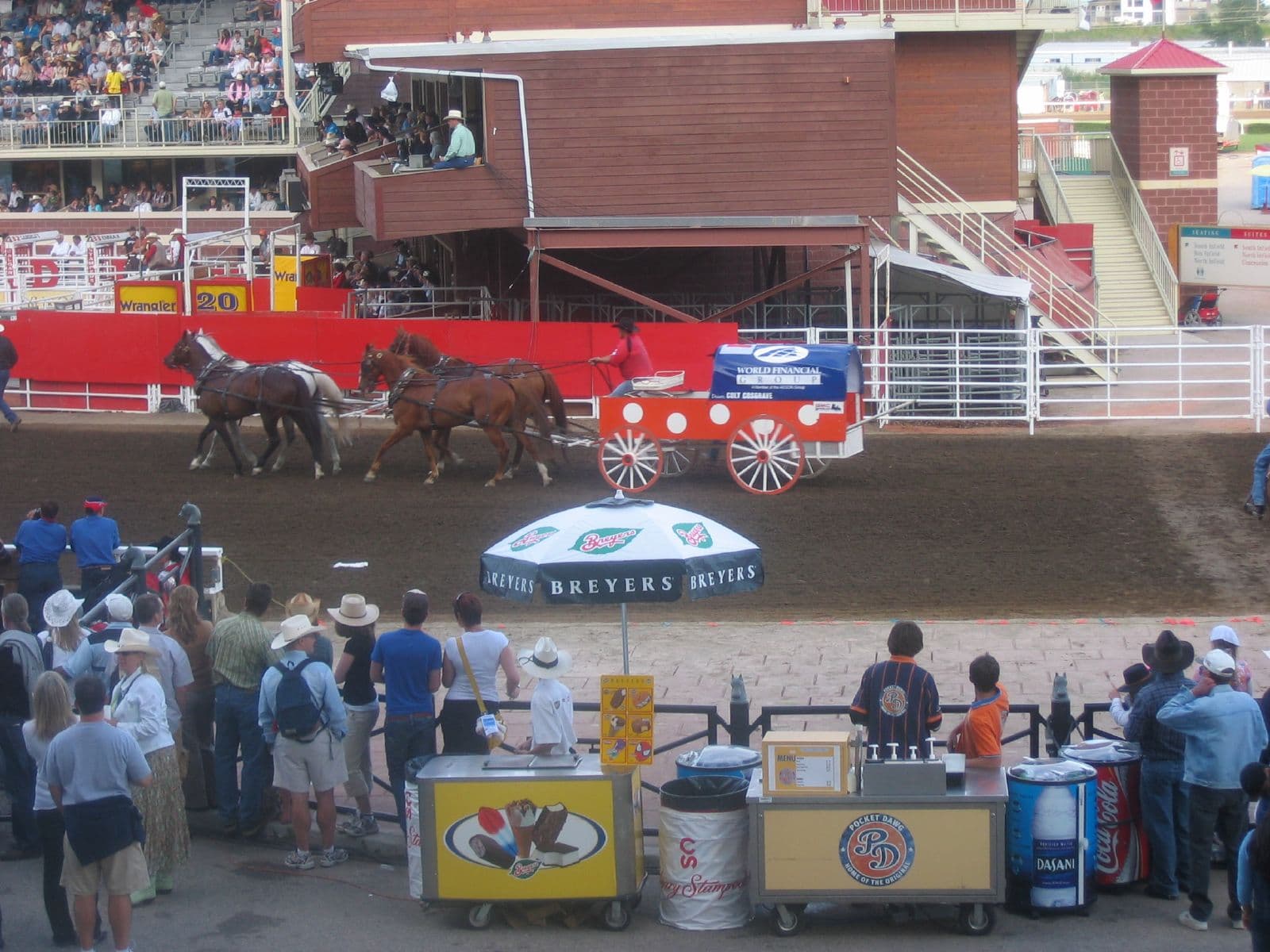
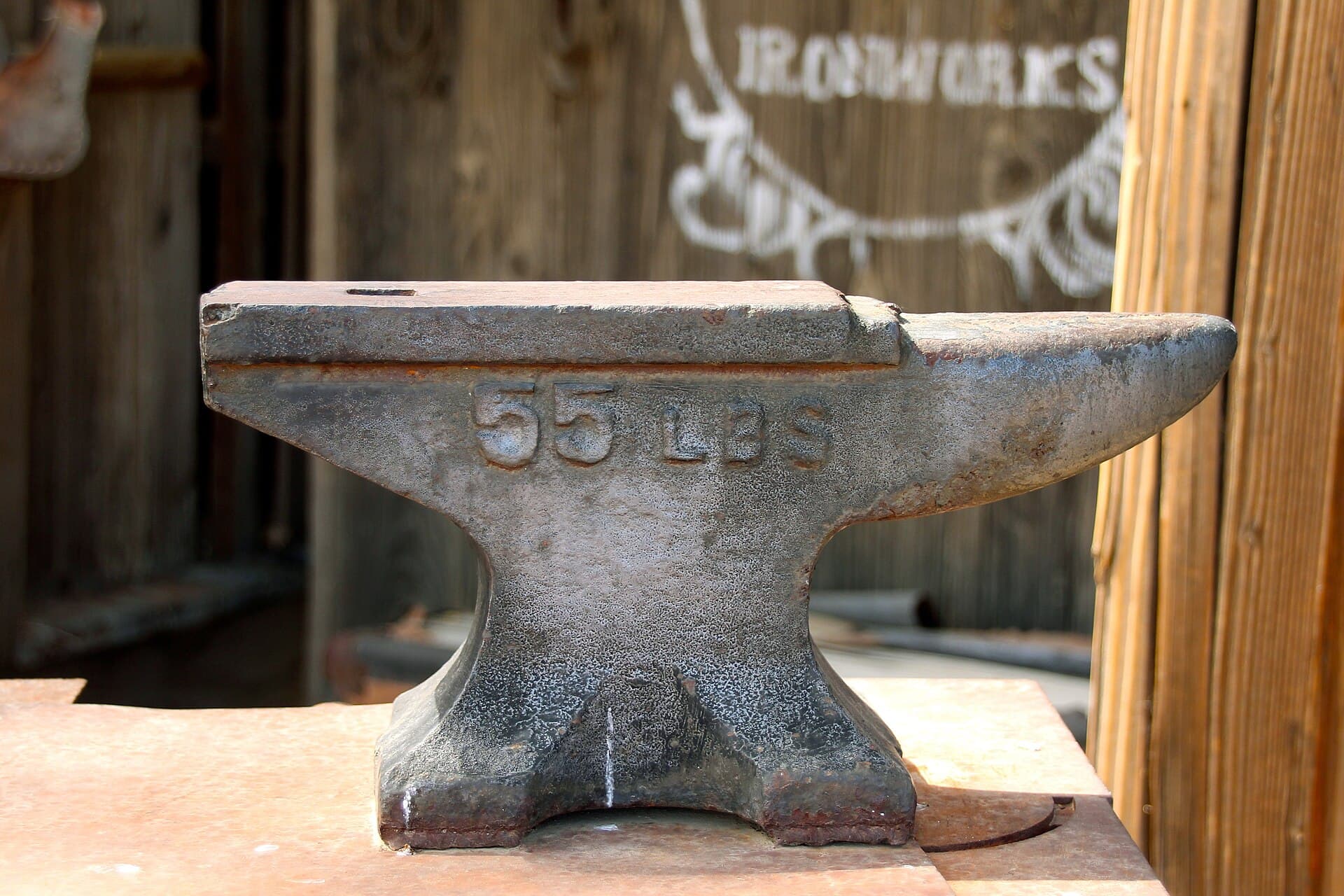 Blacksmith forge · anvil at rest · what our shop looks like
Cast iron, sourdough, and a barrel slung underneath.
The wagon carried a specific list. A cast-iron Dutch oven for biscuits and stew. A coffee grinder bolted to the side of the box. A water barrel slung beneath the bed, big enough for two days. A possum belly — a stretched cowhide hammock under the wagon — for kindling picked up along the trail. A jockey box up front for tools, horseshoes, and the cook's whetstone. And somewhere, always, a small crock of sourdough starter that the cook kept alive by the heat of his bedroll.
The cook himself had a title: cookie. On a trail drive, the cookie outranked everyone but the trail boss. He set the wake-up hour, picked the night's bedground by where he parked the wagon, and pointed the wagon tongue toward the North Star at dusk so the boss knew the heading before sunrise. You did not argue with the cookie. You did not, under any circumstance, tie your horse to his wagon.
The other rules were just as fixed. You did not ride in front of the wagon and kick up dust into the cook's work. You did not help yourself to anything in the chuck box without asking. You filled your plate, you stepped clear, and you brought the plate back to the wreck pan when you were done. The wreck pan was a galvanized tub by the rear wheel. A trail crew that respected the wreck pan ate well; a crew that did not was on cold biscuits inside a week.
The man, in plain biography.
Illinois boy, Texas Ranger, trail driver, rancher.
Charles Goodnight was born on March 5, 1836, in Macoupin County, Illinois — the same week, by accident of the calendar, that the Texas convention at Washington-on-the- Brazos was drafting a declaration of independence. He arrived in Texas as a boy of ten in 1846, the year after annexation, riding bareback on a white-faced mare behind his stepfather's wagon. The family settled in Milam County, then moved up to the Brazos. By fifteen he was working cattle on shares. By twenty-one he had partnered with his stepbrother on a small herd in Palo Pinto County and was already known as a man who could find water in country where there was not supposed to be any.
From 1857 to 1860 he rode with a company of Texas Rangers on the frontier line between the settlements and the Comanche country. He was a scout, not a fighter by preference, and his reputation was for finding trails, not making them. In December 1860 he guided the Ranger company that overtook a Comanche camp on the Pease River and recovered Cynthia Ann Parker, the long-captive Anglo woman who was the mother of Quanah Parker. The episode is a knot of grief and politics that historians are still trying to untie. Goodnight afterward spoke of it with regret.
The Civil War caught him in Texas, frontier-side, where he rode in a state ranging company guarding the line. When the war ended in 1865, the cattle were everywhere and the markets were nowhere. Longhorns had multiplied in the brush country while the men were gone. A steer worth three or four dollars in Texas was worth thirty or forty in Kansas, Colorado, or New Mexico if you could get it there. Goodnight decided to try.
His partner was Oliver Loving, an older cattleman from Collin County who had already pushed a herd to Illinois before the war. In June 1866 the two men gathered two thousand head at Belknap, on the Brazos, and pointed them west and then north — out around Comanche country, down the Middle Concho, across the dry country to Horsehead Crossing on the Pecos, and up the Pecos valley to Fort Sumner, New Mexico. The army was buying beef there to feed the Navajo at Bosque Redondo. The two men made a profit on the first drive that paid for the next ten years of their lives. That route became the Goodnight-Loving Trail.
It was on the second drive, in 1867, that Loving was wounded. He had ridden ahead with one cowhand, Bill Wilson, to make the contract in Santa Fe in time. Comanches caught them near the Pecos. Loving took an arrow in the wrist and another in the side; Wilson got him to a brush thicket where the two held off the attack through the night. Wilson walked out barefoot for help. Loving was carried to Fort Sumner, where gangrene set into the arm. He died there on September 25, 1867. Goodnight, by Loving's deathbed promise, had his partner's body sealed in a coffin packed with charcoal, loaded onto a wagon, and driven six hundred miles back to Weatherford, Texas, for burial in the family plot. The drive took the better part of February 1868. Goodnight returned to the trail almost immediately afterward.
In 1876 Goodnight took a herd into the Palo Duro Canyon in the Texas Panhandle — one of the first ranches in that country — and the following year he partnered with John George Adair, an Irish financier, to found the JA Ranch. At its height the JA ran more than a hundred thousand head across a million-plus acres of canyon and plain. Goodnight managed it for two decades. He experimented with cattle breeds, fenced his first pasture with timber hauled up from New Mexico, and kept a small bison herd alive in the canyon out of conviction that the animal should not be lost. Those bison are the genetic root of the official Texas State Bison Herd at Caprock Canyons State Park today.
He outlived almost everyone of his generation. His first wife, Mary Ann Dyer Goodnight, died in 1926. He married again the next year, to a young nurse named Corinne Goodnight, at the age of ninety-one. He died on December 12, 1929, in Phoenix, Arizona, where he had gone for the winter, and was buried in Goodnight, Texas, the small town in Armstrong County that bore his name. He had lived through the Republic, the war, the trail-drive era, the closing of the open range, the coming of the railroad, and the first automobiles on the High Plains. He kept building wagons in his shop into his eighties.
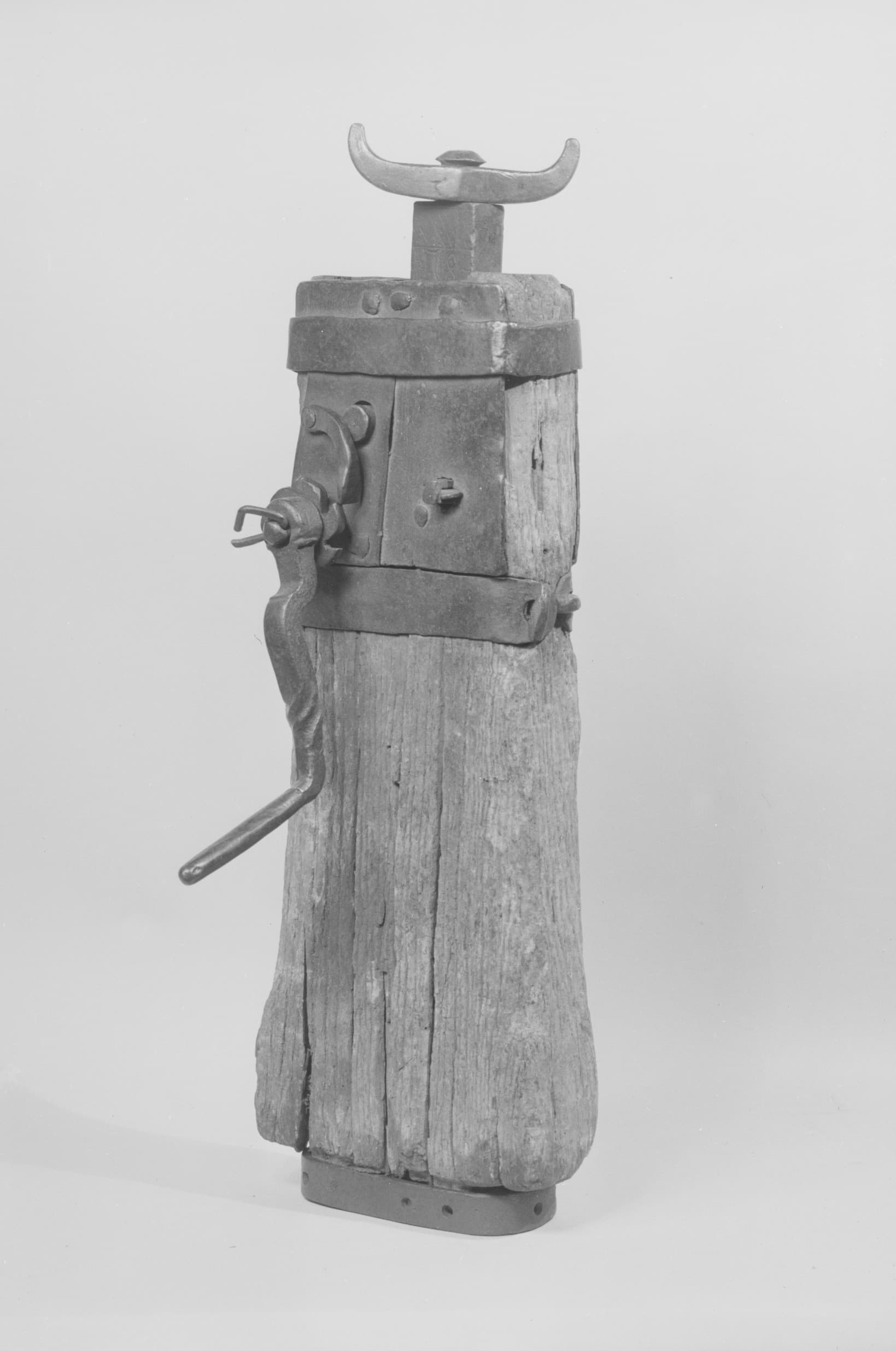
1867 to 1884 — the road north, and the wagons that ran it.
Five million head, and one chuck wagon per outfit.
The Chisholm Trail opened in 1867, the year after Goodnight cut his cabinet. By the time it closed in the mid-1880s, somewhere on the order of five million longhorn cattle had walked it — from South Texas across the Red River and up to the railheads at Abilene, Newton, Wichita, and Caldwell, Kansas. The figure is hard to verify exactly, but the Texas State Historical Association puts it in that range.
Every outfit that took to the trail had at least one chuck wagon. Bigger drives had two — one for the cook, one for the bedrolls and spare gear, sometimes called the hoodlum wagon. The wagons were nearly always Studebakers or Schuttlers, bought used and re-rigged in Texas blacksmith shops. The boxes were reinforced with iron strapping, the axles greased every morning before sunup, and the wheels trued by hand at every river crossing.
A trail crew was twelve men, three thousand cattle, sixty horses, and one wagon. The wagon was the slowest piece on the trail — and so the wagon set the pace. Fifteen miles a day, maybe less if the river was up.
The trail itself was named for Jesse Chisholm, a Cherokee-Scottish trader who had cut the northern leg of the route in 1864 hauling freight by ox-wagon between his trading posts in Indian Territory. Chisholm never drove a cow up the trail he gave his name to. He drove wagons. The cattlemen came later and used the ruts he had already laid down. That is a small fact, but it is the right one: in Texas, even the cattle trails were wagon roads first.
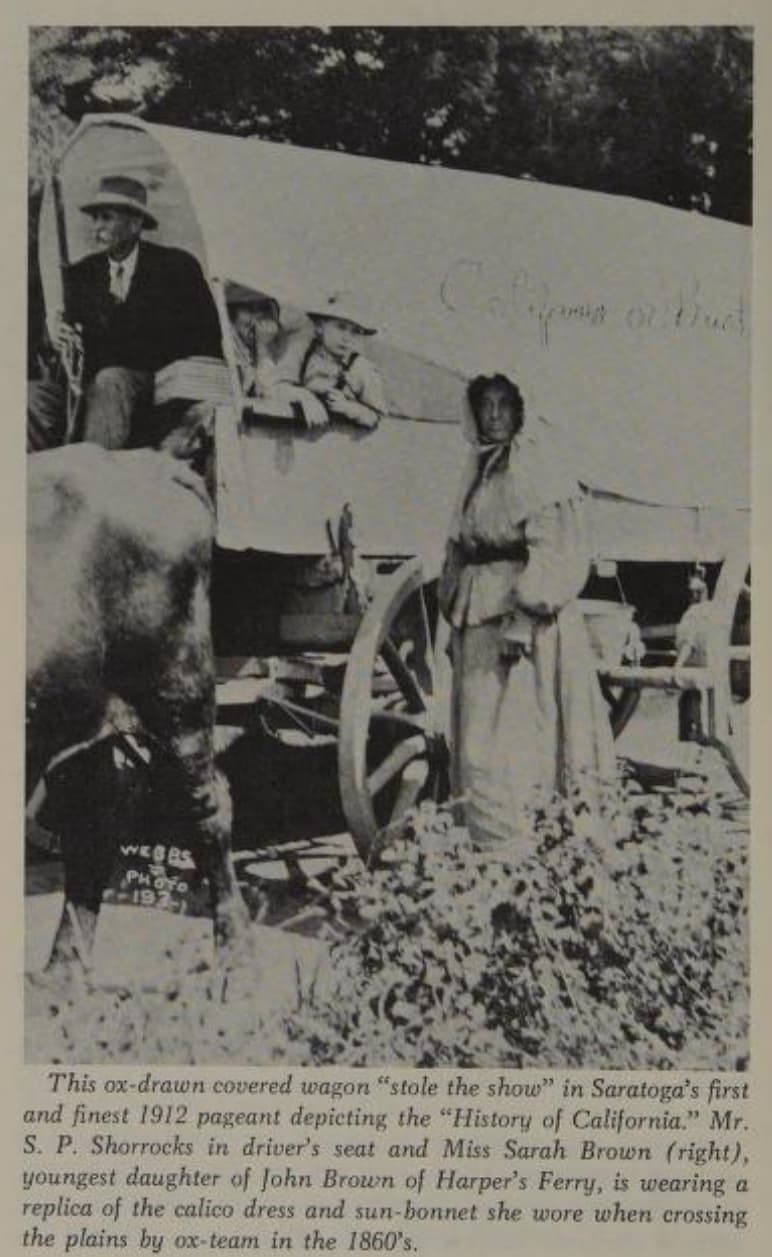
West, then north — the harder route.
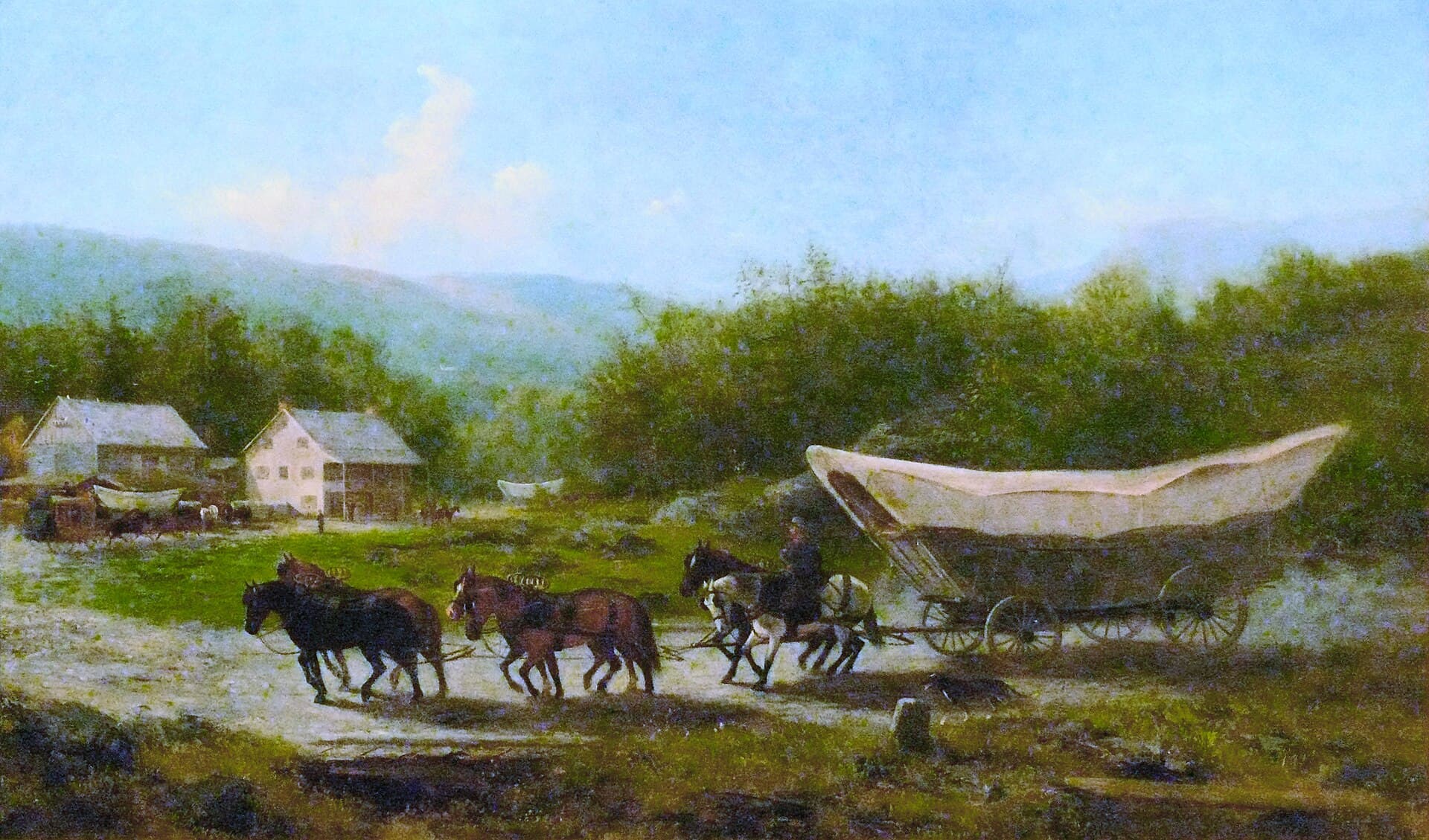
The trail Goodnight cut with Oliver Loving in 1866.
The same year Goodnight invented the chuck wagon, he and Oliver Loving drove a herd west out of Young County to Fort Sumner, New Mexico, and then north along the Pecos to Colorado and eventually Wyoming. The route bypassed the Comanche country on the central plains by swinging through the Llano Estacado and the Pecos River valley — longer, drier, harder on the herd, easier on the men.
The Goodnight-Loving Trail ran for roughly twenty years and seeded the cattle business across the entire Mountain West. It is also the trail on which Loving was wounded by Comanche arrows near the Pecos in 1867 and later died at Fort Sumner. Goodnight, who promised to bring him home, drove the wagon that carried Loving's body six hundred miles back to Weatherford, Texas, for burial. The wagon that built the cattle industry also carried its grief.
The chuck wagon, piece by piece.
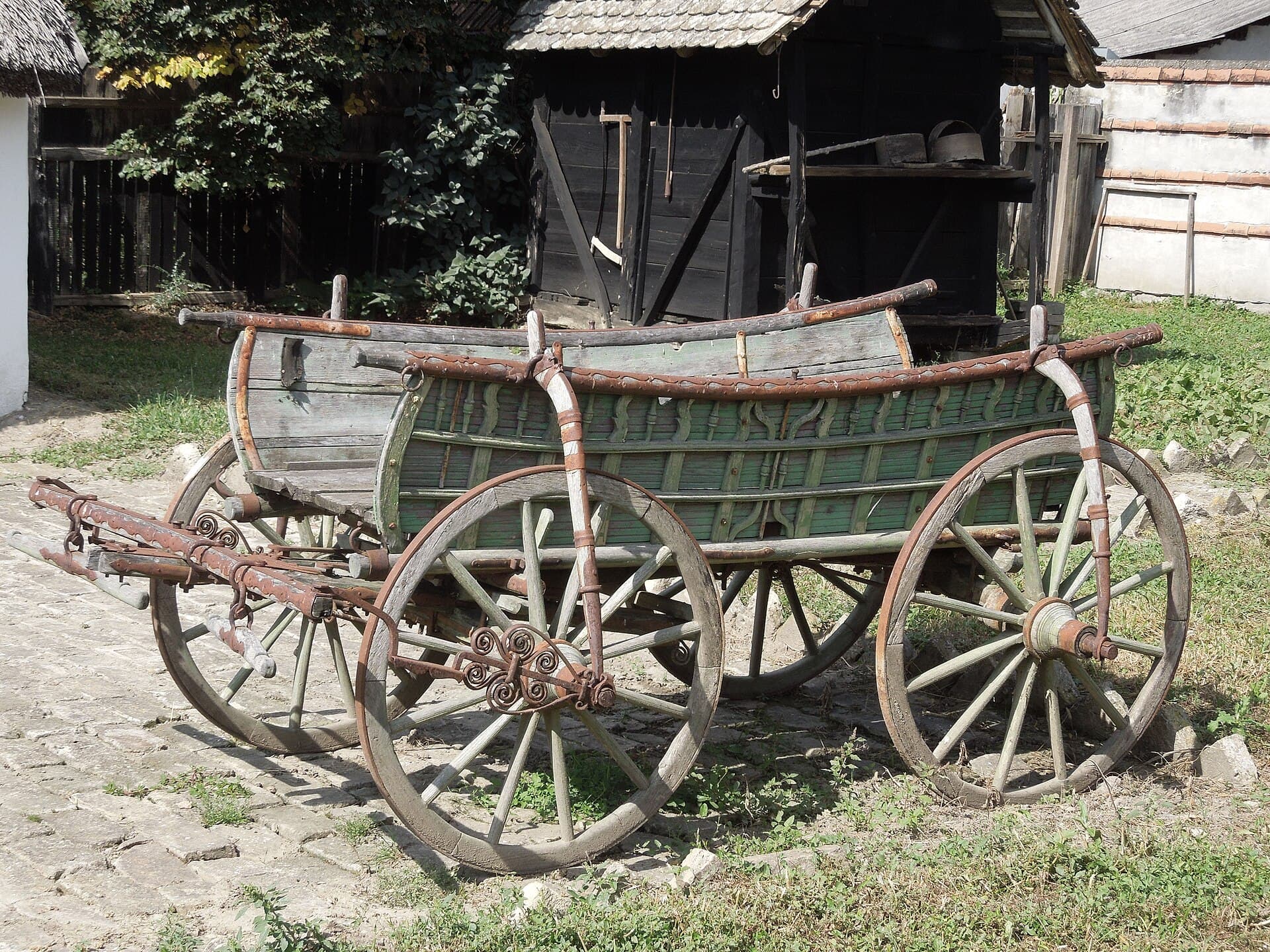
The drop-down kitchen, the possum belly, and the jockey box.
Start at the rear of the wagon and work forward. The piece everyone remembers is the chuck box, the tall pine cabinet bolted to the tailgate. Inside it lived the cook's whole inventory: coffee in tin canisters, flour in a sack, salt and sugar and pepper in small drawers, dried beans, salt pork, lard, baking soda, vinegar, and in season a jar of molasses or sorghum. The face of the box was hinged at the bottom. When the cook unhooked the iron rod that held it shut, the face dropped down onto a folding leg and became his work table. The little pigeonholes inside were now at eye level. He kept his sourdough crock in a specific cubby lined with flannel, because the starter had to be kept warm enough not to die and cool enough not to over-ferment, and on a cold night he slept with the crock between his legs.
Below the chuck box, slung between the rear axle and the wagon bed, was the possum belly— a stretched cowhide hammock about the size of a bathtub. The cook threw kindling and dry brush into it every time he passed a stand of cottonwood or mesquite. On the open plains, where firewood was scarce, the possum belly was the difference between a hot supper and a cold one. Some outfits used a canvas sling instead of a hide. The Texan slang was the same.
On the side of the wagon, lashed to the box with iron bands, rode the water barrel. A standard barrel held about forty gallons, enough for twelve men and the cook's use for two days if no one washed. There was a small wooden tap with a leather washer. The cookie filled the barrel at every creek crossing and resented anyone who used it without asking. On the opposite side of the wagon hung a coffee grinder bolted to the box, a tar bucket for the wheel hubs, and a lantern in a tin cage.
At the front of the wagon, under the driver's seat, was the jockey box— a locked compartment for the outfit's valuables. Pay-day money, the bill of sale for the herd, the foreman's tally book, a pistol, the cook's whetstone, and almost always a small bottle of whiskey kept for snakebite. The jockey box was the safe. Only the trail boss and the cookie had the key. Beneath the wagon bed, between the front axle and the bows, a canvas boot hung down for spare horseshoes, a hammer, a pair of nippers, and the iron tools the cook used to lift a Dutch oven off the coals.
The bed of the wagon carried the bedrolls, the spare gear, a sack or two of grain for the team, and the wreck pan— a galvanized washtub bolted near the tailgate where the crew dropped their dirty plates after each meal. The wreck pan was a contract. A crew that filed past it properly, scraping their plates clean and stacking them in order, ate three hot meals a day for the length of the drive. A crew that let plates pile up or threw them in sideways got biscuits and water until they learned manners. Cooks reset the contract that way.
Over all of this arched the bows— oak or hickory hoops bent into half-circles and slotted into iron staples on the side rails — and over the bows the wagon sheet, a heavy duck canvas treated with linseed oil and beeswax. A good wagon sheet would shed a Panhandle rain for two days before it leaked through. A bad one was the cook's worst enemy on the third day of a wet drive.
The cookie himself was a specific kind of man. He was older than most of the hands, often a former cowhand who had been kicked by a horse or torn up by a steer and was no longer fit for the saddle. He drove the wagon, broke camp before anyone else woke, scouted ahead at noon to pick the evening's bedground, and parked the wagon with the tongue pointed at the North Star so the foreman knew the heading at first light. His pay was a third more than the hands and his word was law in the camp. The unwritten code said you did not speak ill of his food in his hearing. You did not ride between the wagon and the wind when he was cooking. You did not enter the chuck box without being handed something out of it. And if you wanted seconds, you asked, and you waited, and you said thank you.
The wagon-makers of the Hill Country.
A wagon-making tradition older than the state.
Bandera County, in the Hill Country an hour northwest of San Antonio, has called itself the “Cowboy Capital of the World” for the better part of a century — and with reason. It was a staging ground for the Western Trail in the 1870s and 1880s, and home to several generations of German, Polish, and Tejano wagon-makers who built carts, buckboards, and freight wagons for the ranch trade.
The Bandera tradition was practical. Cedar from the local slopes, iron forged in town, and a hub design that survived limestone roads. A Bandera wagon was lighter than a Conestoga and tighter than a Studebaker, and you can still find a few of them in private collections and at the Frontier Times Museum on Main Street. The craft did not die there; it just got quiet. A handful of men still build wagons by hand in the county. The work we do in Midway draws from the same well.
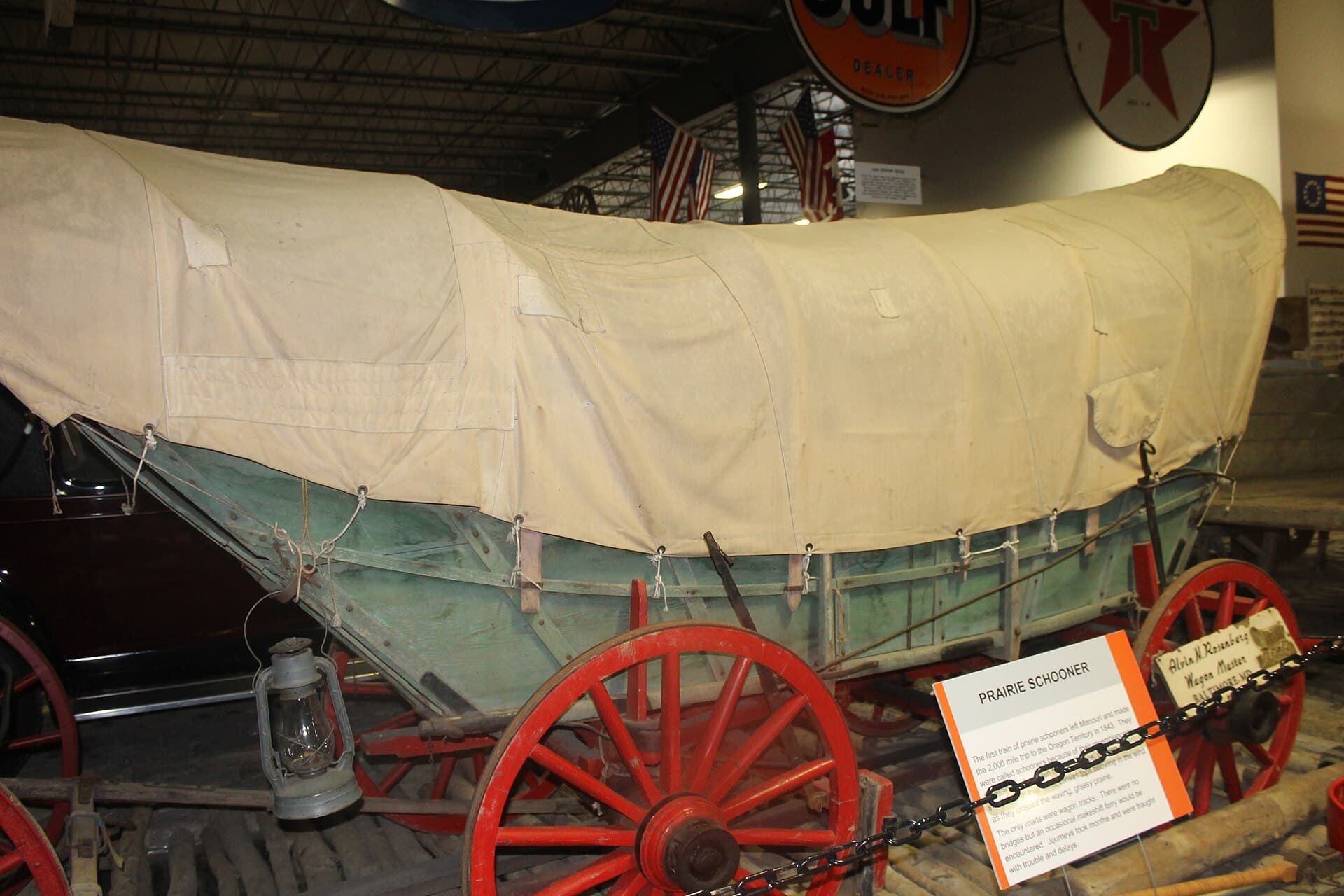
Sabinal-river wagon shops and the immigrants who ran them.
Bandera was settled in 1853 as a cypress-shingle camp on the Medina River, but the character of the place was set in the second wave of immigration, between 1855 and the early 1870s, when sixteen Polish families arrived under the leadership of Father Leopold Moczygemba — the same priest who had founded Panna Maria, the first Polish settlement in the United States, in Karnes County in 1854. The Bandera Polish were stonemasons, blacksmiths, and wheelwrights from Upper Silesia, a region of central Europe where the wagon trades had been practiced for generations and where the wood was hard and the winters long.
What they brought with them was knowledge. The Silesian wagon was a tight, narrow-tracked vehicle with a slightly dished wheel and an oak-hub bored on a foot-treadle lathe. Transferred to the Hill Country, the design adapted to local materials: cedar replaced beech for the box, mesquite for some of the hardware, and Texas live oak for the spokes and hubs. The shops set up along the Sabinal River and along Bandera Creek, where there was water for the steam-bending boxes and timber on the near slopes. By the 1870s, Bandera wagons were a recognized class of vehicle in South and Central Texas. They were not as heavy as a freight wagon and not as wide as a Conestoga, and the ranchers liked them because they could be turned in a narrow draw without jackknifing.
The Western Trail, which moved cattle from South Texas up through the Hill Country and on to Dodge City between 1874 and 1893, ran near Bandera. The town outfitted drives. The wagon shops did the iron work, repaired axles, set tires hot, and shod the team horses. A cattleman could lose a wheel on a stretch of caliche near the Llano and be back on the trail in two days if he could limp into Bandera. That economic role — outfit town, repair town, blacksmith town — lasted longer than the trail itself.
The Frontier Times Museum on Main Street, founded in 1933 by the newspaper editor J. Marvin Hunter, holds a working collection of the surviving wagons and the small hand tools that built them: a tire-bender from one of the original Polish shops, a wheelwright's traveler (the iron wheel that measures wheel circumference), a draw knife with a hand-forged blade, and a wagon jack of the kind that lifted a six-thousand-pound freight box one inch at a time. The museum is not a recreation. The tools came out of the shops they were used in, donated as those shops closed. You can read the names of the families on the cards: the Anderwalds, the Mazureks, the Pyks, the Hayses. Some of the grandchildren still live in the county. None of them, so far as anyone we have talked to knows, builds wagons for a living anymore. The knowledge ran out at the third generation. The tools remain, and the wagons remain, and the river remains. The craft is what has thinned.
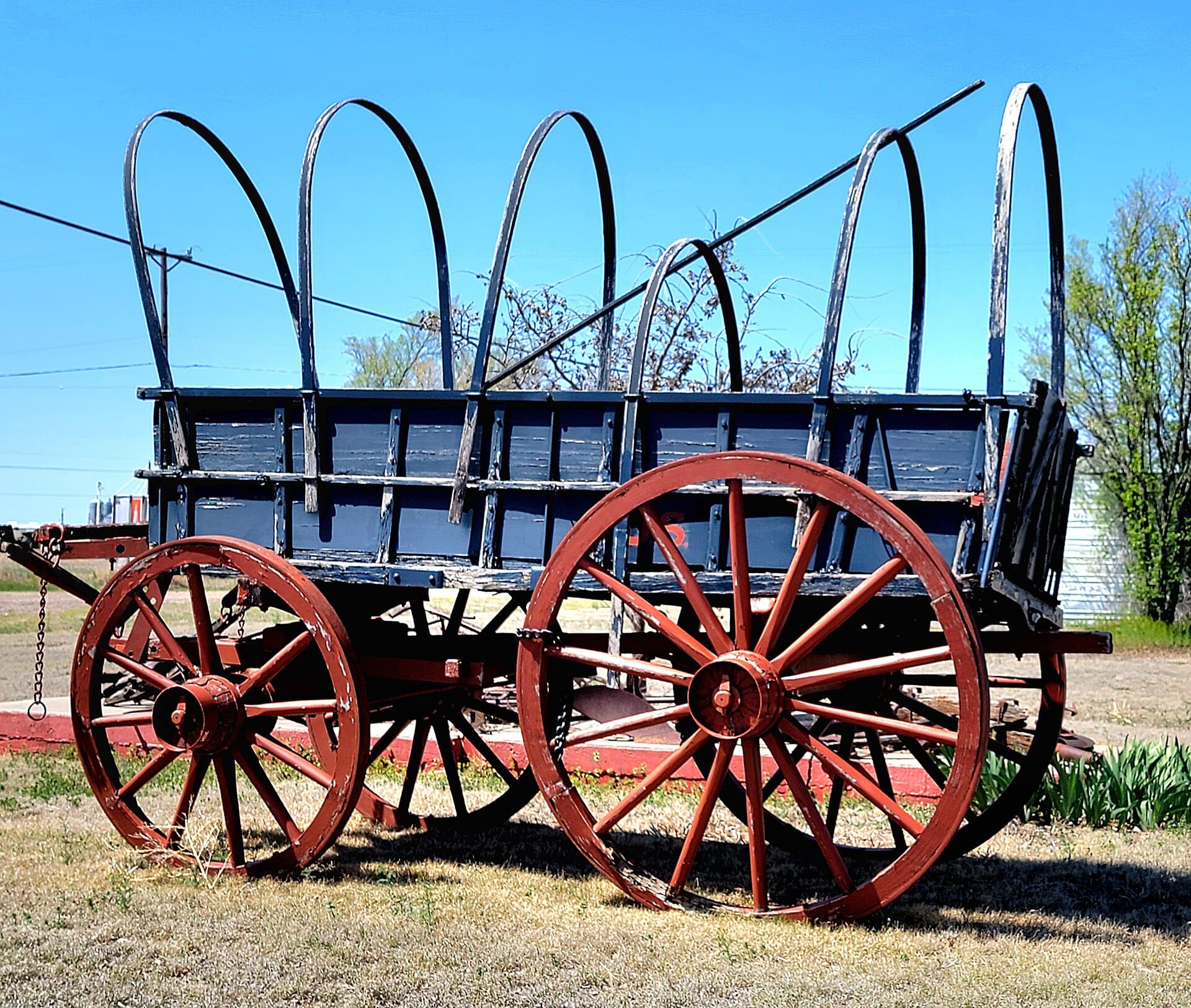 Conestoga wagon · Vega, Texas · a working example of the form we build
Wagons of the Texas Republic, 1836–1845.
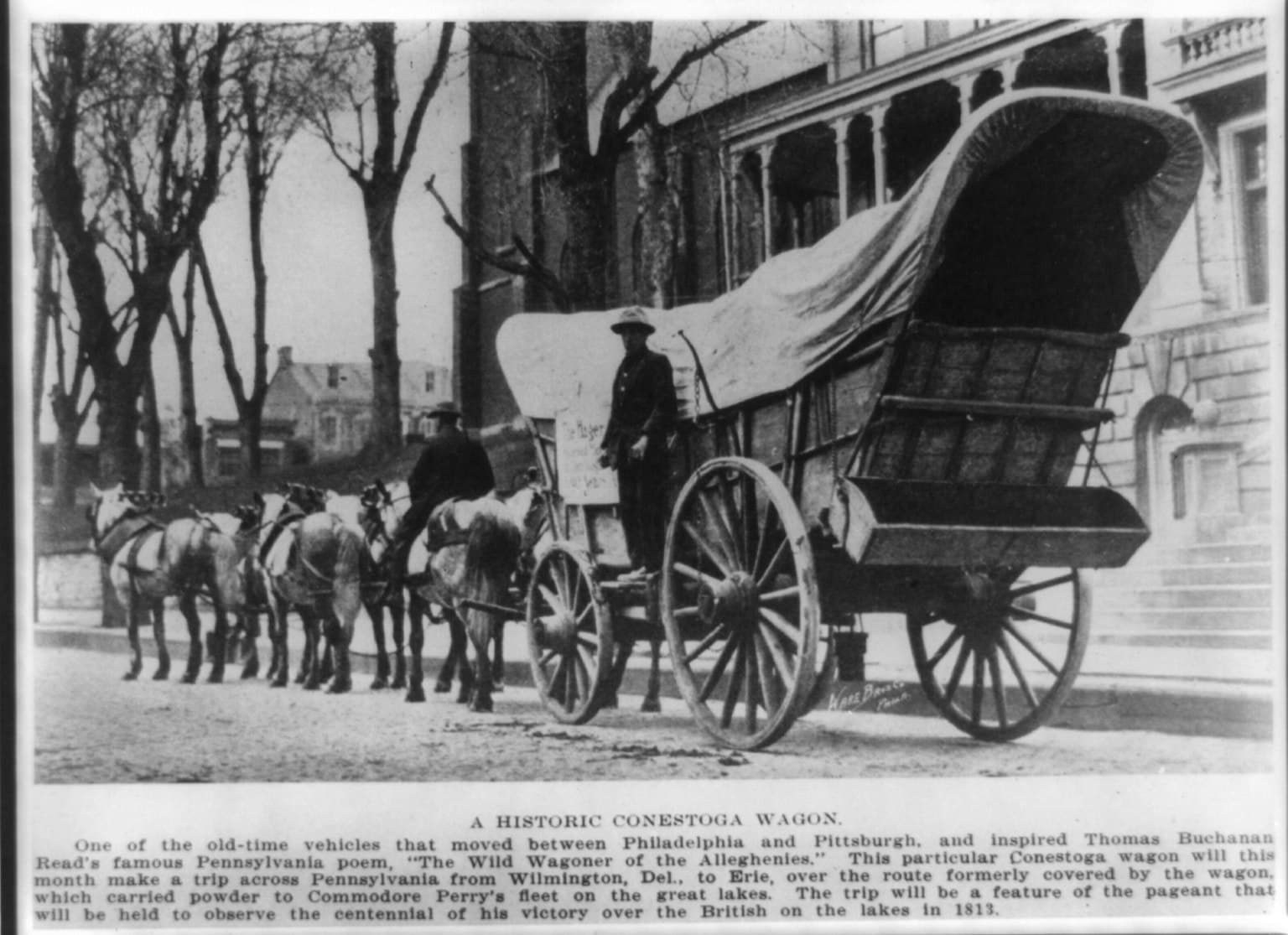 Historic Conestoga · Library of Congress · early 1900s
Nine years, three capitals, one runaway.
Before the cattle drives, before the chuck wagon, there was the republic — and the republic moved by wagon. When Santa Anna's army marched east after the Alamo in the spring of 1836, settlers loaded what they owned onto carts and ox-wagons and ran for the Sabine. They called it the Runaway Scrape. Whole towns emptied. The wagons rolled night and day until news of San Jacinto turned them around.
For the next nine years, between independence and annexation in 1845, the wagon was the republic's freight system, its post road, and its mobile capital. The seat of government itself moved three times by wagon — from Washington-on- the-Brazos to Houston to Austin — and when Sam Houston tried to move it back, his men intercepted the government archives on the Colorado River. The Archive War of 1842 was fought, in essence, over a wagonload of paper.
Why Houston still rolls into Memorial Park.
Thirteen trail rides, one rendezvous.
The Houston Livestock Show and Rodeo opens each February the same way: with wagons. Thirteen separate trail rides start from points across the state and converge on Memorial Park in Houston the Friday before the rodeo. Some of the riders have come three hundred miles by horse and wagon. Some have come fifty. All of them roll into the park on the same afternoon, and the city closes streets to let them in.
The tradition started small. In 1952, four men rode horses from Brenham to Houston to promote the rodeo — a publicity stunt that grew, by the next year, into the Salt Grass Trail Ride. The route ran roughly the path of the old stagecoach line, and they took a chuck wagon. The chuck wagon was the point. It made the ride a community instead of a parade.
Within a decade, other communities wanted their own ride. The Old Spanish Trail Ride started in 1959 out of Logansport, Louisiana, following the old Spanish freight road. Los Vaqueros Rio Grande Trail Ride started in 1973, riding up from the Rio Grande Valley behind Tejano vaqueros and Mexican-American cowboys whose families had moved cattle on that road for two centuries. By the 1980s the count had reached thirteen, and the rodeo capped it there. Each ride keeps its own wagons, its own outfit, its own cookie.
The unwritten etiquette is the part you only learn by going. You ride single-file across bridges. You water your horse before yourself. You eat what the cookie put on the table or you eat nothing. You do not pass the trail boss. You do not tie up to a wagon you do not own. And you wave at every porch the ride passes — because the porches, for a few hours each February, are watching the state remember itself.
The wagons themselves vary. Some are restored Studebakers and Schuttlers a hundred and forty years old. Some are new builds, made the old way, in shops scattered from Bandera to East Texas. The Houston Livestock Show and Rodeo publishes the full list of rides each year, and most of them welcome volunteers and visitors at their staging points.
The Salt Grass story is worth telling in its specifics because it is the founding ride and the template for the others. In February 1952, four men — Reese Lockett, the mayor of Brenham; E.H. Marks, a rancher; Pat Flaherty, a Houston journalist; and Emil Marks (no relation to E.H.), a Houston cattleman — set out on horseback from the Marks ranch in Brenham toward downtown Houston to promote that year's Fat Stock Show. They covered about eighty miles in three days, slept on the ground, and arrived at the show in time for the opening parade. The publicity was enormous. The next year, sixty riders joined them. By 1953 a chuck wagon had been added to feed the riders. By 1955 the count had climbed into the hundreds, and the route had been formalized along the old San Felipe stagecoach road that ran west out of Houston through Bellville and into Washington County.
The Old Spanish Trail Ride followed in 1959, organized out of Logansport, Louisiana, just across the Sabine. It rode west into Houston along the corridor of US Highway 90, the old colonial road that the Spanish had used to move freight and military supplies between Mexico City and the Louisiana outposts during the eighteenth century. The route is roughly three hundred and twenty miles. The ride takes about two weeks. They cross more bridges than any other group, which is its own kind of logistical problem when you are moving wagons and stock through working highway traffic.
The Los Vaqueros Rio Grande Trail Ride, founded in 1973 by Tejano vaqueros and Mexican-American cattlemen in the Valley, is the longest of the thirteen. It starts in Hidalgo, near the Mexican border, and rides nearly four hundred miles north and east to Houston. The ride takes approximately twenty-two days. The wagons carry both the practical kit — food, water, gear — and a small shrine. Many of the families on the ride trace their cattle heritage to land grants from before the Republic, and the ride is partly a working ride and partly a procession of memory. The route passes through Tejano country that the Anglo trail histories rarely cover.
The Northeastern Trail Ride, founded in 1957 by black cowboys out of Cheek, Texas, near Beaumont, is the historic African-American ride. Texas had black cowboys from the start — an estimated quarter of the men who walked the Chisholm and Goodnight-Loving were black, freedmen and former slaves who took to cattle work because the trail paid in cash and asked no questions. The Northeastern ride preserves that history. It runs from the piney woods of southeast Texas west into Houston and converges with the others at Memorial Park on the same Friday.
The thirteen rides come into the park at a staggered pace across that Friday afternoon. Each ride has its own colors, its own banner, its own wagon order, and its own way of announcing itself. The horses are watered. The wagons are parked in a long arc on the park grass. The cookies set up their fires. The riders sleep one more night under canvas. On Saturday morning, the parade rolls down Main Street into downtown Houston, and the rodeo formally opens that night at NRG Stadium. The cycle resets the following February. The trail rides started as a publicity stunt for four men and a herd of horses. Seventy-three years on, they are the largest sustained wagon procession in the United States.
Why the wagon stayed Texan.
A working tool that became a working memory.
Most of America has put its wagons in museums. The Conestogas that ran the National Road sit behind ropes at the Smithsonian and at Lancaster. The prairie schooners that rolled the Oregon Trail are restored exhibits at Scotts Bluff and at the High Desert Museum. They are remembered fondly — and they are still.
Texas put its wagons back to work. The chuck wagon never really retired; it just changed jobs. It went from the trail drive to the ranch cookout to the rodeo grounds. Charrería associations in South Texas keep their carts running. Cowboy churches stage wagon services. County fairs still host chuck wagon cook-offs where the rules require a real wagon, a real Dutch oven, and a real fire on the ground. The form was useful, and Texans are slow to put useful things away.
There is also the geography. The state is big enough — Bandera to Brenham is the same distance as Boston to Baltimore — that a wagon ride still feels like a real journey here. The Salt Grass Trail Ride covers about a hundred miles. The Los Vaqueros ride covers nearly four hundred. You can take a wagon out of Hempstead in the morning and not see another paved road for an hour. That does not happen in most states anymore.
And there is the temperament. Texas treats heritage as practice, not display. You do not honor the wagon by photographing it; you honor it by hitching a team to it and rolling out. That is the difference, and it is the reason a workshop like ours exists in Midway at all. The work is continuous with the work that Goodnight did at Palo Duro in 1866. Different tools, different oak, the same idea.
You can read more on the design and joinery in The Craft of Wagon Making, the broader American story in A Short History of the Wagon, and the reasons the trade nearly disappeared in The Lost Art of Wagon Making. For the accessible builds the workshop is gearing up to make, see Accessible Wagons. For background sourcing on the dates and figures above, the Texas State Historical Association and the National Park Service trail-history pages are the standard references, and Texas Folklife keeps the living-tradition side of it.
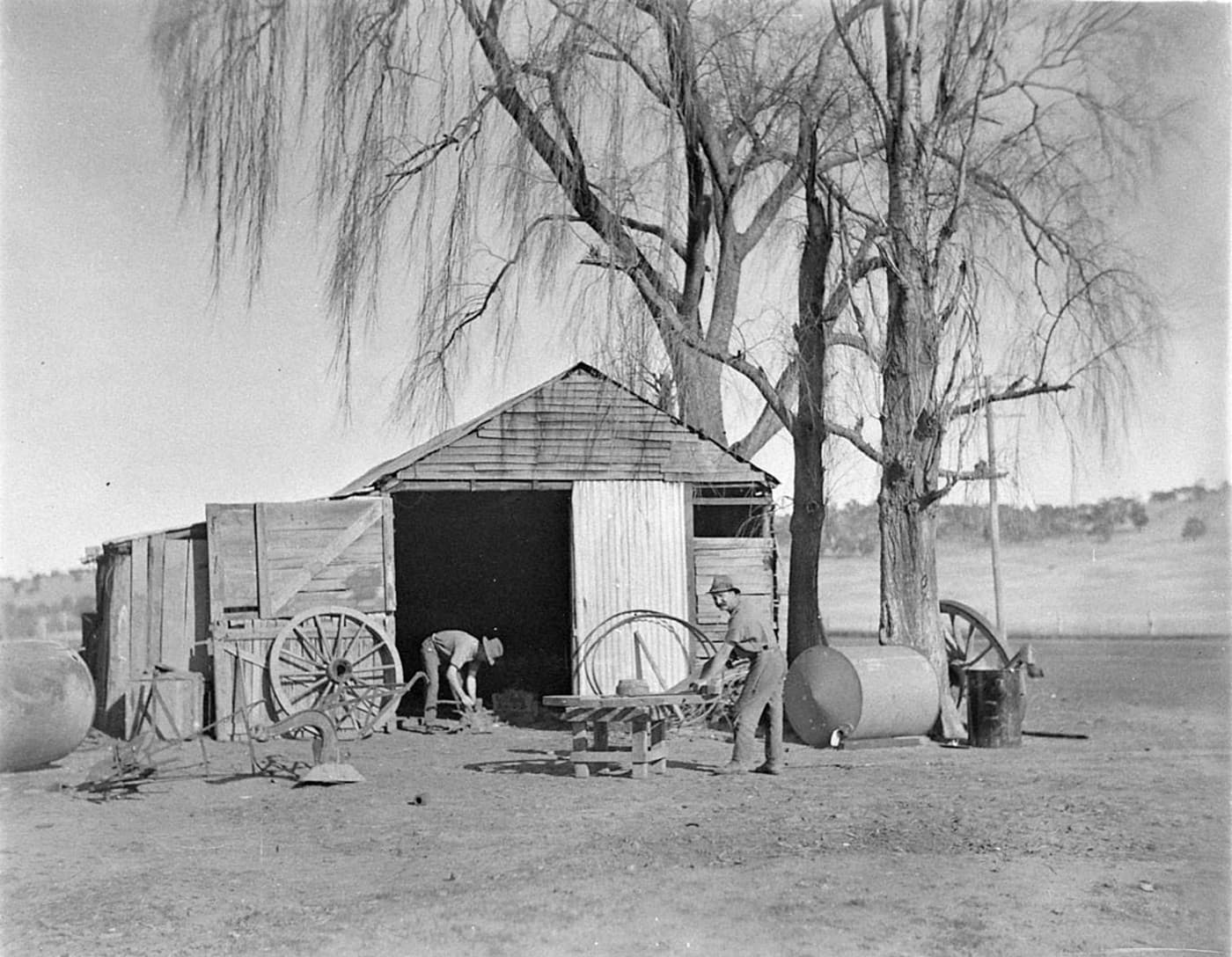 Wheelwrights at the wheel · archival photograph · Sam Hood
Where the facts above came from.
This article relies on standing public-domain sources. If you want to follow any thread further, these are the right places to start.
- Texas State Historical Association — Handbook of Texas, “Goodnight, Charles”. The standard reference biography of Charles Goodnight, with citations to the primary sources and to J. Evetts Haley's 1936 book Charles Goodnight: Cowman and Plainsman, the most complete account of his life.
- Texas State Historical Association — Handbook of Texas, “Loving, Oliver”. The biographical entry on Oliver Loving, including the Pecos attack of 1867 and the wagon-borne return of his body to Weatherford.
- Texas State Historical Association — Handbook of Texas, “Chisholm Trail”. The dates, the routes, the head counts, the railheads. The TSHA Handbook is the right first source for anything about Texas history before about 1920.
- Houston Livestock Show and Rodeo — Trail Ride Committee. The current roster of the thirteen rides, with founding dates, route descriptions, and contact information for each trail-ride association.
- Frontier Times Museum, Bandera. The working collection of Hill Country wagons, wagon tools, and the records of the Polish, German, and Tejano shops that built them. The museum has been open continuously since 1933.
- National Park Service — Chisholm and Great Western Cattle Trails. The federal trail-history pages, useful for crossing state-line context and for the federal route maps.
A barn in Midway, getting the first wagon ready.
Healin' Wheels is a Texas non-profit just getting started. Kelly is in the shop most days, laying out the first wheelchair-accessible heritage wagon — built the old way, with a ramp in the rear gate and tie-downs in the bed. If you want to talk about the work, the history, or how to help, the phone is the right way in.