
Wagon Types · The Chuck Wagon
The chuck wagon. A moving kitchen on the trail.
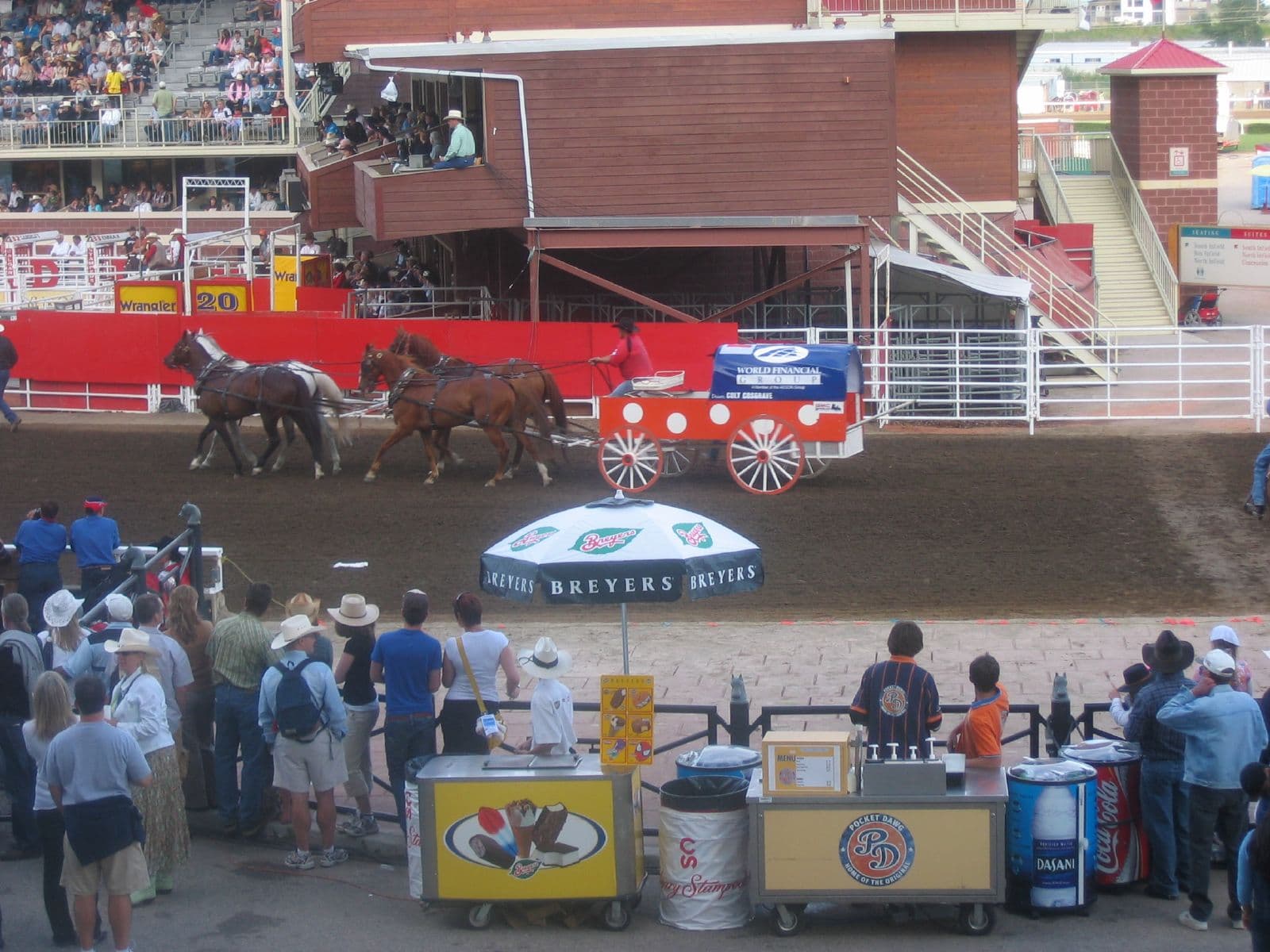
Charles Goodnight bolted a drop-down cabinet onto the back of a surplus Studebaker in 1866 and invented the rolling kitchen that fed every cattle drive in the American West. The form spread across the trails in a season and is still cooking — at competitions, ranch reunions, and Western festivals — a hundred and sixty years later.
Hero photograph: John Johnston (Flickr). CC BY 2.0
The Man · 1836–1929
Who Charles Goodnight was.
Charles Goodnight was born in Macoupin County, Illinois in 1836, walked to Texas behind a settler family at age nine, and was a working cowhand in the brush country south of Waco by his early teens. He rode with the Texas Rangers through the late 1850s on the Brazos and Clear Fork frontier, scouting for the Frontier Regiment during the Civil War, then came home in 1865 to find Texas full of unbranded longhorns and no market closer than Missouri. The cattle were worth four dollars a head in Texas and forty dollars in Colorado. The whole problem was getting them there.
In 1866 Goodnight partnered with Oliver Loving — a longer, leaner man twenty years his senior who had been pushing cattle north since the 1850s — and the two of them blazed what became the Goodnight-Loving Trail. The route ran south-west from Young County, Texas, down the Middle Concho, across eighty waterless miles to Horsehead Crossing on the Pecos, up the Pecos to Fort Sumner, New Mexico, and on into Colorado. Two thousand head of cattle. Eighteen men. Roughly seven hundred miles. Six weeks.
They needed to feed those eighteen men three times a day every day for six weeks across some of the driest country in the country, with no resupply between Fort Concho and Fort Sumner. Eighteen men, ninety days, three meals: about four thousand meals. There was no model for this. Earlier trail drives had packed food on mules and let the cook ride alongside the herd with a sack of dried beans. Goodnight wanted something better, and he was a man with bench skills and money to spend. He bought a wagon and he rebuilt it.
The Invention · 1866
What Goodnight actually built.
The wagon Goodnight started with was a surplus Army wagon — by most accounts a Studebaker, of the type the Quartermaster Corps had bought in the thousands during the Civil War and was auctioning off at fire-sale prices after the surrender. A standard Studebaker freight wagon: heavy white-oak running gear, iron-tired wheels, a flat box bed about ten feet long, canvas top stretched over hickory bows. Stout, simple, fixable in a blacksmith's shop anywhere west of the Mississippi.
Goodnight took the wagon to a carpenter in Parker County and had the back end rebuilt. What got bolted onto the rear of the wagon was a stout cabinet, about three feet deep and four feet wide, with a heavy hinged tailgate that dropped down on a chain to become the cook's worktable. Inside the cabinet, a wall of drawers and pigeonholes: flour, beans, coffee, sugar, salt, sourdough starter, dried fruit, salt pork, tin plates, tin cups, Dutch ovens, a coffee grinder bolted to the side. The grinder was the detail Goodnight was proudest of. A cook who could ride into camp and start coffee at the same moment the cattle were being bedded down was a cook who got the day's riders fed before they fell asleep in the saddle.
The whole arrangement came to be called the chuck box. The wagon it bolted to came to be called the chuck wagon. "Chuck," in the English of the trail, meant food. Not refined food — beef, beans, bread, coffee, the rough fuel of an outfit. The wagon was named for what it carried.
Underneath the wagon
The possum belly, the jockey box, the water barrel.
The chuck box on the back was the headline. The detail underneath was where the wagon really showed its design. The cook had three problems Goodnight had to solve: how to carry firewood across a country where there was none, how to carry enough water to drink and cook with between rivers, and how to carry the rest of his tools without burying them in the chuck box.
The firewood problem got solved with the possum belly: a stretched cowhide slung in a sling between the front and rear axles underneath the wagon bed, hanging like a hammock. The cook tossed in firewood whenever he passed timber, dried cow chips whenever he didn't, and whatever else would burn. The possum belly held a day or two of fuel. On a dry stretch the cook would ride out from camp at the day's halt and walk a half-mile circle, picking up chips, until it was full.
The water problem got solved with a barrel — usually a forty- gallon white-oak barrel, iron-hooped, bolted to the side of the wagon and tapped with a wooden spigot. Forty gallons was three to four days of cooking and coffee water for fifteen men if nobody washed. The cook was the gatekeeper of that barrel. The riders drank what they were given.
The tool problem got solved with the jockey box: a small lockable wooden box on the front of the wagon, behind the seat, where the cook kept the things he could not afford to lose — the sourdough starter crock, the salt, the coffee, his personal knife, the laudanum and the calomel for whatever ailment came up that month. Some chuck wagons added a tool box on the off side for axes, mallets, and horseshoeing supplies. The arrangement varied. The principle did not. Everything had a place. The cook knew where everything was. He had to. There was no second wagon.
The Spread · 1866–1885
How the form crossed every trail in a season.
Goodnight did not patent the chuck wagon. He did not write a manual. He did not, by all accounts, even talk about it much. What he did was put it to work on the Goodnight-Loving Trail in the summer of 1866, and within a year every outfit pushing cattle north out of Texas had seen one — at a river crossing, in a holding camp outside Fort Concho, at the railhead in Abilene — and gone home and built one. By 1870 the chuck wagon was standard equipment on the Chisholm Trail. By 1875 it was standard on the Western Trail. By 1880 you could not run a serious cattle drive in the American West without one.
Studebaker — recognizing the trade — began offering a "chuck-wagon kit" in its catalog, bolting Goodnight's pattern of cabinet, possum belly, and water-barrel rigging onto its standard freight wagon at the factory in South Bend. Other shops did the same. A new chuck wagon out of a serious shop in the 1880s ran somewhere between a hundred and fifty and two hundred and fifty dollars depending on the fit-out — a serious investment for a Texas outfit, but cheap measured against the cost of feeding a crew on the wrong end of nothing.
The cattle drives themselves wound down between 1885 and the early 1890s, as Kansas and the Panhandle filled in with rail and barbed wire and homesteaders. The long drives stopped. The chuck wagons, though, did not. They kept rolling on the big ranches — the JA, the XIT, the Matador, the Pitchfork — through spring and fall roundups well into the twentieth century, and on some Texas ranches the spring branding crew still works out of a chuck wagon on the original pattern today.
The Cook
Cookie — second only to the foreman.
The cook on a trail drive was the second-highest-paid man in the outfit. Only the trail boss — the foreman — ranked higher. A top cowhand in 1875 made about thirty dollars a month and board. A trail-drive cook made forty-five to sixty. Some cooks asked for, and got, more. The cook was hired before the cowhands were hired, sometimes before the herd was assembled, and a trail boss who knew his work spent as much time finding the right cook as he did finding the right horses.
The reason was practical. The crew rode twelve to fourteen hours a day, came into camp hungry and tired, ate, slept four to six hours, and rode again. If the food was bad, the crew quit. If the food was good — biscuits hot, beef tender, coffee strong, a pie on Sunday — the crew put up with country, weather, and a thousand other miseries the trail handed them. The cook was, in a real sense, what held the outfit together. Trail bosses understood that. Cooks understood that. So did the cooks' nicknames: "Cookie," yes, but also "Old Lady," "Belly Cheater," "Greasy Belly," and a long list of others that generally did not make it into the family histories.
The unwritten rules of the chuck wagon were strict and they were universal. No rider tied a horse to the wagon. No rider rode close enough to throw dust into the cook's flour. The cook's word on where the wagon parked was final. When the tailgate was down and the cook was working, the area in front of the chuck box was his kitchen, and a rider stepping into it without invitation was a rider about to be told something in clear English. The wagon parked with the tailgate facing away from the wind, so the cook could work the fire without ash in his face. The cook chose the camp. The trail boss usually deferred to him on water and shelter, because the cook had to fetch the water and set the fire and feed everybody, and if he was unhappy nobody ate.
The Food
What an outfit actually ate.
The standard trail diet was beef, beans, bread, and coffee, in roughly that order. The beef came from the herd itself — a young steer butchered at camp every few days, the choice cuts cooked first, the rest jerked or stewed. The beans were pinto, boiled overnight in a Dutch oven banked into the coals. The bread was sourdough biscuits, baked in another Dutch oven with coals on the lid, six to ten dozen at a time. The coffee was Arbuckle's, sold in pre-roasted whole-bean bags with a peppermint stick inside — the peppermint went to whichever cowhand was willing to grind the day's coffee, which was about the worst chore in camp short of nighthawking.
Sundays, if the drive had a half-day off, the cook produced something extra. Dried-apple pie, if there were apples. Vinegar pie, if there were not. Son-of-a-bitch stew — the organ meats from a fresh-butchered calf, simmered with onions and chili — was a delicacy and a controversy. The trail biscuit, properly made, was the cook's calling card. A man's entire reputation in the working life of the trail could rest on whether his biscuits broke open clean.
The chuck wagon today
Where the form is still cooking.
Texas named the chuck wagon the official state vehicle in 2005. The recognition was a long time coming, and it landed at about the same moment a quiet revival of the form was beginning to pick up speed. Chuck-wagon cook-offs have become serious business in Texas, Oklahoma, New Mexico, and Wyoming — the Western Heritage Classic in Abilene, the National Cowboy Symposium in Lubbock, the Lincoln County Cowboy Symposium in New Mexico, the Pendleton Round-Up wagon cook-off in Oregon. The rules at most events require an authentic period wagon, a wood fire, Dutch-oven cooking, and a menu that would have been recognizable to a trail cook in 1875.
On the working side, the spring branding crews at a number of Texas ranches — the Pitchfork, the 6666, the JA, the Tongue River — still take a chuck wagon to the pasture and cook out of it for two or three weeks at a stretch. The wagon is not ceremonial on those operations. It is the kitchen. The cook is the same role he was a hundred and fifty years ago.
And in the heritage-build world, the chuck wagon has become one of the most-commissioned wagon forms, second only to the Conestoga. A new chuck wagon, built from a Studebaker pattern with hand-forged hardware and a properly fitted chuck box, runs in the mid five figures and takes four to eight months in a working shop. We get the calls. So do the other half-dozen shops in the country still doing the work. Read more about how a wagon gets built, the wider history of the American wagon, or Texas wagon heritage if the form pulls at you.
What's left of Goodnight's idea
The wagon that fed the West.
Charles Goodnight died in 1929. The cattle drives he was famous for ended forty years before that. The trail he blazed with Oliver Loving has been crossed by a highway and most of the water stops have dried up. But the wagon — the rough working machine he put together in Parker County, Texas in the summer of 1866 — is still in service, in working ranches and at competition cook-offs and in heritage shops, more than a hundred and sixty years after he bolted the first chuck box to a Studebaker tailgate.
That is the test of a good design. It survives the work it was built for. The trail drives ended. The chuck wagon did not.
The Workshop · Midway, Texas
Building a chuck wagon, or restoring one?
Healin' Wheels is a Texas wagon shop in Midway, working in the tradition Goodnight set on the Goodnight-Loving Trail in 1866. If you have a chuck wagon to restore, a build to commission for a competition or a ranch, or a heritage project that needs an honest answer, there is a phone number below and a person on the other end.