
Wagon Types · The Conestoga
Conestoga wagons. The American freight wagon.
Born in the Conestoga Valley around 1717, painted Prussian blue and barn red, carrying six tons across the Alleghenies on five-foot rear wheels. The wagon that built the road network of the early republic — and the form heritage builders still reach for first.
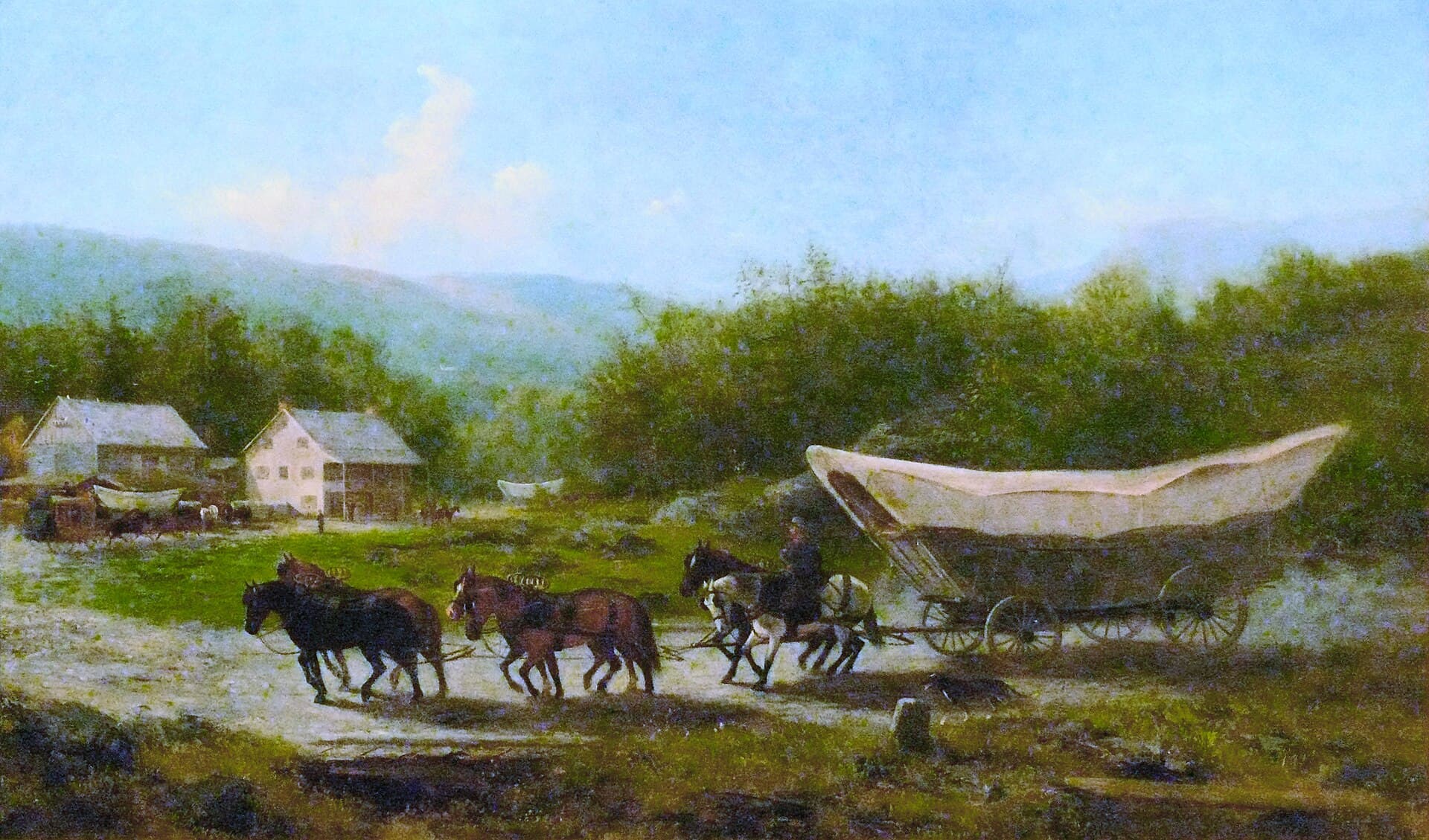
Hero photograph: Newbold Hough Trotter (1827–1898), photographed by Ad Meskens. Public domain
Origins · 1717
A wagon born in a Pennsylvania valley.
The Conestoga was a place before it was a wagon. The Conestoga Valley sits east of the Susquehanna River in what is now Lancaster County, Pennsylvania — rolling limestone country with deep topsoil, tall hickory, and a long growing season. The Pennsylvania-Dutch had been settling the valley since the 1680s under William Penn's open invitation to German and Swiss Protestants. Most were Mennonite, Amish, or German Lutheran. They cleared farms, raised bank barns, and by about 1717 they had begun building a wagon that was big enough to haul their grain, whiskey, iron, and furs to the Philadelphia market over roads that were, by any honest measure, barely roads at all.
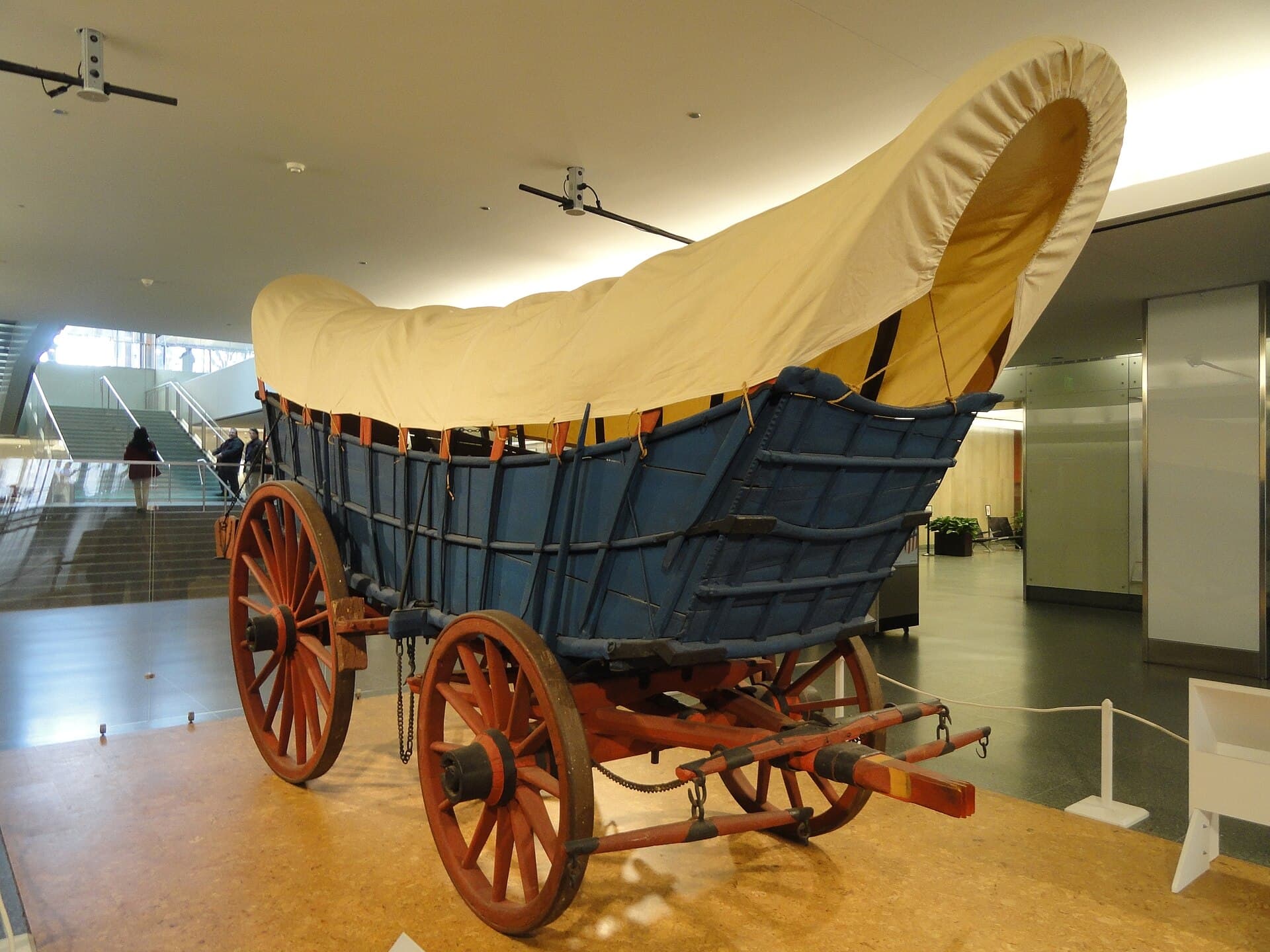
The wagon took the valley's name. So did the horses bred to pull it, the creek that ran past the shops, and — eventually — a stretch of the road itself. By the 1750s the form had settled into the shape that survives in museum collections today: a long, deep, boat-shaped bed slung between four iron-tired wooden wheels, a white canvas top stretched over hickory bows, a tongue out front for a team of four to eight horses, and a paint scheme that you could read from a quarter-mile out across an open hayfield.
The Pennsylvania-Dutch wheelwrights and blacksmiths who built these wagons were not romantics. They were tradespeople, and they were solving a freight problem. The roads east of the Susquehanna ran up ridges, dropped into hollows, crossed creeks at the worst possible angles, and washed out every spring. The wagon had to carry a load heavy enough to make the trip pay, survive a thousand miles of ridge road in a season, and be fixable in any country smithy along the way. Every detail of the Conestoga that looks decorative — the curved bed, the towering rear wheels, the iron strap-work, the blue-and-red paint — came out of that working brief.
The Form
The boat-shaped bed — and why it curves.
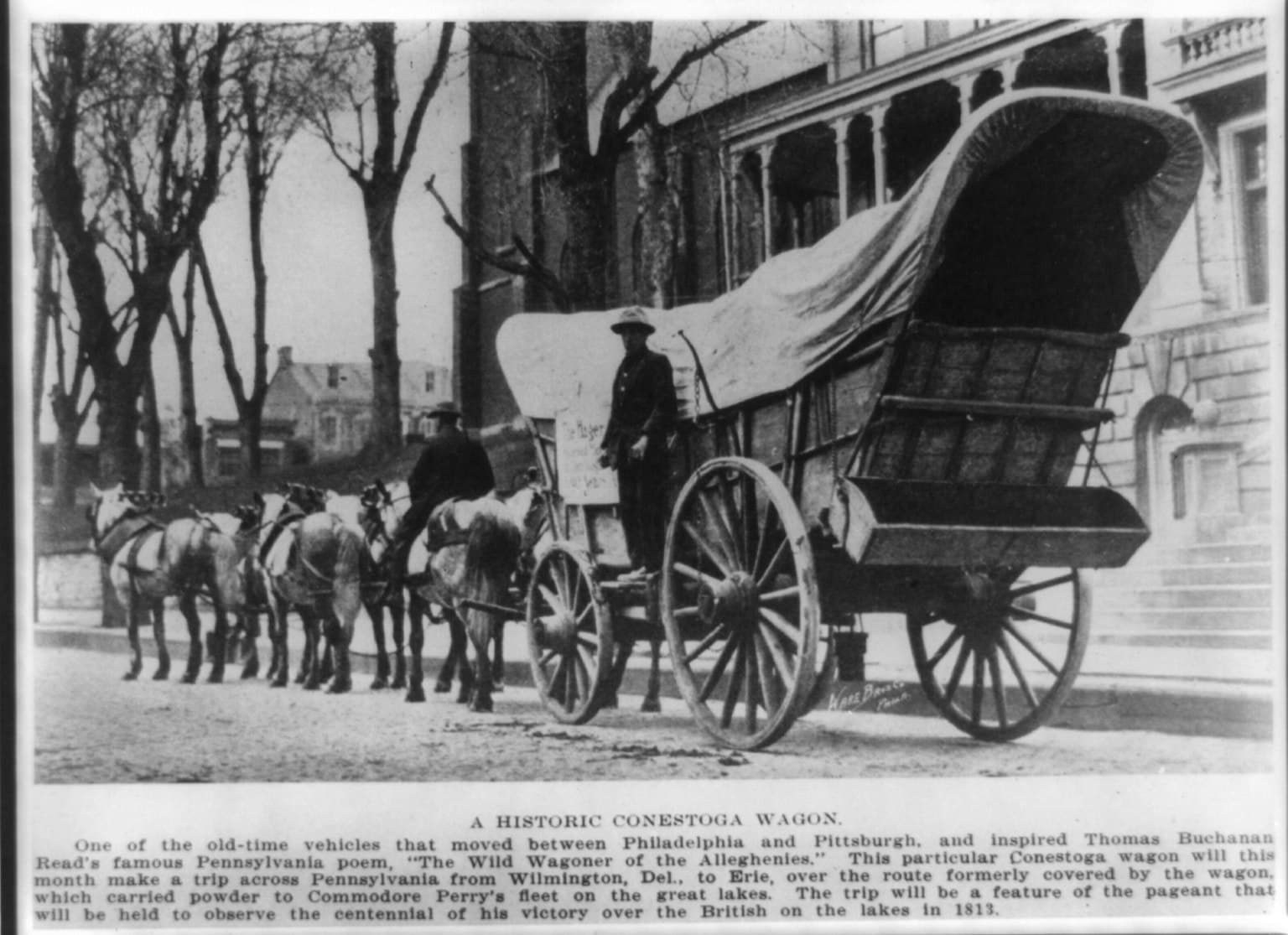
The first thing anyone notices about a Conestoga is the bed. It sags in the middle and rises at both ends, like a flat-bottomed skiff turned upside down on wheels. That curve is the single most distinctive feature of the form, and it is the answer to a specific problem: how do you keep a load of grain barrels, iron pigs, or whiskey casks from sliding out the back of the wagon every time the team drops down a steep grade?
The Allegheny ridge roads were never level for long. A loaded wagon would pitch forward going down a grade, throw weight against the front gate, then pitch back climbing the next ridge and throw the same weight against the tailgate. A flat-bottomed wagon would shift its load with every grade. A curved-bottom wagon settled the load into the lowest point of the bed and held it there. The cargo stayed put. The wagon balanced. The team — already working hard — did not have to fight a sliding load on top of the climb.
The curve was built up out of seasoned white oak planking, ribbed and stiffened with iron straps, sealed at the seams with linseed oil and tar. The whole bed was treated as one structural piece, not a wooden box laid on a frame. That is part of why the Conestoga could carry six tons where a flat-bottomed wagon of similar length would crack a sill under three.
Dimensions
How big was a Conestoga, really?
The size varied by shop and by decade, but the working envelope is well documented. A standard Conestoga ran between sixteen and twenty-six feet long overall — meaning bed plus tongue. The bed itself was usually about eleven to sixteen feet, four feet wide at the rim and a little narrower at the floor. The canvas top stood roughly eleven feet from the ground at its highest point. A grown man could walk under the bows without ducking, and the canvas could be reefed back from either end for loading.
The wheels were the most arresting part of the silhouette. The rear wheels stood up to five feet in diameter — taller than most of the men who walked beside the wagon. The front wheels ran smaller, around four feet, so they could turn under the bed for steering. The whole running gear was set on a long wooden axle, shod with iron tires hot-shrunk over oak felloes, and every wheel was dished — coned outward from hub to rim — so that as the wagon rocked side to side under its load, the lower spokes pressed straight down as columns rather than walking themselves off the axle.
Empty, a Conestoga weighed around three thousand pounds. Loaded to its rated capacity, it carried six tons — twelve thousand pounds of grain, iron, whiskey, or salt — on those four dished wheels and two wooden axles. Six tons is not a hauling figure a modern reader tends to associate with a wagon. It is roughly what a Ford F-350 dually is rated for today, except the F-350 has a turbo-diesel and the Conestoga had six horses and a teamster walking alongside.
The Team
Four to eight horses, and how they were driven.
A standard Conestoga team was six horses — three pairs hitched in line: the wheelers nearest the wagon, the swing pair in the middle, and the leaders out front. Light loads ran with four. Hard grades and bad weather called for eight. The horses were almost always Conestoga-bred, until the breed thinned in the late 1800s and Belgians, Percherons, and grade drafts took over.
The teamster did not ride. He walked on the left side of the wagon, controlled the team by voice and by a single rein — the jerk-line — that ran from his left hand to the bit of the left lead horse. Two tugs left. One tug right. A long steady pull to halt. The whole team had been schooled to that line from yearling age. There was no driver's seat on a working Conestoga; there was a lazy board, a single oak plank that slid out from under the bed on the left side, where the teamster could sit if the road was flat and the team was steady. Mostly he walked. Twelve to fifteen miles a day, week after week, from Lancaster to Philadelphia or Lancaster to Pittsburgh and back.
1811 onward
The Conestoga and the National Road.
The Conestoga was already a working freight wagon by 1750, but its high tide came with the National Road. Congress authorized the road in 1806; construction began in 1811 at Cumberland, Maryland, and the macadam surface pushed west year by year — through Uniontown, into Wheeling on the Ohio River by 1818, on to Vandalia, Illinois by the 1830s. It was the first federally funded interstate highway in the country, and it was built for wagons. The Conestoga, more than any other, was the wagon it was built for.
By the 1820s a Lancaster-to-Wheeling freight run was a routine month-long trip, and the road through the Alleghenies on a busy week carried thousands of wagons in convoy — taverns every few miles, blacksmith shops every dozen, hostlers and feed yards spaced for the night's stop. Pittsburgh, Wheeling, Cumberland, and Hagerstown all grew on the back of Conestoga freight. The figure most often quoted is that some twelve thousand Conestogas were on the road at the trade's peak in the 1830s. The number is hard to verify and may be high. But the shape of the claim — that this single wagon form moved most of the long-haul freight east of the Mississippi for half a century — is not in dispute.
Then the railroads came. The Baltimore & Ohio reached Cumberland in 1842 and Wheeling in 1853. A single train pulled more freight in a day than a hundred wagons could in a month. The National Road tolls fell off, the wagon taverns closed, and the Conestoga as a freight machine had no economic role east of the Mississippi by 1860. The form survived, but its working life as a long-haul ridge-road wagon ended in roughly a decade.
The blue and the red
Why every Conestoga wore the same two colors.
The paint was a convention, not a rule, but the convention was close to universal. The undercarriage — the running gear, axles, wheel hubs, iron strap-work — was painted Prussian blue. The wagon box was painted English vermilion, the color most people now call barn red. The canvas top stayed white, treated with linseed oil to shed water. The whole rig, from a quarter mile out, read as a long red box on blue wheels under a white sail.
Prussian blue was the cheap miracle pigment of the eighteenth century. Synthesized in Berlin in 1706, it was the first modern synthetic blue and it came into common shop use in Lancaster County by the 1740s. It was weather-fast, it sat dark and clear against the red, and it was cheap enough that a country wheelwright could afford to repaint his running gear every couple of seasons. The vermilion was an iron-oxide red — the same family of pigment that has been painting barns for four hundred years. Together they made the Conestoga the most visually distinctive working vehicle in early American life.
The blue Conestoga tradition was a maker's mark. A teamster on the road could tell from a long way off whether the wagon coming the other direction had been built in Lancaster, Lebanon, or York County, by the exact shade of the blue, the way the red carried into the wheel spokes, and the lettering style on the toolbox lid. Some wagons carried hex-style flourishes — six-pointed stars, tulips, a distelfink or two — in the Pennsylvania-Dutch decorative idiom. Those signs were not, despite tourist-era mythology, magical. They were a shop's signature.
1850 onward
Why the Conestoga gave way.
By 1850 the form was already in retreat. The railroads were taking the long freight, and the families heading west on the Oregon and California Trails were not buying Conestogas — they were buying the lighter, narrower prairie schooner, a wagon that could be pulled by oxen across the plains by a single family without a hired teamster and a six-horse Conestoga team. The Conestoga had been designed for the Alleghenies and for paid freight. Neither was the western migration's problem to solve.
The shops that had built Conestogas did not all close. Some shifted to farm wagons, buggies, and surreys. Some, like the Studebaker brothers in South Bend, Indiana, built every form on the catalog from light buggies to heavy freight wagons through the rest of the nineteenth century and into the early twentieth. But the Conestoga as a working long-haul freighter was effectively extinct by 1880. The form survived as a memory, as a museum piece, and — increasingly, in the twentieth century — as a reproduction.
The Conestoga today
Why heritage builders still build it.
Walk into any serious wagon shop in the country today and ask the wheelwright which form he gets the most calls about. The answer, nine times out of ten, is the Conestoga. There is a reason.
The Conestoga is the wagon a layperson pictures when somebody says the word "wagon." It is the silhouette in every western painting and most western movies — even when, technically, the wagon on screen is a prairie schooner. The blue-and-red paint, the bowed canvas, the towering rear wheels, the long tongue: these are the marks of the American freight wagon as a cultural object, and heritage builders, museums, living history sites, and private collectors keep commissioning them because nothing else reads the same. A new Conestoga commissioned today will cost in the high five figures and take six to twelve months in a working shop. It will outlast its owner.
At our shop in Midway, Texas, the Conestoga form is the reference point even for builds that are not technically Conestogas. The bow profile, the strap-work, the wheel construction — these are the standards a wagon-maker learns first, because the Lancaster County shops figured them out two and a half centuries ago and nobody has improved on the answer. You can read more about how we build a wagon, the anatomy of a wheel, or the lost art of the trade.
What's left
The Conestoga in 2026.
There are perhaps a dozen working wagon-makers in the United States who will take a Conestoga commission and finish it to the standard the Lancaster County shops set. The Landis Valley Museum in Lancaster County, the National Museum of American History at the Smithsonian, the Conestoga Area Historical Society, and a handful of state historical sites keep originals on display. Working reproductions appear in living history events, in occasional film work, and on a small number of private ranches and museums that put them through their paces a few times a year.
The wagon is not a relic. It is a tool with a narrow modern use case — heritage display, parade work, ranch events, the occasional accessible community ride — that still rewards being built right. Built right means the same thing in 2026 that it meant in 1817: seasoned hardwood, shrink-fit iron, dished wheels, two coats of paint over linseed primer, and a teamster who has walked beside one before.
The Workshop · Midway, Texas
Thinking about a Conestoga build?
Healin' Wheels is a Texas wagon shop in Midway, working in the same tradition the Lancaster County builders set down two and a half centuries ago. If you are sizing up a Conestoga commission, a restoration of a wagon that's been in the family, or a community-ride build, there is a phone number below and a person on the other end.