
The Craft · An Essay
The lost art of wagon making.
There are fewer than a dozen working wagon-makers left in America. Here is what they actually do — and why the country lost the knowledge in the first place.
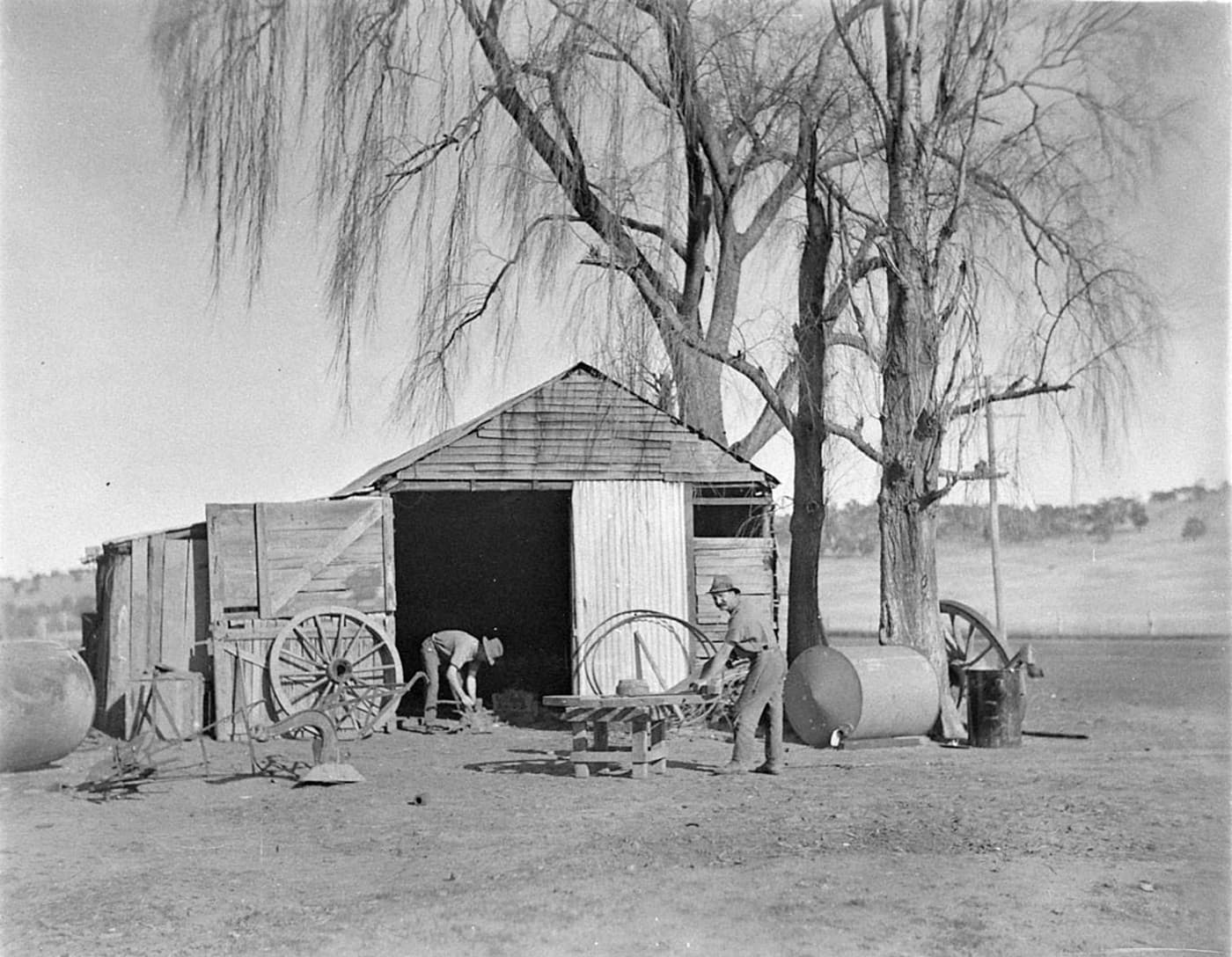
Hero photograph: Sam Hood (State Library of NSW). Public domain
Every county seat had a wheelwright. Every town had a forge.
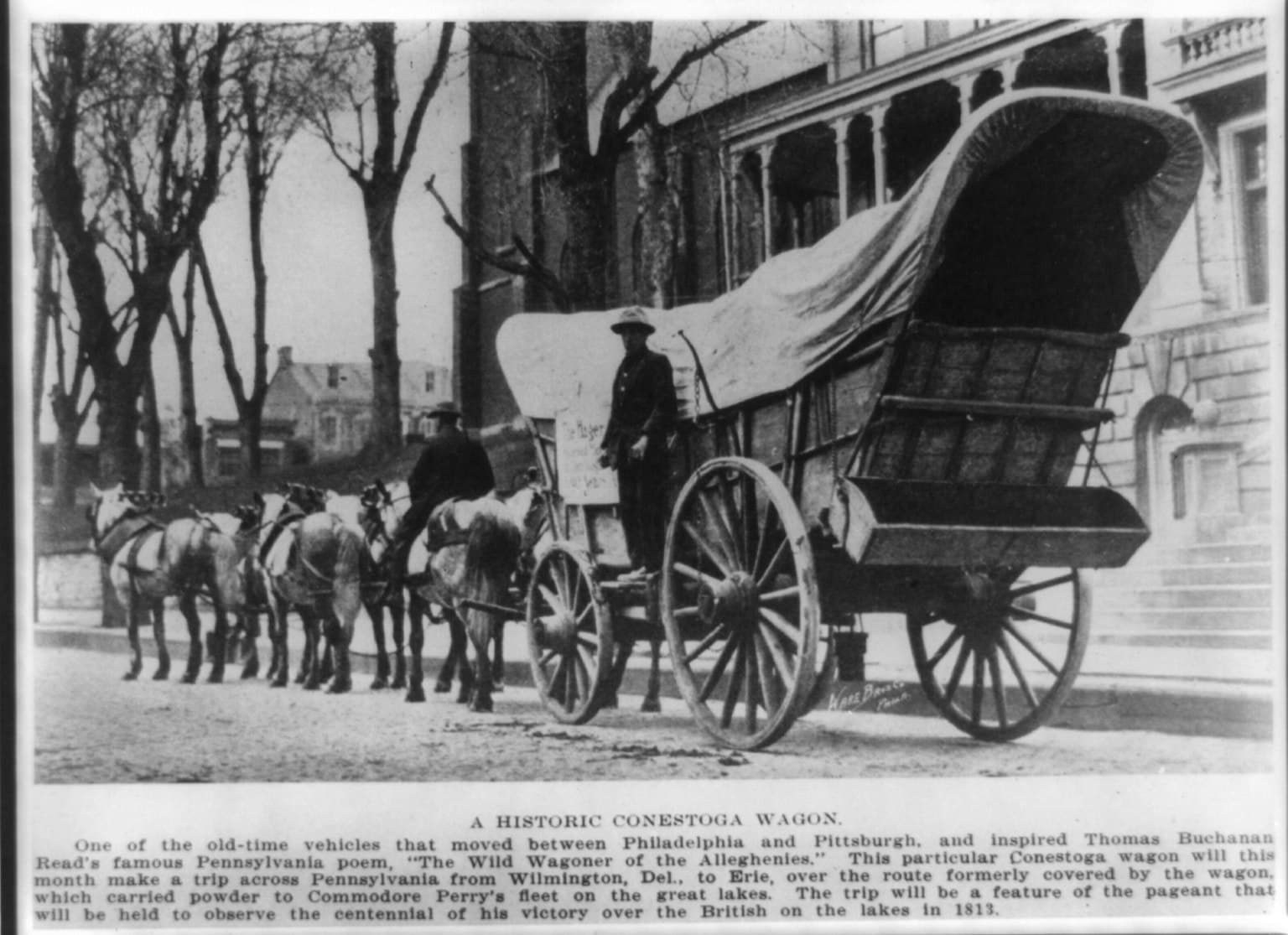
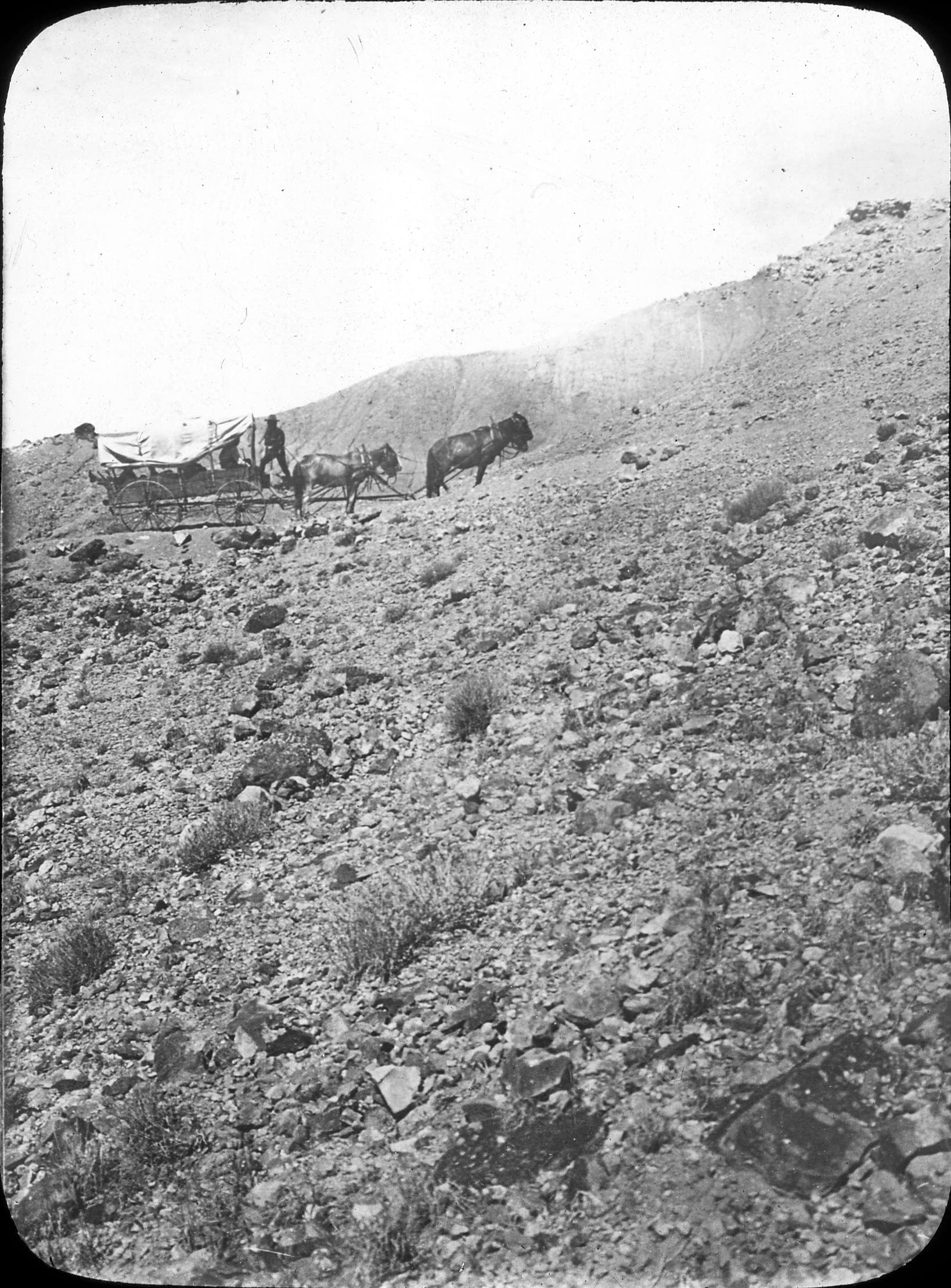
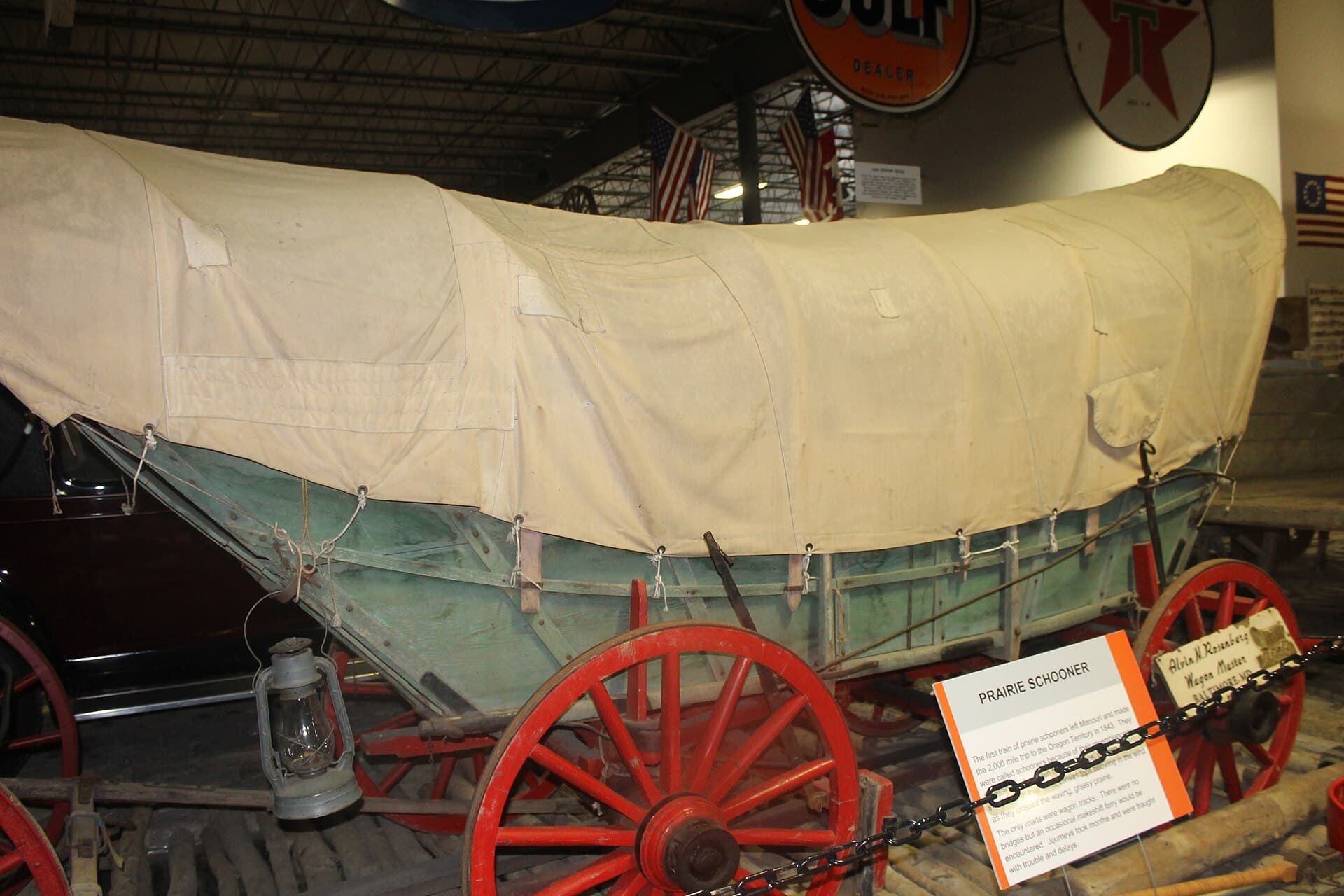
Before the railroads stitched the country together, the wagon was the country. The Conestoga — the heavy freight wagon that came out of Pennsylvania's Conestoga River valley in the early 1700s — hauled iron, salt, whiskey, and people across the Alleghenies for more than a hundred years. Its lighter cousin, the prairie schooner, carried families west on the Oregon and Santa Fe trails. In Texas, the same forms hauled cotton out of the Brazos bottoms and supplies into ranch country long after they were considered obsolete back east.
A working wagon-maker — sometimes called a wheelwright or, in the older spelling, a wheel rite— was three craftsmen in one apron. He worked wood, iron, and leather, and the wagon that left his shop had to outlast the team that pulled it. The Library of Congress still holds plate after plate of these shops — doors propped open, a half-finished wheel on the floor, a man in a vest holding a draw knife like he was born with it.
In 1850, there were thousands of working wagon shops in the United States. By 1950 there were a few dozen. The math is not complicated. The reasons are.
It wasn't the car. It was everything around the car.
People like to say the automobile killed the wagon. That's half true. The car took freight off the wagon road by 1920, but the trade had been thinning for a generation before that. Factory-made buggies out of South Bend and Cincinnati could undercut a custom shop by half. Steel pressed wheels showed up on farm implements. Then the war came, and the apprentices who would have spent ten years at the bench instead spent four in Europe and didn't come home to a shop that could pay them.
What followed was a long, quiet attrition. A wagon-maker who retired in 1948 had no one to sell his tools to. The drawknives and travishers and spoke-pointers went into barns. The journeyman-to-master line broke in most of the country between 1930 and 1960. By the time anyone thought to write the craft down for the Smithsonian Center for Folklife or for state programs like Texas Folklife, a lot of it was already going by way of memory rather than practice.
We do not know exactly how many working wagon-makers remain in the United States today. We know it is small. The number you hear most often, from people who would know, is fewer than a dozen still building from raw lumber and iron stock rather than restoring what someone else built a century ago. Most are in their seventies.
How a wagon-maker made a living — and why he stopped.
The trade did not vanish because the work got worse. It vanished because the math stopped working. A wagon shop in 1850 was a business with three legs under it, and Studebaker kicked out two of them before the century turned.
Three revenue streams, one apron.
A village wheelwright in 1850 did not get rich. He got solvent. The shop ran on three streams of money, and a man who kept all three running could feed a family and put a journeyman up over the forge. The first stream was custom work for neighboring farmers — a new running gear, a new bed, a pair of replacement wheels — paid for in cash at harvest or, more often, in trade. Corn, oats, a side of pork, a day of a neighbor's team to skid logs out of the bottom. A ledger from an Ohio shop in that period reads less like an accounting book than a census of the township.
The second stream was the county fair. A wheelwright who could finish two or three buggies on speculation between planting and harvest could roll them onto the fairground in the fall and sell them in an afternoon to townspeople who had cash and no team-broke horses. A finished spring wagon in 1855 ran somewhere around eighty dollars — roughly four months of a farm laborer's wages, and the kind of purchase a family made once in a decade.
The third stream was the harness shop next door. In most county seats the wheelwright and the saddler worked the same customers, and a good shop split the work cleanly — you built the wagon, the saddler outfitted it, and you handed the customer a single set of keys, more or less. The arrangement worked because both shops were under-capitalized, both needed referrals, and neither could survive without the other.
Studebaker did not invent the wagon. It invented the price.
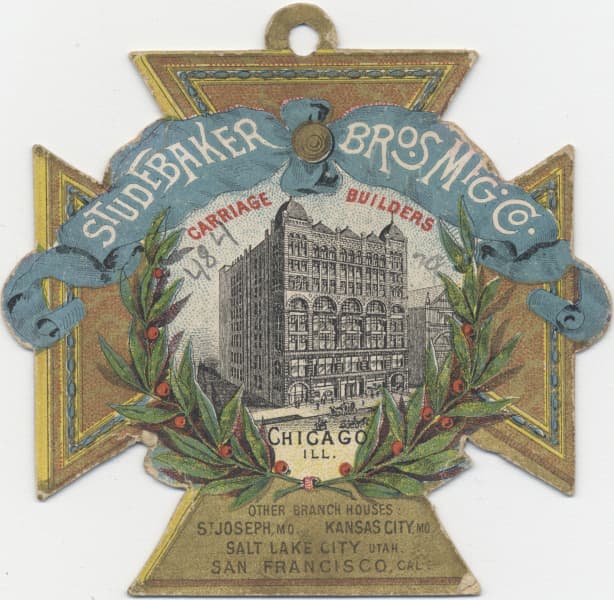
The Studebaker brothers started in South Bend in 1852 as a blacksmith and wagon-building outfit not much different from the shop in any county seat. What changed was scale. By the 1880s the factory could turn out a farm wagon for under sixty dollars delivered, which was less than a village shop had to charge to break even on the materials alone. The factory wagon was not as good. It did not have to be. It was good enough, and it was there.
The village shops did not all fail at once. They became repair shops. A wheelwright who used to build six wagons a year built one and patched twenty. The trade got narrower and the wages got thinner, and by the time the apprentices who would have taken over the bench came of age in 1905, they took jobs at the factory or at the rail yard instead. The trade was not dead. It was unemployable.
Mid-five to low-six figures, and a year on the wait list.
In 2026 the math has inverted. There is no factory anymore. The handful of working builders in the country quote a finished custom wagon at somewhere between thirty thousand dollars for a simple buckboard and well over a hundred thousand for a full Conestoga-style freight wagon with iron fittings, painted body, and a hooped canvas top. A wheelwright's hour, billed honestly, runs ninety to a hundred and twenty dollars, and a wheel is roughly a week of them. The wood alone — properly air-dried white oak in wagon-grade thickness — runs three to five times what you'd pay for furniture-grade stock at a hardwood dealer, because almost no one mills it that heavy anymore.
The customers are not farmers. They are museums, living-history sites, ranches that still use teams for cattle work in country a truck cannot get into, film productions that want the real thing instead of a fiberglass copy, and the occasional private buyer who wants a wagon for the same reason a person wants a hand-built rifle. We are not in that market exactly. The wagons we plan to build at Healin' Wheels are meant to roll under riders — not to sit on a museum floor — and the cost structure is its own animal. But the rates above are the going ones, and worth knowing if you are calling around.
The tool inventory of a working shop.
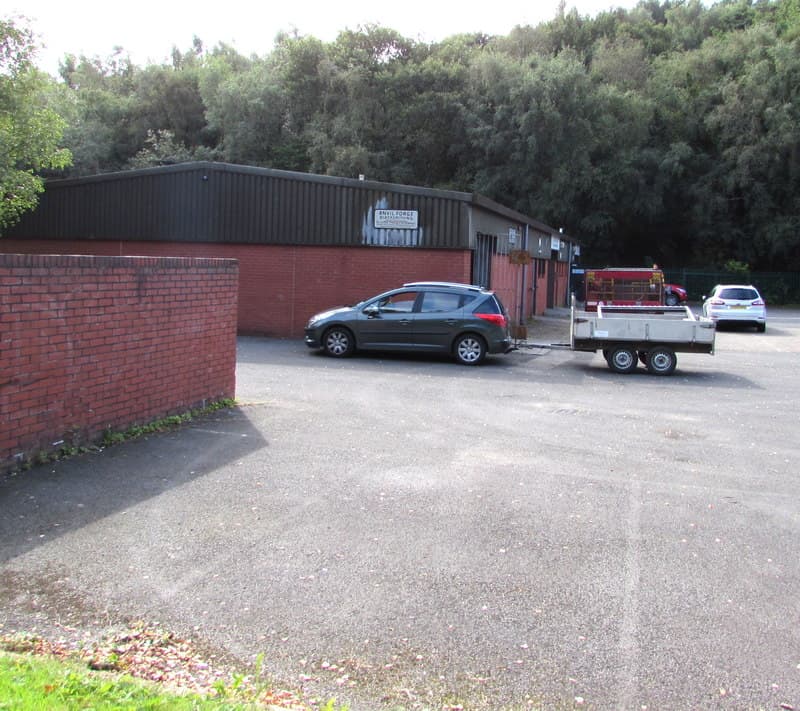
A wagon shop is the wrong place to look for power tools. The bench grinder gets used. The bandsaw gets used. Everything else hanging on the wall is older than the building, and most of it does one job that no machine has bothered to take over because no one builds enough wagons to make the machine worth designing. Walk into our shop in Midway and the first thing you see is the wall.
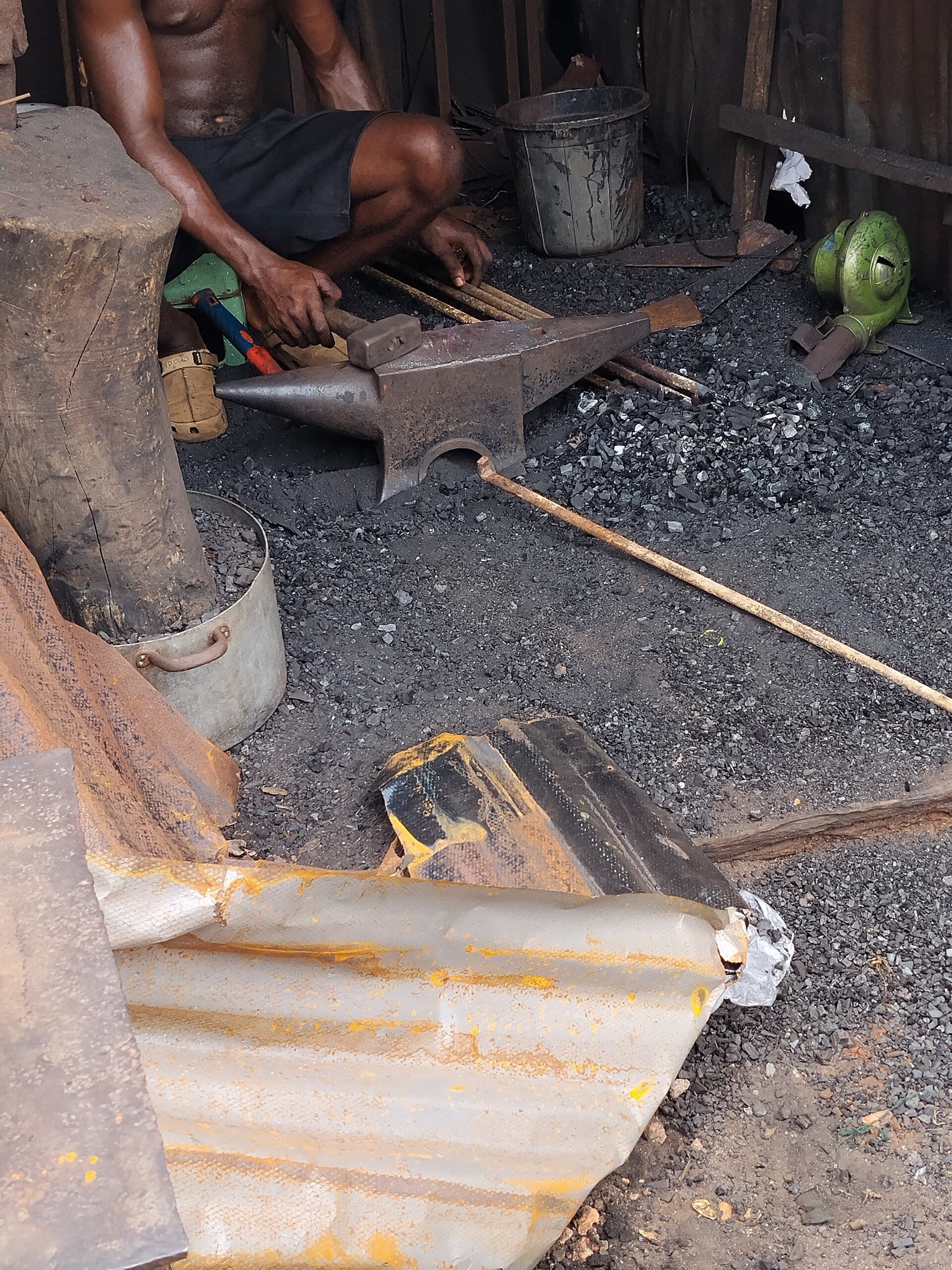
The beetle is a heavy wooden mallet, head the size of a loaf of bread, used to drive spokes home into a hub without bruising the tenon. A steel hammer would split the wood. The froeis an L-shaped blade with a wooden handle — you set it on the end grain of a billet of oak, hit the back of the blade with a club, and split the billet along the grain into a felloe blank or a spoke blank. Riving wood with a froe leaves the grain continuous from end to end. Sawing it does not. The difference matters under load.
The drawknifeis the two-handled blade you've seen in every photograph of a wheelwright — pulled toward the body, it shaves a spoke down to round in long curling ribbons. Behind it on the wall sits the spokeshave, a smaller cousin with a fixed-depth blade, used for the final cleanup and for the taper into the felloe. The traveleris a small toothed wheel on a handle — you roll it once around the outside of the wooden wheel, count the revolutions, and that's your tire length. No tape measure handles a wheel honestly. The traveler does.
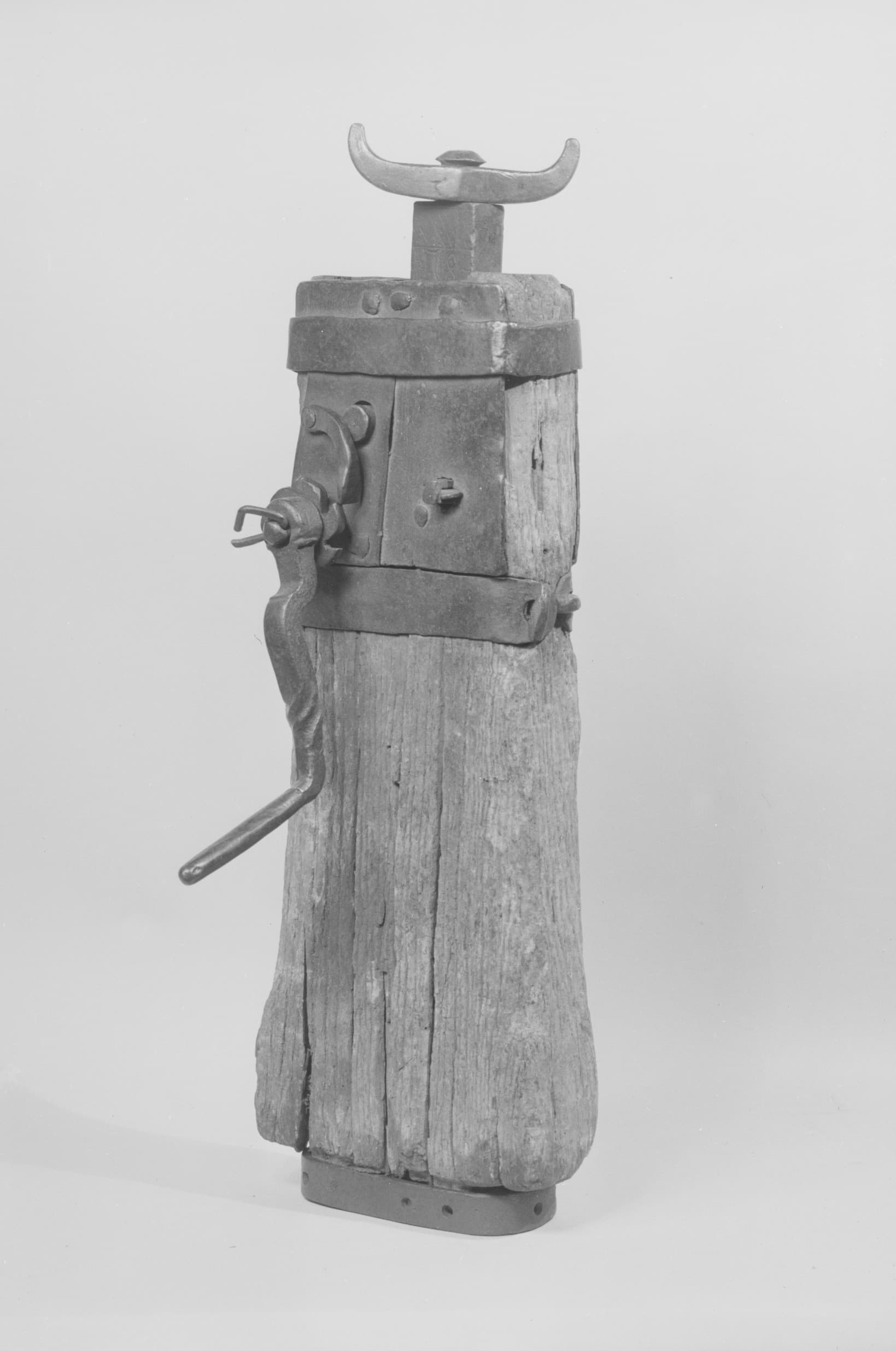
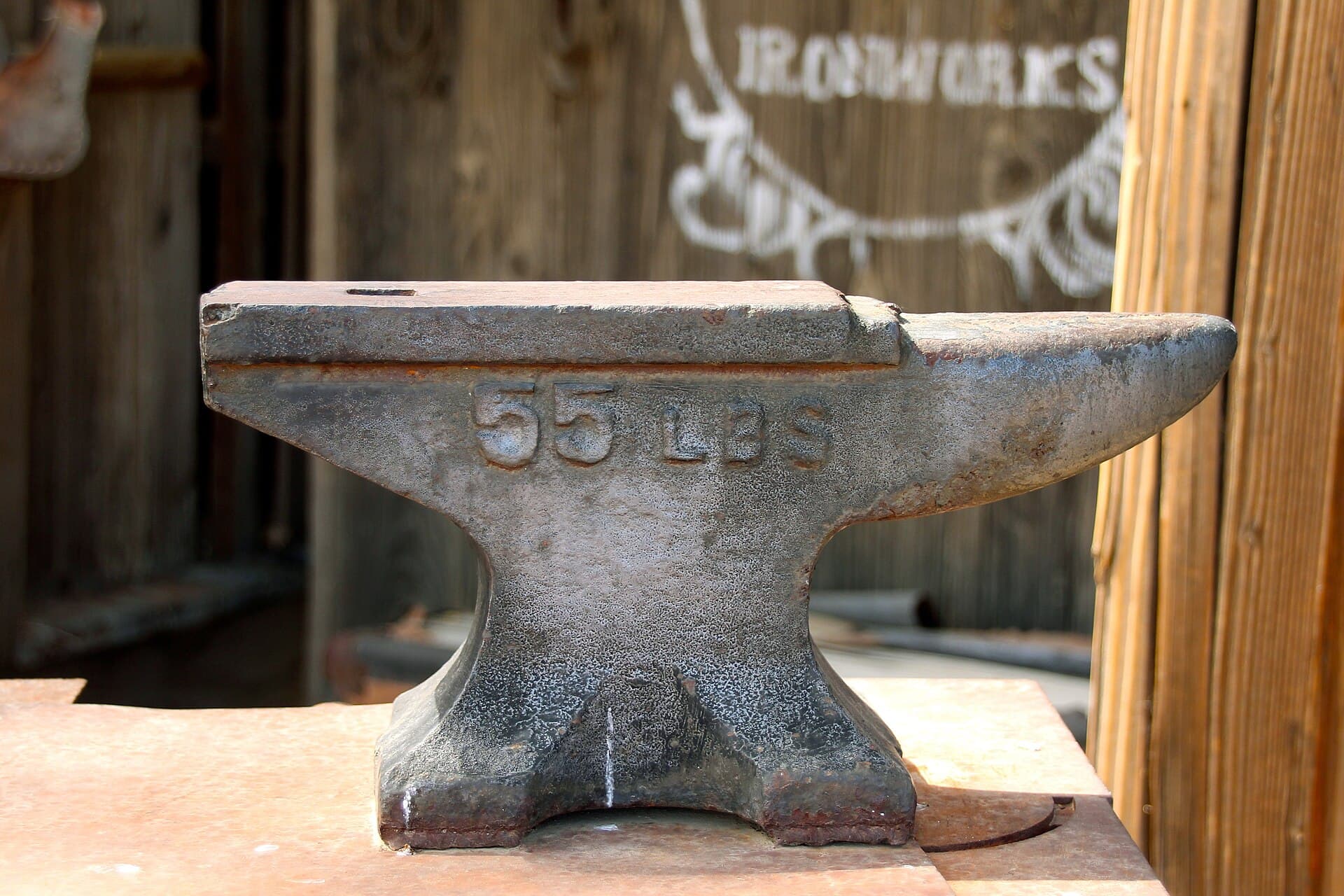
On the iron side: the fuller is a top-and-bottom pair of rounded chisels you set into the hardy hole on the anvil and use to draw down stock or set a shoulder in a tire blank. The hardyitself is the square-shanked tool that lives in the anvil's hardy hole — usually a cutoff hardy, the chisel you hammer hot stock against to cut it. The slack tub is exactly what it sounds like: a wooden barrel of water, kept next to the anvil, used to quench iron and, when a tire goes on, to take the wheel out of the fire. The tuyère blower is the hand-cranked or foot-pumped fan that feeds air to the forge through the tuyère — the iron nozzle that delivers the blast into the firepot. An electric blower works fine. A foot-pumped one teaches you when to stop.
And on the patternmaker's bench: the patternmaker's clamps— long wooden screw clamps with throat depth enough to reach across a wheel hub — for gluing up the felloe segments while you lay out the mortises. None of this is rare. All of it is getting rarer. The drawknives still come up at farm auctions in Pennsylvania and East Texas. The travelers do not, and the tuyère blowers in good condition are the kind of thing you find once and keep.
Why the Knowledge Nearly Died
No certifications, no schools, and the apprentices went to war.
The story of the trade in the twentieth century is not the story of one death. It is the story of four or five separate collapses, each of which would have been survivable on its own, none of which were survivable together.
The first collapse was the metal trades. Through the 1920s and into the 1940s, a working blacksmith in a small town could still feed a family on horseshoeing, wagon iron, plow shares, and miscellaneous farm repair. After the Second World War, the metal-trade work consolidated into industrial welding shops — faster, cheaper, certified, and tied to the contractors building out the postwar infrastructure. The village smith did not get worse. The customer base moved. A blacksmith in 1955 who could still hang a wagon tire was in the same position as a typewriter repairman in 1995.
The second was the loss of the regional vocational schools. East Texas in particular had a network of small trade programs — some attached to county high schools, some run out of churches, some out of the agricultural extension offices — where a young man could spend a year learning horseshoeing, harness repair, basic wagon work, and enough blacksmithing to keep a farm running. Pennsylvania had a similar network around the Conestoga valley shops. Most of those programs were folded, defunded, or rolled into comprehensive shop classes in the late 1950s and 1960s. The comprehensive shop class is a fine thing. It does not teach you how to dish a wheel.
The third was the absence of certifications. The trade has never had a guild, a journeyman exam, or a license. There is no association you can join that will tell a customer the wheel you sold him is built right. That sounds like freedom, and it is. It is also why, when the work got scarce, there was no institutional structure to hold the knowledge in place. Plumbing survived the same century because a town needed licensed plumbers. No town needs a licensed wheelwright. So when the last man in the county retired, the county lost the trade with him, and there was no record of who he was or what he knew that a state agency was obliged to keep.
The fourth was the apprenticeship line. The craft passes master-to-apprentice, the way it always has, and an apprenticeship in a wagon shop is not a six-week certificate. It is six to ten years of bench time before you are turning out work the master is willing to put his name on. The men who would have been apprentices in 1942 and 1943 spent those years in North Africa and the Pacific. The ones who came home took the GI Bill into engineering or into the trades the bill paid for — carpentry, plumbing, electrical — not into a wagon shop that paid a journeyman's wage to a man who would not be a journeyman for another five years. The line broke and did not get spliced.
And then the books. The most influential English-language manual on wagon-shop practice — B. F. Pugh's Wood and Wood Workingand its companion treatments of wagon-shop joinery — was last meaningfully revised in the 1950s, and its underlying material is nineteenth century. The Library of Congress holds Pugh in its nineteenth-century technical collections. Internet Archive holds clean scans. There has not been a new book by a working wagon-maker, written for working wagon-makers, in most of a lifetime. The trade has been documented mostly by historians and museum staff, which is not the same as being documented by the people doing the work.
A handful of shops, two or three living-history sites, and a thin line of apprentices.
You will hear the word revival attached to the trade from time to time. We use the word carefully. A revival implies a return to something near the original scale, and that is not what is happening. What is happening is smaller, and worth describing honestly.
Colonial Williamsburg and Old Sturbridge Village.
The two American institutions that have done the most to keep the craft visible to the public are Colonial Williamsburg in Virginia and Old Sturbridge Village in Massachusetts. Both run working wheelwright shops staffed by full-time tradespeople. Both publish documentation, train interpreters, and — this matters — actually build wheels and wagons to be used elsewhere on the grounds rather than for display. A wheelwright at Williamsburg is not an actor. He is a wheelwright who happens to work in costume. The wheels he builds carry visitors around the historic area for the next decade.
Beyond those two, the picture thins out. There are smaller living-history sites — Conner Prairie in Indiana, Genesee Country Village in upstate New York, the Landis Valley Museum in Pennsylvania — that maintain wagon collections and occasionally demonstrate the work, but without continuous full-time wheelwright staff. They depend on the handful of private builders to keep their wagons rolling, and on the Studebaker National Museum and a few university collections to anchor the documentary record.
Fewer than a dozen, scattered.
We are not going to name living wagon-makers other than our own. The community is small, the work is personal, and it is not our place to make a list. What we can say is that the shops still building from raw stock are scattered across the country — one in central Pennsylvania, two or three in Ohio and Indiana, a handful in the Mountain West, one we know of in Tennessee, and now ours in Midway, Texas. The geographic pattern roughly matches the old freight routes, which is not an accident. Where the wagons were built once, the knowledge has been a little easier to find.
The apprentices coming up — and there are some, more than there were twenty years ago — mostly find their way in sideways. They are blacksmiths who took an interest in wheels. They are furniture makers who took an interest in joinery under load. They are veterans, often, looking for a trade with their hands in it. A few are the grandchildren of men who ran shops in the 1950s, going back for what their grandfathers did. None of them are getting rich. All of them are working.
Kelly came to it the way most people who are still doing it came to it — through a long apprenticeship in the related trades, then by getting his hands on the wagon work itself one job at a time. We are not pretending the trade is healthy. We are pretending, if anything, the opposite — that it is fragile enough that another working shop, here in Texas, is worth the trouble of building.
Four trades in one shop — all of them thinning.
A wagon-maker is not one job. It is four, learned in the same room, over the same decades. Lose any of them and the wagon cannot leave the floor.
The wheel is the whole wagon.
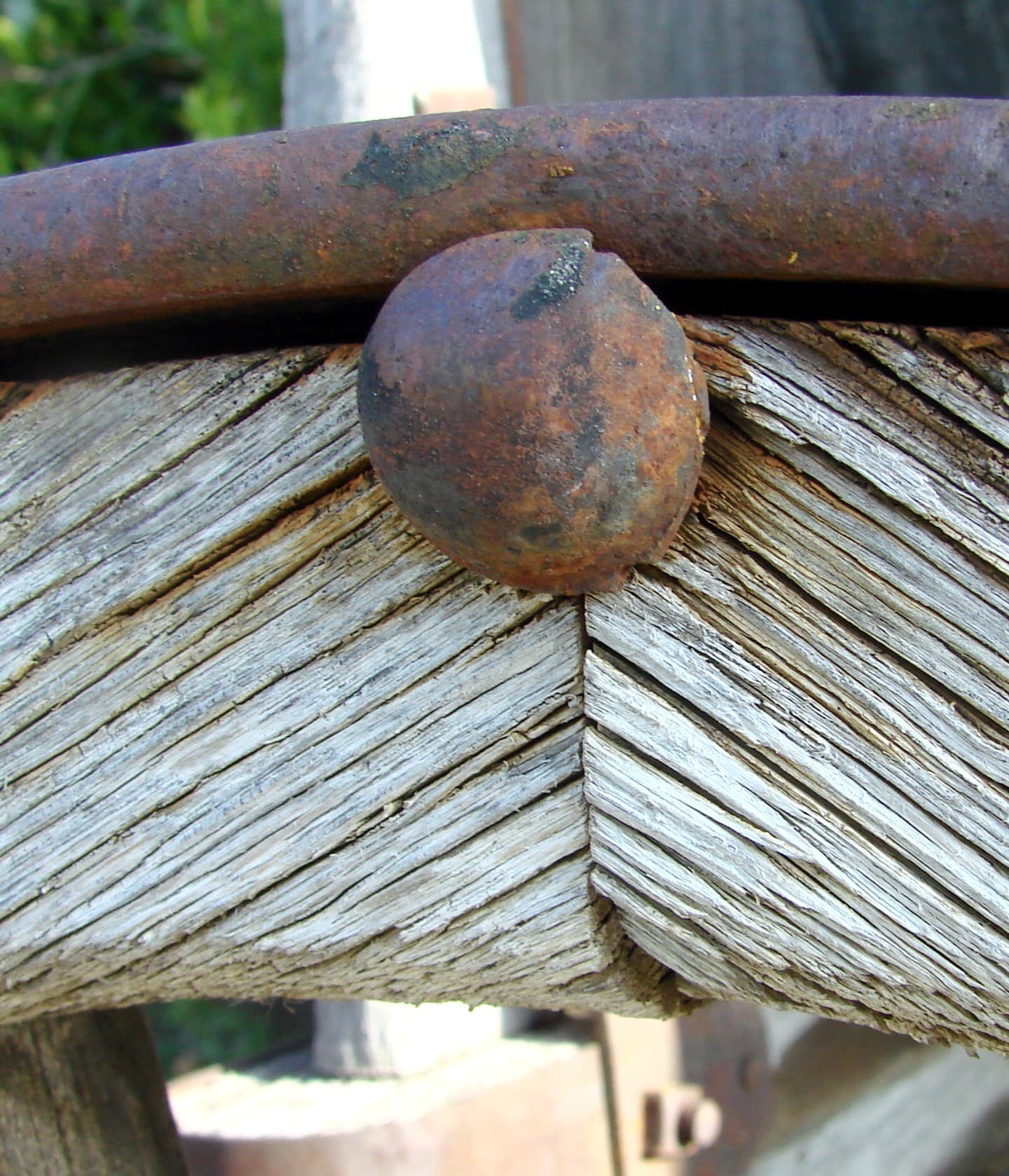
A traditional wagon wheel is built from three parts: a turned wooden hub, twelve to sixteen spokes driven into it, and a rim made of wooden segments called felloes (pronounced “fellies”). Each spoke is drawn to a tenon at both ends and pinned in. No glue does the structural work; the wheel is held together by geometry and a hot iron tire shrunk over the outside.
A good wheelwright can read a wheel by ear. Strike a finished wheel with a hammer and a sound wheel rings, the way a bell rings — clear, sustained, no buzz. A loose spoke or a cracked felloe answers with a dead thud. That ringing test is older than the United States and is still the best instrument in the shop.
The wheel is also dished. Look at any historic wagon straight on and the spokes splay outward slightly, like a shallow saucer. People often think this is wear. It isn't. The dish is on purpose — it lets the wheel carry side load from a crowned road, throws mud and water away from the hub, and gives the rim a wider track over rough ground. Build a flat wheel and you've built something that will fail inside a season.
Fire shrinks iron onto wood.
The iron banding around a wagon wheel is not bolted on. It is forged as a single closed hoop, made deliberately a quarter to a half inch smallerthan the wooden wheel itself. Heated cherry red on a tire fire, the iron expands enough to drop over the felloes. The smith and a helper move fast. Water hits the metal — in the slack tub or from a hose — and the iron shrinks back to its true size, crushing the wood inward, locking the spokes against the hub, pulling the whole wheel into one solid object.
There are blacksmiths in every state. There are not many left who can size and hang a wagon tire. The math — iron expands roughly one part in a thousand for every hundred degrees Fahrenheit — sounds simple until you are standing in front of a wheel that costs three weeks of work and a hoop of red iron that wants to roll off the bench.
Mortise, tenon, peg.
A wagon bed is laid out with mortise-and-tenon joinery, drawn tight with oak pegs called trunnels— tree nails. The frame doesn't use screws or bolts where the load lives. It can't. The whole wagon flexes under load, across washboard road and through creek bottoms, and a bolted joint will work itself loose long before a pegged one will. A pegged joint actually tightens under stress; the wood swells around the trunnel and grips it.
This is the same joinery that holds together timber-framed barns and Shaker furniture. It is not lost — furniture makers and timber-framers carry it — but the wagon-shop application of it, where the joint has to survive twenty years of rough road, is rarer than it looks.
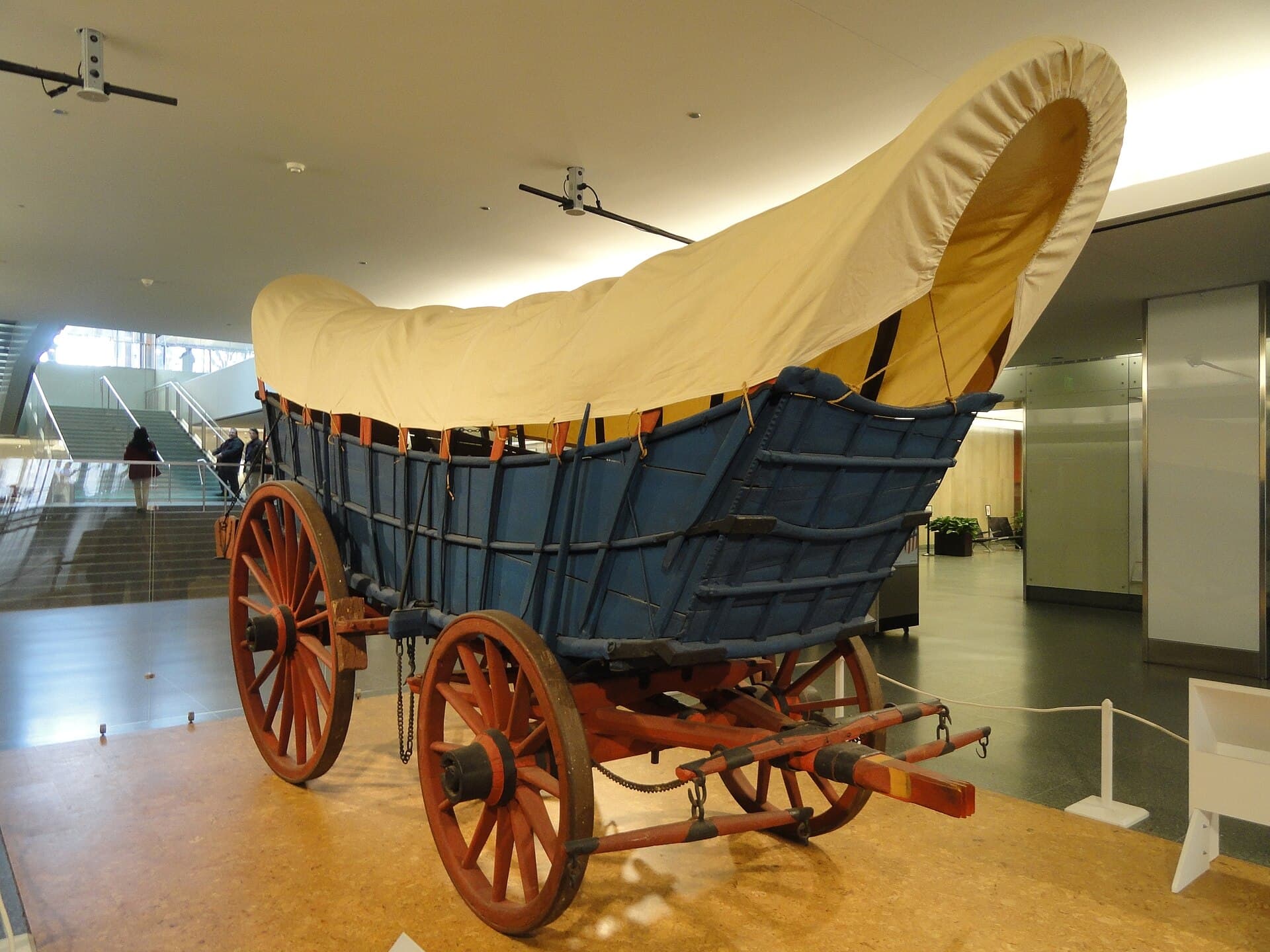 Conestoga, c.1840–1850 · National Museum of American History
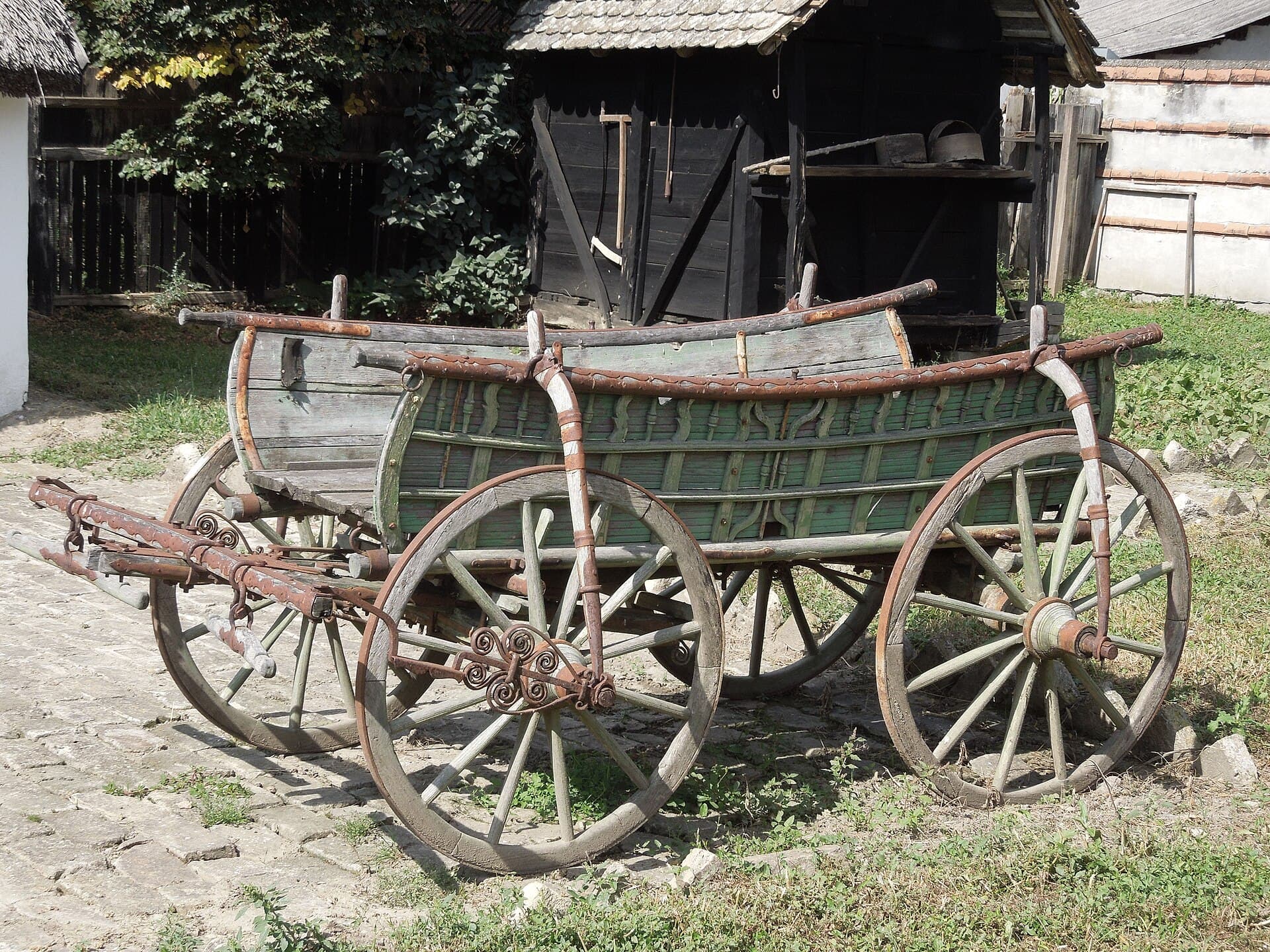 Old horse-drawn wagon
The fourth craft no one talks about.
Every wagon has leather on it — harness, traces, brake pulls, bench seats, sometimes the boot. The saddler's trade is alive in tack rooms across Texas, but the wagon-shop saddler is rarer. You need someone who can cut and stitch bench seating that will hold a family for forty miles, and who understands that the leather has to match the wood and the iron in tone or the wagon looks wrong. Done right, leather is the last thing you notice on a wagon. Done wrong, it is the first.
Why White Oak
You can build a wagon out of a lot of things. You shouldn't.
Of all the small choices a wagon-maker makes, the choice of wood is the one that decides everything else.
White oak (Quercus alba) is what the old shops preferred and what our shop uses now. There are reasons that read like a list and they are all true at once. White oak is dense — around 47 pounds a cubic foot when dry — so it carries load. It bends well under steam, which matters when you are hooping the canvas top or shaping a felloe. Its vessels are filled with structures called tyloses that block water from moving lengthwise through the grain, which is why coopers use it for whiskey barrels and why a wagon built of it will sit out in a Texas rain for a winter without rotting through.
Red oak, by comparison, is open-grained. You can blow air through a piece of red oak like a straw. It will wick water and start checking inside a year of outdoor work. Hickory is used for spokes — it has flex without splitting — but the bed, the felloes, and the running gear are white oak or they shouldn't be a wagon.
And there is the smell. Green white oak, fresh-sawn, smells slightly sour, a little like vinegar from the tannins. The same board after a year of air-drying loses that edge and takes on something closer to dry hay and old paper. A wagon shop in summer smells of both at once, plus coal smoke from the forge and neatsfoot oil from the leather bench. It is one of the markers of the trade. You learn to know what stage of drying a stack of boards is at without touching it.
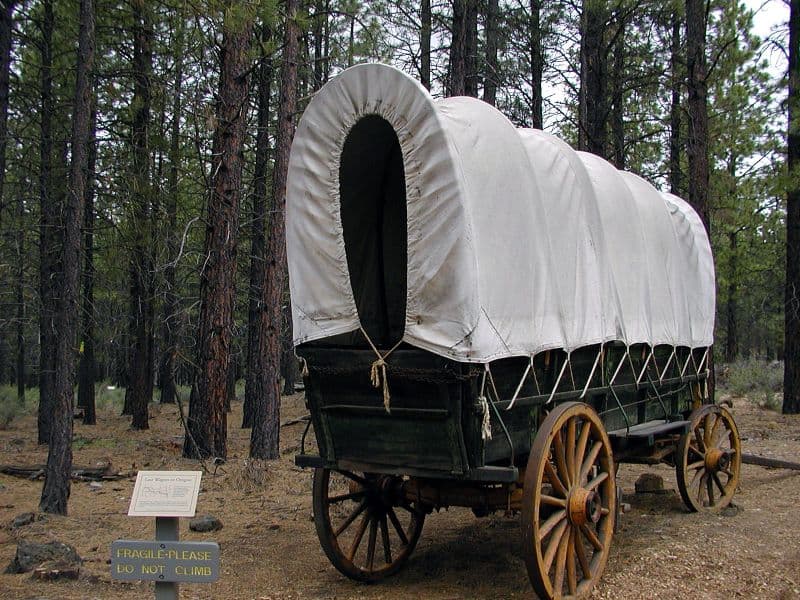 Covered wagon · High Desert Museum
Putting an old wagon back on its wheels is not the same as building one.
Most of what passes for “wagon work” in America today is restoration. There are good restorers in every state — people who can find a Studebaker farm wagon in a barn, straighten its frame, replace the broken spokes, scarf in a new felloe, hang fresh iron, and roll it back into the light. That work is honest and it keeps a lot of history above ground. We send people to it gladly.
It is not the same trade as building from raw stock. Restoration starts from someone else's decisions. You inherit the axle width, the wheelbase, the dish of the wheels, the joint pattern, the canvas hoop spacing. A builder makes all of those decisions from a stack of lumber and a sketch. The skills overlap; the judgment doesn't. A restorer can spend a decade in the trade without ever turning a hub on a lathe.
The reason this matters is that restoration is bounded. There are only so many old wagons left, and once the last good one is fixed, that's the work. Building is unbounded — you can make another wagon. But building is also the harder line to keep alive, because no one needs a wagon the way they needed one in 1880. The shop has to find another reason to exist. We think we've found ours, and we wrote about it at length on accessible wagons and on our story.
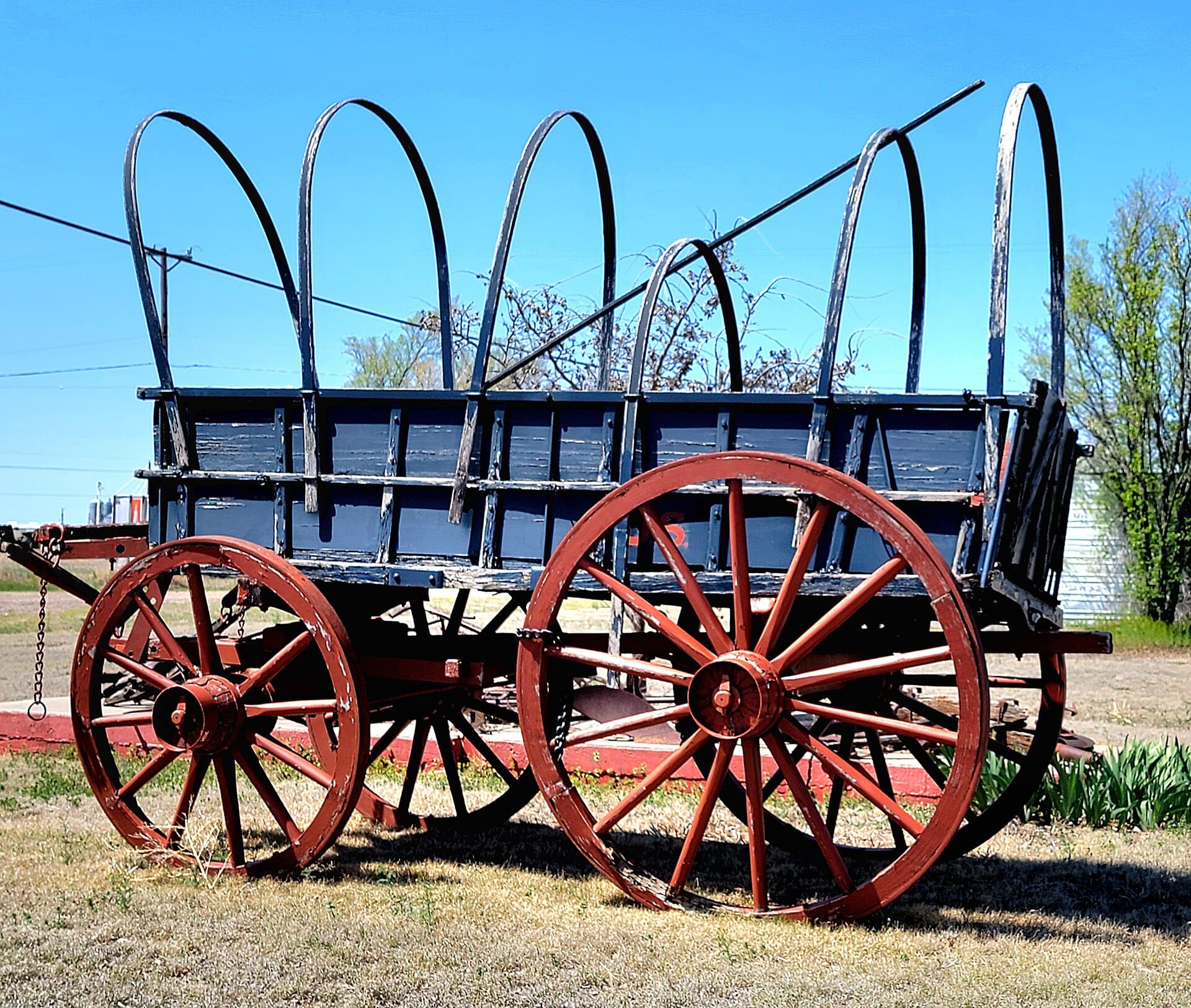 Conestoga wagon · Vega, Texas · a working example of the form we build
Why It Matters
We are not in the wagon business. We are in the not-losing-this business.
You can ask why any of this matters. A wagon is not faster than a pickup. A forged iron tire is not better than a pneumatic one. A pegged frame is not stronger than a welded one. All true, and beside the point.
A craft is a way of paying attention. When the last person who knows how to dish a wheel stops dishing wheels, the country loses more than a wheel. It loses the kind of judgment that comes from doing the same job several thousand times under changing conditions — the ear for a sour ring, the eye for a felloe that's drying wrong, the hand that knows when to quench. That judgment doesn't live in books. It lives in shops.
The bodies that try to keep this kind of work around — the Texas Historical Commission, Texas Folklife, the Smithsonian Center for Folklife — do honest work documenting and supporting traditional trades. Documentation is necessary. It is not sufficient. A trade survives by being practiced, on real jobs, by people who are getting paid for it. That is what a working shop is for.
The wagons we plan to build at Healin' Wheels are not museum pieces. They are meant to roll, and to carry people who have spent too long being told there isn't a seat for them. The accessibility is the reason we get to do the wheelwrighting at all. The wheelwrighting is the reason the accessibility means something.
Conestoga, c.1840–1850 · National Museum of American HistoryWe are just starting. That is not a small thing.
Healin' Wheels is a Texas non-profit at the beginning of its work. Kelly has decades of craft behind him — wood, iron, leather — but the shop itself, here in Midway, is new. We have not built a fleet yet. We have a barn, a founder, a stack of plans, and a phone that rings when the right people see it on a website.
If you want to know what we plan to build, the what we build page lays it out. If you want to know how a heritage wagon is put together, the craft of wagon making page walks through the build stage by stage. If you want to help us put the first wagon on its wheels, the get involved page is the place to start.
We don't romanticize this. The trade is hard. The hours are long. The wood is heavy and the iron is hot. But the reason to keep doing it is the same reason anyone ever did it: because someone needs to ride.
If you want to go deeper — start here.
None of the following is behind a paywall. All of it is the real archive of the trade, kept by institutions that have done the documentary work for a century or more.
Library of Congress — wheelwright photographs. The LoC Prints and Photographs Online Catalog holds hundreds of plates of working wagon and wheelwright shops from the late nineteenth and early twentieth centuries, including the Detroit Publishing Company and Farm Security Administration collections. loc.gov/pictures
Smithsonian Center for Folklife and Cultural Heritage. Long-running documentation programs on traditional American trades, including wagon-making, blacksmithing, and harness work. Field recordings, photographs, and the annual Folklife Festival archives. folklife.si.edu
B. F. Pugh, Wood and Wood Working (1898). The standard nineteenth-century manual on wagon-shop joinery and timber work. Public domain. Clean scans on Internet Archive. archive.org
Studebaker National Museum archives. South Bend, Indiana. The most complete documentary record of the factory side of the trade — production ledgers, pattern books, wagon plans, photographs, and the wagons themselves on the museum floor. studebakermuseum.org
Help Us Keep the Trade
You can call the shop. You can sponsor a build.
If any of this hit something in you — the smell of green oak, the ring of a true wheel, the idea that there might still be a seat for everyone on a Texas wagon — we'd like to hear from you. Kelly answers the phone.