
Wagon Types · The Prairie Schooner
Prairie schooners. The wagon that crossed the West.
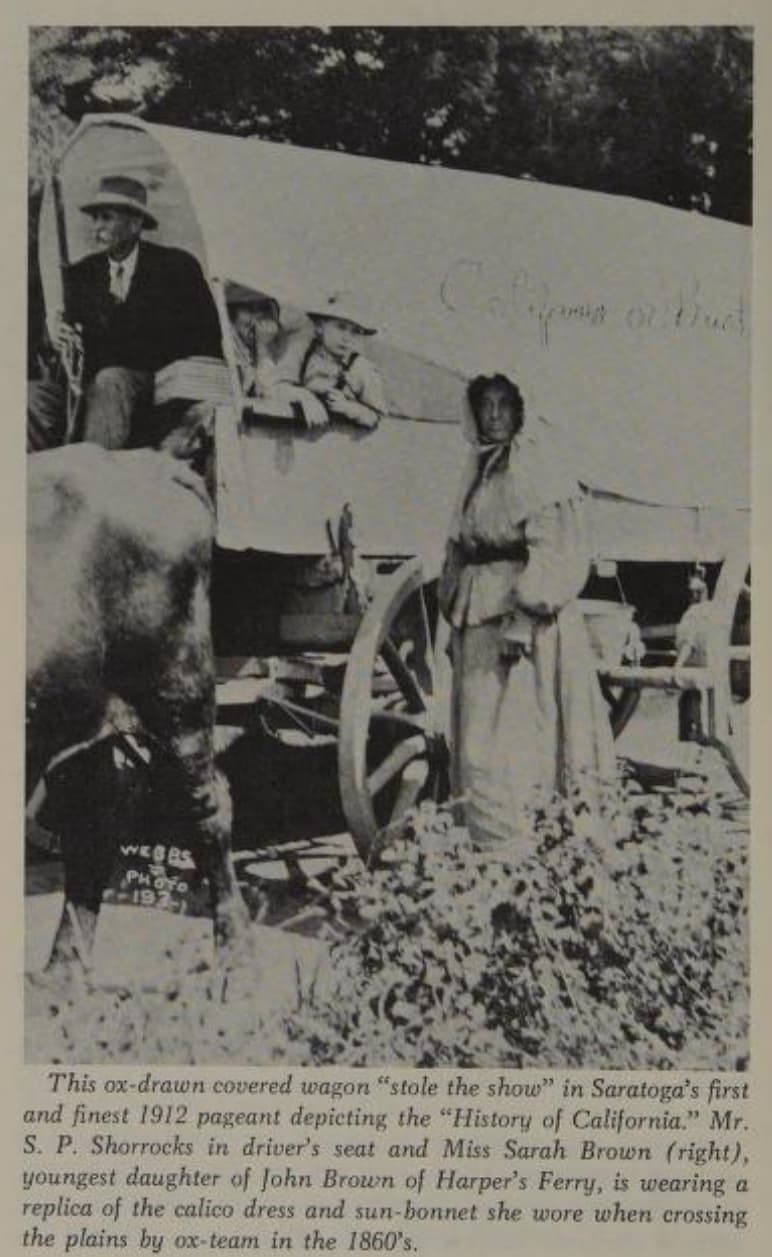
Smaller than the Conestoga, lighter than a Studebaker freighter, cheap enough that a young family could buy one with everything they owned — the prairie schooner carried four hundred thousand people across two thousand miles of plains, desert, and mountain between 1841 and 1869. It is the wagon most people picture, most often photographed, and most often built again today.
Hero photograph: Unknown / Public domain (Wikimedia Commons). Public domain
The Form
A lighter cousin to the Conestoga.
The prairie schooner did not come out of a single workshop the way the Conestoga came out of Lancaster County. It came out of the practical math of the western migration: a Conestoga was too big, too heavy, and too expensive for a young couple with everything they owned, a team of oxen that had never crossed the Missouri, and two thousand miles of country between them and a homestead in Oregon. So through the 1830s and 1840s the wagon makers in Independence, St. Joseph, and Council Bluffs shrunk the form. They flattened the bed. They cut the wheels down. They narrowed the box. They took the Conestoga and made a wagon a family could actually afford to drive.
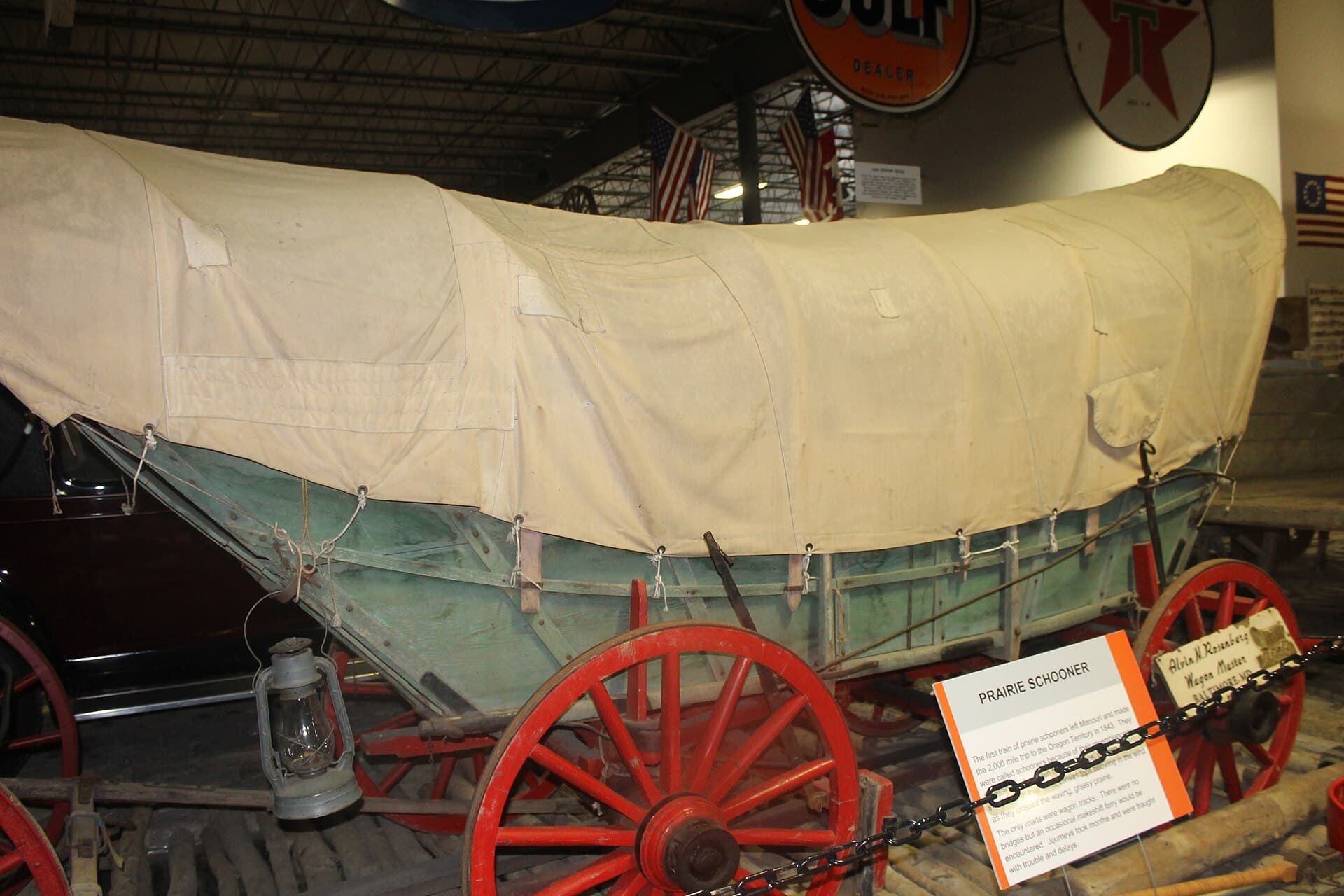
What came out the other side was the prairie schooner. Twelve to sixteen feet long. Four feet wide. Seven to eight feet tall at the canvas top. A flat bed with low sides, hickory bows holding up a white canvas top, iron-tired wooden wheels — the rear pair around four feet, the front pair around three — dished outward in the standard way. Built mostly out of seasoned white oak and hickory, ironed by a country smith, painted or left bare depending on the shop and the season. The whole wagon weighed about thirteen hundred pounds empty, where a Conestoga weighed three thousand.
The name was a metaphor. Settlers cresting a swell of prairie grass would watch a line of white-topped wagons drift across the horizon and say they looked like ships under sail — like small schooners moving across a green sea. The name stuck. The wagon's working name, the one in the catalogs and on the bills of sale, was the emigrant wagon. Prairie schooner was the name the country gave it.
The Team
Oxen, mostly. And here is why.
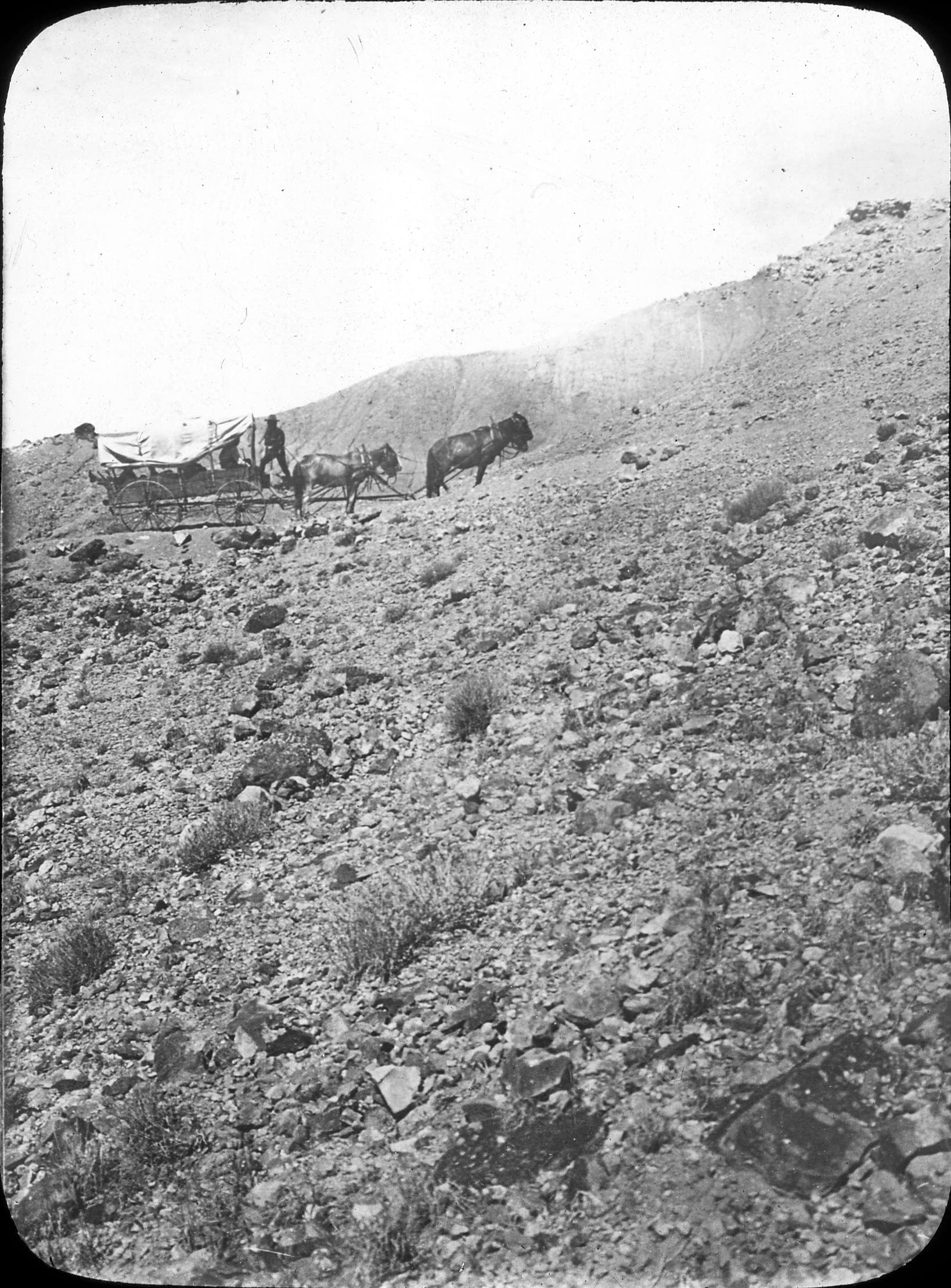
The classic prairie-schooner team was four to six oxen. Sometimes a smaller family rig pulled with two yoke (four head) and a lead pair. Horse teams were less common on the long trails for three plain reasons. Oxen drank less water. Oxen ate worse forage. Oxen, if everything went sideways and the herd had to be eaten through the winter, were edible. Horses, by comparison, needed grain, needed water twice a day, and were stolen at every river crossing. An ox cost about twenty-five dollars a head in Missouri in 1850. A horse cost three to five times that, and was generally worth less on the far end of the trail.
A four-ox team pulled a loaded prairie schooner at about two miles an hour on flat country, which worked out to twelve to fifteen miles in a working day. Eight on a bad day. Twenty on a rare good one. The math of the trip was unforgiving. Two thousand miles from Independence to Oregon City, divided by fifteen miles a day, with rest days, river crossings, breakdowns, weather, and sickness, came out to four to five months of continuous travel. You left in April when the grass on the plains came up. You crossed the Rockies in July or August. You came down out of the Blue Mountains into the Willamette Valley in October if you were lucky, in November if you were not, and if you were not lucky at all you did not come down at all.
The Load
Two tons — and what that included.
A prairie schooner was rated for about two tons of cargo. Four thousand pounds. That was the figure most emigrant guidebooks named, and it was the figure most outfits aimed at when they packed in Independence. Overloading was the single most common mistake of the first-time emigrant. Two tons sounds like a lot. Two tons of flour, salt pork, beans, coffee, sugar, bacon, dried fruit, tools, a small forge, a plow, seed for next year, bedding, a stove, clothing, a Bible, a clock, a family Bible if there were two Bibles, and the children — two tons disappears fast.
The standard pack was two hundred pounds of flour per adult, seventy-five pounds of bacon, a hundred pounds of dried beans, fifty pounds of coffee, twenty of salt, ten of sugar — call it eight hundred pounds of food per adult for a five-month trip, with a thin margin for emergencies. A family of five, fully provisioned, ran four thousand pounds in food alone. Add the tools and the household goods and the people, and the wagon was over its rated load before it left the riverbank. The trails are lined, even today, with the cast-offs of overloaded outfits — anvils, cookstoves, sets of china, a piano or two — jettisoned in the first hard week to spare the oxen.
The family did not, for the most part, ride in the wagon. The wagon was loaded. The family walked alongside it. Children rode if they were small or sick. Mothers rode if they were pregnant or nursing. Everyone else walked. Two thousand miles on foot. The figure is hard to absorb. Most of the emigrant diaries that survive — and there are thousands — make a quiet, repeated point of this. They did not ride west. They walked.
The Routes
Four great trails, one wagon form.
The prairie schooner ran on four major routes through the middle of the nineteenth century. The Santa Fe Trail opened first, in 1822, from Independence, Missouri to Santa Fe, New Mexico — about nine hundred miles, primarily a freight route into Spanish and then Mexican territory, run by traders rather than emigrants. Wagons on the Santa Fe were often heavier than the standard prairie schooner — closer to Conestoga dimensions — because the load was paid freight, not a family. The Santa Fe Trail ran continuously until the railroad reached New Mexico in 1880.
The Oregon Trail opened to wagon traffic in 1843, with the "Great Migration" of about a thousand emigrants leaving Independence for the Willamette Valley. From 1843 through the railroad's completion in 1869, the Oregon Trail carried somewhere between two hundred and fifty thousand and three hundred and fifty thousand emigrants — the numbers vary by historian — over two thousand miles of plains, desert, and mountain. Roughly one in ten died on the way. Cholera in the first third, accidents and exhaustion in the middle, weather and starvation in the last third.
The California Trail branched off the Oregon Trail at the Snake River and ran south-west into California. It carried light traffic until 1848. Then James Marshall picked up gold at Sutter's Mill, and in 1849 alone roughly thirty thousand people crossed the California Trail in a single season — the largest one-year migration in American history to that point. The trail kept running, at lower volumes, through the 1860s. Total California Trail traffic from 1841 to 1869 is generally estimated at around two hundred and fifty thousand emigrants.
The Mormon Trail opened in 1846 when Brigham Young led the first party of Latter-day Saints west from Nauvoo, Illinois toward the Great Salt Lake. The route ran from Council Bluffs, Iowa across present-day Nebraska and Wyoming to the Salt Lake Valley — about thirteen hundred miles. Between 1846 and 1869 roughly seventy thousand Mormon emigrants made the crossing, including the handcart companies of 1856–1860 who walked the route with two-wheeled handcarts instead of wagons, by necessity rather than choice.
The Journey
What four months on a wagon trail meant.
The emigrant diaries are the best record. They are remarkably consistent. The first month, leaving Independence in late April or early May, was the easy part — flat prairie, good grass for the oxen, good weather, daily progress in the fifteen-mile range. The trail crossed the Kansas River, the Big Blue, the Little Blue, then ran up the Platte River valley through Nebraska. Cholera was the first killer. Outbreaks at the river crossings could carry off a dozen members of a party in a week.
The second month, up the Platte and the North Platte, was still relatively easy. The trail passed Fort Kearny, then Fort Laramie — the great resupply stops — and began to climb. Buffalo, in the early years, were everywhere on the plains. By the late 1850s the herds had thinned, and by 1865 they were gone from the trail.
The third month was the hard part. South Pass, the broad wagon-friendly gap through the Rockies, was the high point of the trip both physically and psychologically. Beyond it lay the Green River, the Snake River, the high desert of present- day Idaho. Water became scarce. Wagons broke down. Oxen died. Families that had started with two wagons left one behind. Families that had started with two yoke arrived at Fort Hall with one and a half. The trail diaries thinned out in the third month. The writing got shorter and harder.
The fourth month was the descent — the Blue Mountains in Oregon, the Sierra Nevada in California, the Wasatch Range for the Mormon trail. The descents were often more dangerous than the climbs. Wagons had to be roped down steep grades. Brakes failed. Oxen panicked. The Donner Party of 1846, on the California Trail, is the famous catastrophe of the descent. There were many quieter ones.
1869 onward
How the railroad ended the trail.
On May 10, 1869, at Promontory Summit, Utah, the Central Pacific and the Union Pacific drove a golden spike and connected the two ends of the first transcontinental railroad. From that day forward, a passage from Omaha to Sacramento took seven days by rail at a cost of about a hundred and fifty dollars in coach. The same trip by prairie schooner took five months, cost a wagon and a team and most of a family's possessions, and killed one passenger in ten.
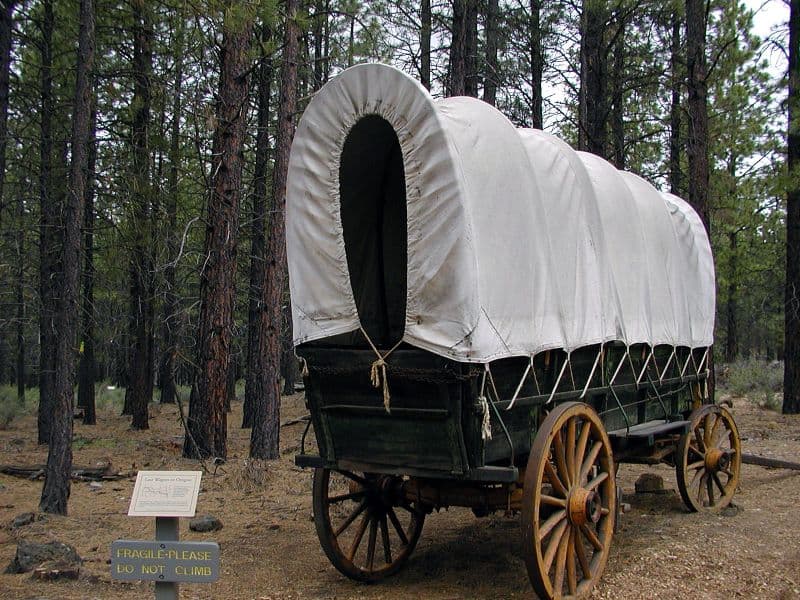
The trails did not die instantly. Wagon traffic on the Oregon and California trails continued at lower volumes through the 1870s — short-haul migrations, supply trains to towns the rail had not yet reached, settlers heading to land claims off the rail corridor. By 1885 the long emigrant migration was effectively over. The wagons that had crossed the West got sold, rebuilt as farm wagons, broken up for lumber, or abandoned along the trails where they had ended their working lives. The trail ruts themselves — visible in places to this day, in the prairie sod at South Pass and along the North Platte — outlasted the wagons by a hundred years.
The form, though, did not disappear. The prairie schooner kept on as a working farm and ranch wagon through the rest of the nineteenth century and into the twentieth. The flat bed and the bowed canvas were too useful to retire entirely. A farmer hauling hay in 1910 in west Texas was still working out of a wagon a 1849 emigrant from Missouri would have recognized.
The prairie schooner today
The most-photographed wagon in America.
The prairie schooner is the wagon in the photograph. Every western movie. Every history textbook. Every painting of the Oregon Trail. The Conestoga is the freight wagon and the chuck wagon is the cattle-drive kitchen, but when an American says "covered wagon," ninety-five times out of a hundred they mean a prairie schooner. It is the wagon in the cultural imagination, and that is the wagon the heritage-build market asks for most.
Working reproductions appear in living history sites along the trails — the National Oregon/California Trail Center in Montpelier, Idaho; Scotts Bluff National Monument in Nebraska; the End of the Oregon Trail Interpretive Center in Oregon City; the National Frontier Trails Museum in Independence, Missouri; This Is The Place Heritage Park in Salt Lake City — and at re-enactor encampments, parade work, ranch reunions, and a steady trickle of film and television productions. Private collectors and small museums commission new builds every year.
A new prairie schooner built to heritage standards — seasoned white oak, hickory bows, shrink-fit iron tires on dished wheels, hand-stitched canvas, real ironwork — runs in the low five figures and takes three to six months in a working shop. It is the most-built form in the heritage trade, because it is the form most people picture and most people commission. We get the calls. At the workshop in Midway, Texas the prairie schooner is the wagon we are asked about the most. More on the work itself in how a wagon gets built, and on the broader trade in the lost art of wagon making.
What's left
The wagon that crossed the West.
Four hundred thousand people on the Oregon and California trails alone, over twenty-eight years, on a wagon that weighed less than a modern compact car. Most of them walked. About one in ten did not arrive. The ones who did built the towns of Oregon, California, Utah, and the western Great Basin. The wagon that carried them was a Pennsylvania-Dutch design, shrunk and simplified, built by country wheelwrights in Missouri and Iowa, and rebuilt later by heritage shops in twelve states. The form is older than most of the towns it built. It is, in the long arc, the most consequential wagon in American history.
That is why the prairie schooner is the wagon most often reproduced today. It is the form that carried the country west. There is no other wagon that earned the right to that phrase.
The Workshop · Midway, Texas
Thinking about a prairie schooner?
Healin' Wheels is a Texas wagon shop in Midway, building the form that carried the country west — by hand, on a bench, the way the country wheelwrights built it. If you have a prairie schooner to commission, a covered wagon to restore, or a community-ride build that needs the right silhouette, there is a phone number below and a person on the other end.